Crises and Initiations
We have repeatedly discussed, from the standpoint of the Hermetic myth, the psychophysical constitution of a human being (body in the broad sense, guf, גוף) includes three main elements:
1) body (in the narrow sense, as “flesh,” “basar,” בשר) corresponds to the element of earth),
2) “etheric (or vital) body, composed of three “first principles”:
a) vital energy, or “breath” (“nefesh,” corresponds to the element of air, described as “wind” (Tib. lung; Skt. “prana”);
b) the desire to live (“the power of the body,” “koach-ha guf,” corresponds to the element of fire);
c) the experience of processuality, the “flow” of life (“blood,” dam (דם) corresponds to the element of water).
3) mind (ruach, רוח, as the connecting force with the “higher” levels — “soul,” which in turn has a three-part structure — neshama, chaya, yechida).
The relationships between these three elements are built on the principle of mutual interpenetration and support: the body provides support, life corresponds to actuality, and mind — to the process of development. Accordingly, the process of development, actualization, and manifestation of mind also involves a transformation/restructuring of the life energies, which, in turn, require the stabilizing “supporting” apparatus of the physical body.
In other words, it is impossible to develop, expand, and liberate consciousness without restructuring the energetic configuration of the vital body and maintaining the healthy functioning of the physical body.
Therefore all traditional methods of development, all Paths and Schools pay attention to the three components, noting that the development of each subsequent level, or layer, of the human being is impossible without a firm support from the lower level.
And even with such a holistic approach, even with such comprehensive preparation, it is practically impossible to avoid crises and imbalances that arise every time processes at one of the levels become out of sync with the transformation of the other layers. Every time movement at one of the levels gets ahead of (or, conversely, bogs down in) the readjustment of the others — a subjective sense of illness arises, pathology, which can manifest to varying degrees.
In other words, the process of development almost never progresses smoothly; it inevitably includes periods of falls and more or less serious crises. They arise as a result of the unpreparedness of the lower conduits to support increased intensity of the flows of the subsequent levels.
Such painful phenomena can be of two kinds — “crises” and “blows.” The former occur as lawful “molts” or “leaps,” when consciousness reaches new frontiers, it pulls its foundations and conduits along, which, due to greater inertia, lag behind and stretch under altered intensities. The latter arise as a result of short-sighted excesses in practice, overexertion and injuries, when the vessels of body and mind encounter energies that exceed their capacities. That is, crises are lawful and expected, whereas blows are unintentional, though also practically inevitable.
At the same time, most often imbalances are linked to a component of the vital body, although they can spread to the physical body as well.
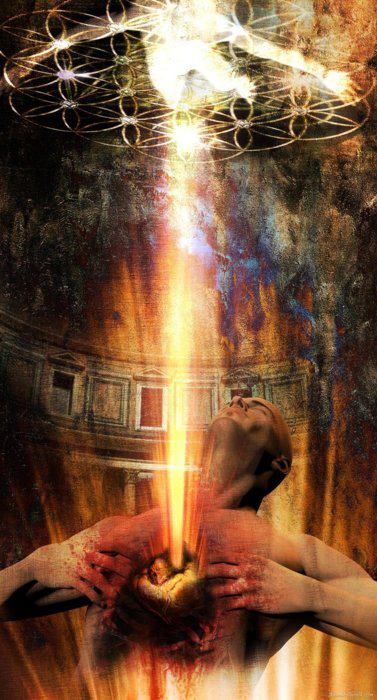
Thus, we have already discussed that a lack of skill controlling desire-energy can lead to an excess of creative forces, the “Creative Fire” (nur, נאור), which can lead to sharp “blows of light” or “fiery rods.” This type of painful phenomenon most often arises in contacts with energies, beings, or processes that greatly exceed one’s level. That is, if we reach for something that is beyond our level, we receive a “discharge,” a “blow,” usually saving us from total destruction, because if such contact were to last, the superior energies would simply destroy our conduits. Physically, these “blows” manifest as increased blood pressure (up to strokes and heart attacks), headache, loss of consciousness, and other acute symptoms.
If the practitioner lacks the ability to control the flows of energy in the vital body itself, then most often they experience the so-called “contemplatives’ illness” (or, in the Tibetan tradition, “wind illness,” “lunga”). This crisis is linked to the lag in restructuring of the system of channels and meridians along which the pneuma moves, in response to the growing needs of consciousness, and manifests as an increase in restlessness, anxiety, sleep disorders, and the like. Note that this disorder occurs even among very experienced practitioners; for example, even the great Master of Tibet Je Tsongkhapa suffered from it.
If the emotional component “bogs down,” that is, the reactions of vitality to new impressions do not have time to be tamed, then a hysteroid disorder develops — the ‘rebellion of the blood’, manifesting as unbalanced uncontrollable emotional reactions — crying, uncontrollable laughter, and the like.
It is practically impossible to completely avoid both crises and blows on the Path. Thus, the Hermetic Path usually begins with such an illness, called the ‘entry crisis’, and, for example, in archaic traditions the beginning of movement is often accompanied by the so-called “shamanic illness.” In addition, the transition from stage to stage, from degree to degree on the initiatory Path is also usually marked by more or less pronounced crises. Therefore, one should not treat such manifestations as something negative, as a consequence of an error or deficiency. One must be prepared for them and know how to reduce their negative impact.
Among such ways are breathing practices and physical exercises, ritual methods and rest, a change of activity, switching to another (provided it is not destructive) activity. It is well known that, for example, the wushu system was developed as protection from the destructive influence of “lunga illness.”
It is precisely in order to reduce the negative influence of crises and blows that Traditions impose strict regulations of practices, monastic vows and discipline, and so on.
If practices are carried out systematically, and development proceeds in a multifaceted way, then usually the influence of crises and blows is quite insignificant. However, in the absence of such regulation, with disorganization and lack of system in practice, practitioners risk serious health disorders including death or insanity.
Thank you, Master! We discussed the internal aspect. But how should we deal with the external?
The external aspect needs to be supported by the right living environment, food, and (if necessary) medicinal preparations.
All the described states are related to excessive tension in a certain ‘area’ of the field of a person. What if the crisis is experienced instead as relaxation, dispersion?
We also discussed this question: https://en.enmerkar.com/myth/smertelnaya-nega. Relaxation, lack of sufficient potency for movement is caused by the activation of distractors, not the natural logics of the Path.
Thank you for your answer. I read that article; it is about something else. The dispersion I am talking about is not related to sadness, depression, or apathy.
So enjoy this relaxation)). The only thing is that later it can be difficult to re-enter this interesting work mode – a certain laziness appears. As I understand it, during intensive work, the pneuma reaches its maximum point of ‘Tonicity’ – intellectual strain or strain during complex visualizations, but you cannot exist in such a mode for long. In theory, if we take the Qi system, then maximally tonified pneuma accumulates in Shen – a blue ball in the head. So, nothing dissipates anywhere. What you have realized and understood stays with you. Energy can always be replenished from other sources.
Which body is responsible for physical movement? Sometimes I feel very lazy to move on a physical level. I love static, calm states. But I noticed that my physicality starts to deteriorate, and my whole body begins to hurt. I have to periodically smooth it out and create stress situations (for example: strength training or taking a dip in a pool) to feel more alive, so to speak. Is this an excess of the earth element or a deficiency?
So the physical body both responds and has two types of ‘engines’: its own (food, water, air) and energetic (provided by the Body of Life). In your case, it is likely a deficiency not of Earth but of Fire.
To prevent such states, there is a teacher who monitors the state of the student’s consciousness. Also, in my case, we have a duty officer in the network who observes as well. Students are different. One might delve into the worlds of death, another might want to pull the moon from its orbit… Anything can happen.
Hello.
Does it work the other way around? In other words, are there kinds of “problems” if the lower levels are developed much more strongly than the higher ones? For example, if someone focuses heavily on bodybuilding without developing anything else?
And if there are such problems, does it mean that purely physical development necessitates some accompanying spiritual growth as a necessary complement?