
Strikes of Light
We have said many times that, from the standpoint of a magical worldview, the meaning of the cosmic process is the gradual entry of consciousness into Being, leading to the transition of the latter from a potential state into an actual one.
However, this process is stretched indefinitely over time and can only be completed in theory, gnoseologically, without being realized. At the same time, it is perfectly natural for any conscious being to wish to hasten this process, if not for the whole universe, at least for itself. To a certain extent this is possible, although it requires careful control, and, in essence, it is precisely such an acceleration of evolution that is the aim of any hermetic magic. Yet if the process of the Father entering the Mother, the Spirit entering Matter is accelerated too much, it leads to traumatic consequences, because the new, light-filled elements do not have time to integrate into the existing system. For a particular being, such a case may result in trauma or even death.
Mythological literature is rich in accounts of such cases. They traditionally appear as a “Strike of Light” or as ‘Fire,’ since the destructive and exalting action of Spirit is expressed in the fiery principle.
The Midrash (one of the parts of the Talmud) uses the notion of “a fire that consumes (every other) fire” to describe an absolute spiritualization that is unbearable for all material things. In the same Midrash the Creator’s spiritual light protects Moses from the (spiritual) fire of the angels. “Fire” in this case means “an unbearable, superhumanly strong or painful presence of God,” the active principle of the cosmos.
The talmudic tractate Bava Metzia recounts how the great righteous man Rav Hiyya went to the synagogue to pray for rain. When he, reciting the Shmoneh Esreh, the “Eighteen Blessings,” pronounced “He commands the winds to blow,” a great wind immediately blew. And when he read “And commands the rain to pour,” a downpour began. Then Rav Hiyya was to recite “And resurrects the dead,” and the heavens feared that the dead would be raised prematurely, before the coming of the Messiah. The Almighty asked, ‘Who revealed these spiritual secrets to men? And the angels answered Him: Elijah the Prophet. Instantly they smote the prophet Elijah with sixty fiery rods, pulsa de-nura, and he descended to earth appearing as a blazing bear, and drove Rav Hiyya out of the synagogue before he could speak the words about the resurrection of the dead. In other words, a person’s acquisition of God’s creative, transformative power led to the wounding of the indirect agent of that “change of status” — the prophet Elijah.
Kabbalistic literature notes that such an acceleration of evolution, without special preparation, is traumatic even for angels. In particular, the story of the four sages who entered Paradise contains this episode: “Another entered and saw Metatron, the angel — scribe of the book of destinies. Another mistook him for God and did not repent of his error, though he saw 60 Pulsa-De-Nura ( Ar. פולסא דנורא, “strike of fire”; the word “pulsa” — “strike” — is borrowed from Latin — a figurative expression in Talmudic literature meaning “a painful punishment at the level of the non-physical, essential world”), striking the angel and removing him from the place of the Shekhinah. Then Metatron was made to erase all the merits of that Other that he had before.”
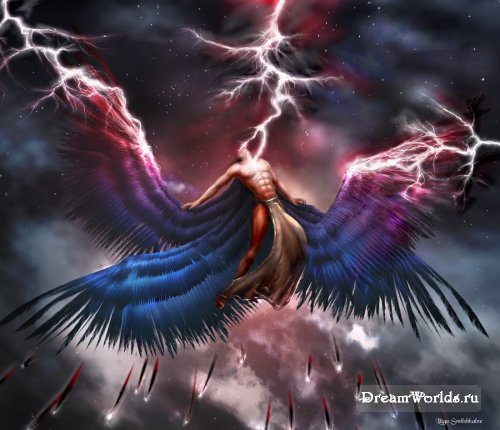
This “Other,” Elisha ben Abuyah, who saw Metatron seated beside God on an equal throne, suspected that two equal powers operated in the universe — God and Metatron. In other words, the Angel responsible for the sage’s erroneous assessment of his status (the sage considered himself worthy to behold God) also suffered the traumatic consequences of that error. References say the same “Strikes of Light” befell another great Archangel — Gabriel.
The possibility of “beholding God” was generally perceived in the ancient Near East as a sign of high spiritual status, “closeness to God,” and hence there are numerous accounts of the deaths of people who dared to look (and sometimes simply to approach) the Ark of the Covenant — the place of God’s special presence. Even at the very beginning of its existence, two of Aaron’s older sons were burned “by fire from the LORD” for violating cultic decrees; flame issued from the Ark and consumed them. Later, when the Israelites had already entered the Promised Land and fought the tribes living there, in a clash with the Philistines the Israelite army was routed and the Ark of the Covenant fell into the hands of the enemy. The Philistines brought it as a trophy to their city of Ashdod and placed it in a temple. Pilgrimage began — everyone wanted to see the Ark and look inside: “And the hand of the LORD was heavy upon the Ashdodites, and He afflicted them with tumorous sores.” The Ashdodites sent the dangerous trophy to the people of another Philistine city, Gath, but there the same thing happened — widespread disease and death among those who looked into the Ark. The Ark was then taken to a third city, Ashkelon, whose unlearned inhabitants likewise flocked to see the trophy.
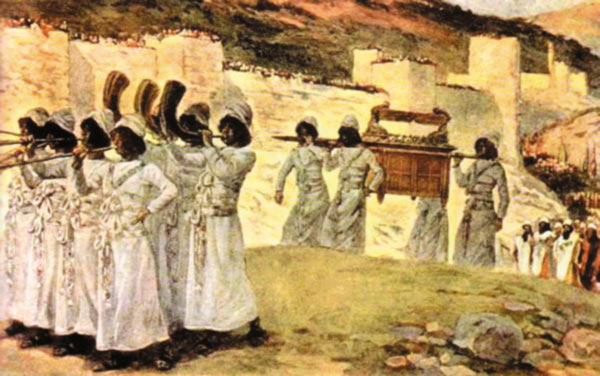
The natural result of this curiosity was that “the heavy hand of God was upon them,” and mass deaths and plagues began. Eventually it was decided to return the dangerous trophy to the Israelites. It was placed on a cart drawn by two cows and sent on the road to the Israelite city of Beth-shemesh. The Israelites rejoiced greatly at the return of their sanctuary. The Ark was set upon a great stone, a solemn service and sacrifices were held. Crowds of pilgrims came to worship their sacred object. But their joy proved premature, for God “… struck the men of Beth-shemesh, because they had looked into the ark of the LORD, and he smote among the people of the men of Beth-shemesh, seventy men and fifty thousand; and the people mourned, because the LORD had smitten the people with a great slaughter.” (First Book of Samuel.) Elsewhere in the Bible an unfortunate incident related to the Ark is recounted many years later, in the time of King David. It was decided to bring the Ark to the capital: “And they set the ark of God upon a new cart, and brought it out of the house of Abinadab… And the sons of Abinadab, Uzzah and Ahio, drove the new cart… And when they came to Nachon’s threshingfloor, Uzzah reached out toward the ark of God, and took hold of it; for the oxen stumbled. And the LORD was displeased with Uzzah, and smote him there for his presumptuousness; and there he died by the ark of God.” (Second Book of Samuel.)
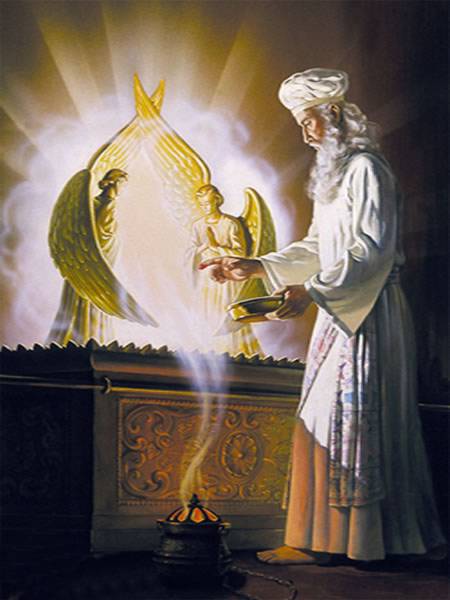
The result was that, in the days of the First Temple in Jerusalem, a rope was tied to the foot of the High Priest who entered the Holy of Holies (the place where the Ark stood) so that, if the priest died, his corpse could be pulled out.
The fixed expression “fiery rods” was also applied to people in the Middle Ages. One of the greatest kabbalists of Provence, Ra’avad (R. Abraham ben David; the modern term “Kabbalah” was coined by his son, R. Isaac the Blind), said of his opponent Maimonides: “If the [ancient] sages were alive, they would have scourged him with fiery rods.” The expression “a fire that consumes another fire” became the basis for a ritual in which the metaphorical heavenly fire summoned by the sages is transformed into an earthly punishment of sinners.
Practical Kabbalah employs such a traumatic entry of light in the rite of “Pulsa-de-Nura“, described in one of the oldest books of practical Kabbalah, Harba de-Moshe (“The Sword of Moses”). The creation of the rite is attributed to the legendary Rabbi Akiva, the fourth of the sages mentioned above who entered Paradise (Pardes).
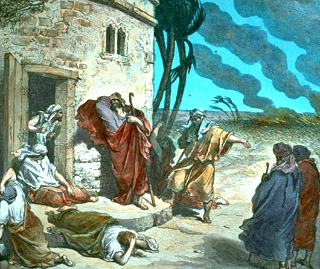
So this is what the fire of the Apocalypse looks like!
So, a Kabbalist with knowledge of the evolution of the Kli can stimulate, press on the Kli of Creation with his flow, taking on the responsibility of the Creator. The consciousness of creation, when pressed by Light, seeks refuge to hide from the Light in which cell of awareness, in which partzuf, or conversely begins to reflect light with its own Glow if there is one :), opposing itself to the Creator. The ability to control the pressure of light on the Kli will protect the creation from premature heart attack or from an unexpected stroke of the creator.
Enmerkar, what do you think about the idea that the Ark could have been an electric capacitor created under the guidance of aliens (the entourage of Yahweh)? This is claimed by Erich von Däniken in “Chariots of the Gods”.
I tend to hold more traditional views, and, as I’ve been told, the Ark is still a Communication Object with the Higher, rather than with aliens.
How interesting!!! Thank you very much