The Mind of the Flow
As we have already discussed, mind, as the basic property of reality to attain definiteness and stability, exists as internally interconnected ensembles of individual ‘fixing’ or cognitive acts — i.e., in the form of flows. At the same time, the stability — that is, the inner coherence — of such sequences is maintained by their shared directionality, collinearity, the “essential” basis of which is called the “logos” or the “semantic core” of a given flow.
We also said that the structure of each flow can be described from three different positions:
- as its “resultant” vector, its general direction,
- as its “inner mechanics,” its processuality — or the so-called “vortex,” and
- as the very mechanism of its stabilization, the form of stability — the “matrix.”
At the same time, for different flows of mind, one mode of description is used predominantly in accordance with the nature of each flow, its “inner meaning,” its functional orientation.
Thus, in relation to flows of mind manifesting as distinctly progressive or regressive forces — hierophants, guides, and the like — it is most appropriate to use vector terminology; in relation to service spirits, whose nature consists in maintaining a complex of interactions and mutual opposition, it is most convenient to use vortex concepts; and as applied to free and dual beings — to rely on matrix representations. Of course, this does not mean that Guides are exclusively vectorial, or that demons cannot be considered matrix manifestations; it only indicates in which system of concepts the description may be most adequate.
The human form of mind can be regarded as weakly vectorial, moderately vortical, and distinctly matrix-based. In other words, approaches to increasing efficiency and reducing the destructiveness of the functioning of the system of the human region of the psychocosmos are best developed by treating it as a system of interaction of many matrices with varying levels of constructiveness. For evolutionarily higher forms of mind, in particular, gods, a “single-matrix” structure of the flow of mind is more characteristic, when it is structured in one dominant way.
At the same time, the very principle of the matrix nature of mind can be regarded as one way the logos manifests — as a form (μορφή) — an ordered structure of psychic processes. In this sense, the vortex is the manifestation of the logos as the “device” (μηχανισμός) of the psychocosmos, and the vector — as its “directedness” (χαρακτήρας).
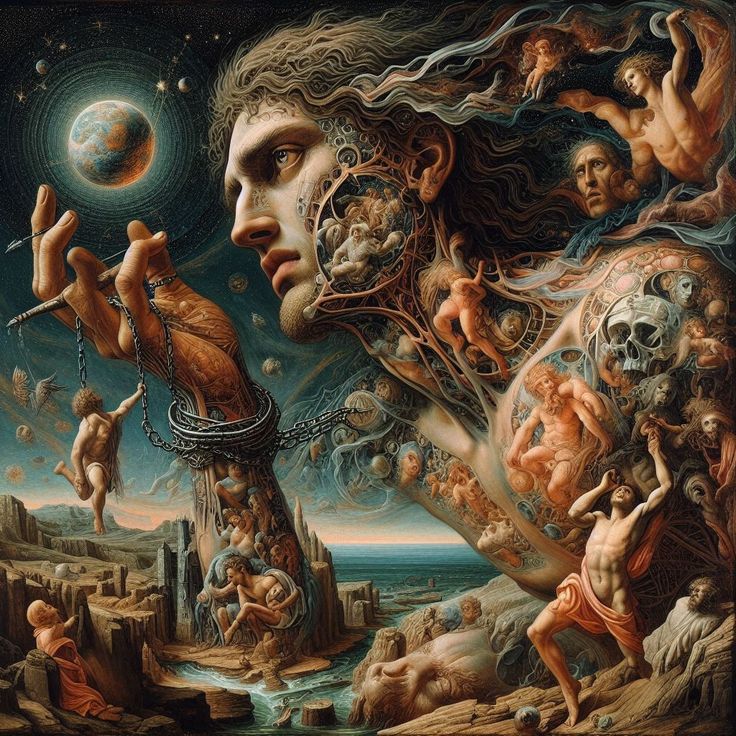
At the same time, the multi-matrix structure of the human mind is both its advantage (since it provides an extensive choice of behavior models and paths of development) and its limitation (since, on the one hand, there is always a risk of competition among different matrices, thus — their mutual weakening and dissipation of energy, and on the other — the danger of activating destructive matrices, destructive activity both within the psychocosmos and in its “external” expressions).
This is precisely why the main task in harmonizing one’s mind is, firstly, in identifying the matrices active within it, and secondly, in weakening destructive matrices as much as possible, and activating constructive matrices.
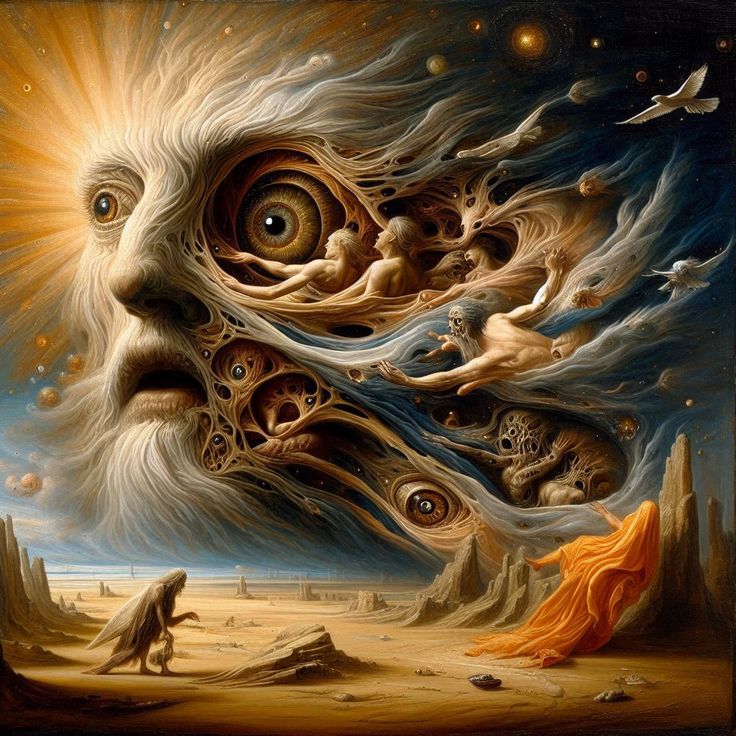
At the same time, a matrix-formed system of mind is, although the most widespread, not the only way of ordering manifestation of the logos. Many systems of mind development speak of the effectiveness of a certain departure from “matrix” functioning of mind in favor of “flow” perception. However, a complete exit beyond the limits of the ordering influence of matrices for the human mind means immersion into chaos, into dreaming, loss of structure, and, at best, loss of mental coherence, and at worst — madness or even death.
Nevertheless, it is also possible to touch this sense of flow without completely losing “anchors” and ordering structures — by existing not in the shackles of morphe (form), but in the current of what the ancient Celts called “crus” (cruth) — the inner coherence of the flow. This notion means a natural, living form, the manifestation of the inner essence of a being or object in a given moment. The difference between living in cruth and in morphe is the difference between living as a process, or existing as the implementation of a program. A person living in morphe strives to “correspond” — to an image, a role, a function. They look at themselves “from outside.” One who lives in cruth responds to the moment. They change without losing themselves. They do not repeat a form — they give birth to it from within anew each time, like breathing, like improvisation.
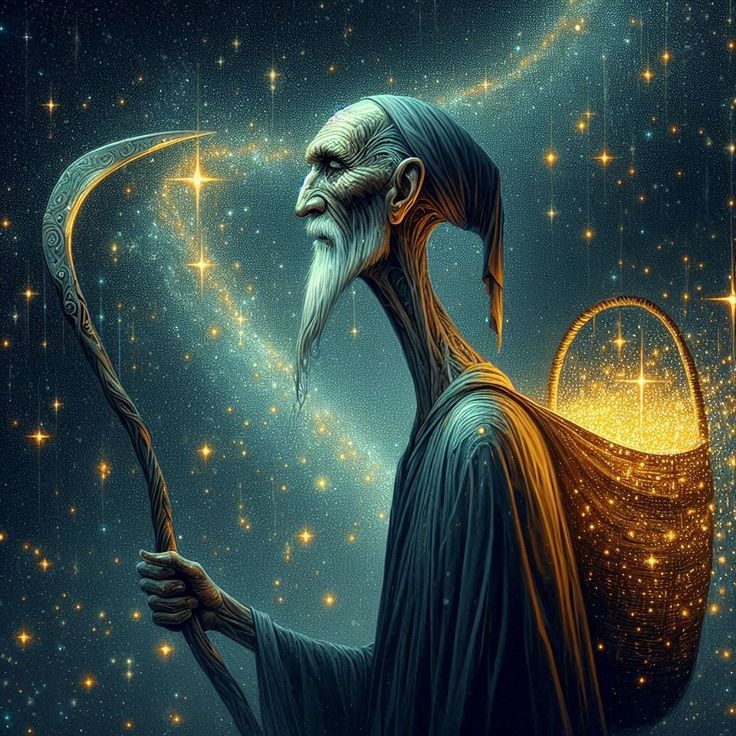
This is exactly how a unique group of beings exists — faerie. They do not “express” form; they live it. Their Magic is not coercion but attunement. Their language is not morphe, not a linear utterance, but poetry, gesture, dance, a glance. Their essence is the spontaneity of form, appearing in the instant of need and disappearing when it becomes irrelevant. Human mind, accustomed to morphe, fixes, defines, compares. The world of faerie, living in crus, is fluid, elusive, changing under every gaze.
In other words, the mind of faerie differs from all other, better known and more widespread forms of organization of the psychocosmos: it is oriented toward the perception of the world’s changeability and the flow-ness of mind itself; it weakly “twists” into vortices and is even less directed along vectors, and all the more so — it does not “freeze” into matrices. This is precisely where the most important aspect of the existence of the Magical people is manifested — their fundamental nonlocality.
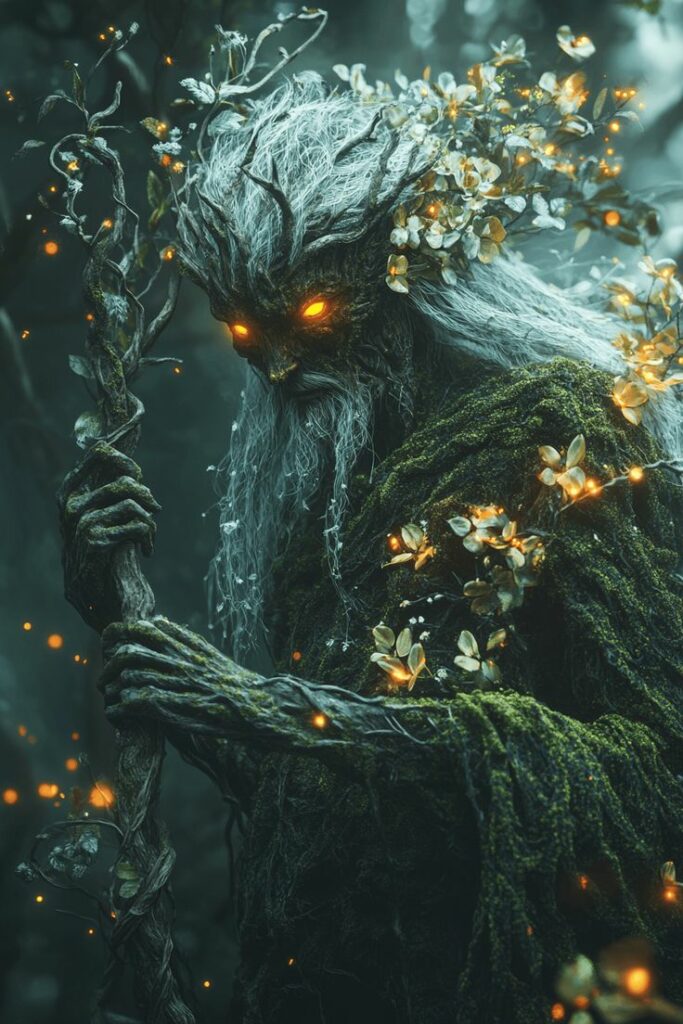
Let us repeat once again that for a human being a full transition from their formed, matrix-based mental functioning to the fluidity of the psyche of faerie is impossible. However, learning from them some aspects of such perception can be very useful.
We have already noted that neither demons nor other predatory entities of the Other world can really “feast” on the energy of faerie — it is too resilient for them. Indeed, how do you catch the wind or drink a sunbeam? A force that is in constant motion and does not lose harmony cannot be appropriated from outside.
And perhaps, when a human being suddenly stops, stops clinging to a name, to their memories and self-identifications, forgets who they want to become, and simply hears how the world sounds — they will briefly sense: the form exists, and it is already here. This will be their crus. In such “flow-ness” of mind there is no violence, which many “spiritual” practices often propose, “shaking” mind out of its habitual matrix structure into “free-floating,” depriving it of anchors and reference points. Therefore the transition from perceiving oneself as a set of matrices to sensing the inner coherence, the deep wholeness of one’s flow of mind is an important therapeutic approach, which can be learned through interaction with faerie.

Feeling oneself as a set of matrices is certainly an exaggeration; nobody feels like that. Moreover, matrix networks program form-morphs rather than essence. And the attachment to a name, a memory of oneself does not hinder one from being spontaneous and however one likes. This is why matrix forms are unified, but all people are different. The structure of fairy consciousness is interesting; it strongly resembles my dogs – awareness in the moment, an active, light body language, and a very mobile psyche. And, of course, instant reactions to the changing world.
Thank you, Enmerkar. In your description of the fairies, you select words so accurately according to my understanding that it seems as if I wrote it. Please tell me about the language of the fairies.
Beautiful!