Ragnarök and Planetary Cycles
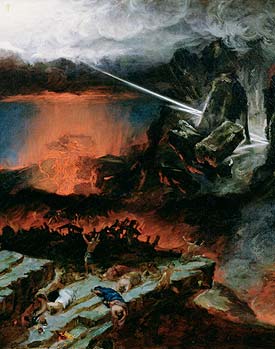
The popularity of ‘end-of-the-world’ scenarios as triggers for panic and exploitation is colossal. Practically every century, people expect a cosmic event that, in their view, will fundamentally alter their view of the universe.
However, unlike the “young” religions that assert a linear view of existence (one birth, one death, one end of the world), traditional pagan religions are based on a different principle — the principle of cyclicity, or, more precisely, the spiral nature of cosmic development.
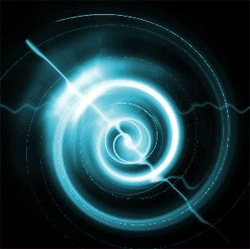
In our discussion of the World Wheel we examined the quaternary principle of this movement. Yet a simple quaternity does not give the full picture — the picture of a spiral. Indeed, the next turn of the quaternary is not identical to the previous one: the second Passivity gives birth to a new Activity, rather than recreating the first. Therefore, a cycle is only the flat projection of a spiral.
The Hindu notions of “Kalpas” are well known: they follow one another much like one day follows another. Each Kalpa (“Day of Brahma”) includes 14 manvantaras (periods of Manu, the cosmic man), each of which is divided into 71 maha-yugas, each of which in turn comprises four yugas. The Indians worked with vast numbers to measure their cosmic spans of time (a Kalpa lasts almost 4.5 billion years), but for us what matters here is not the numbers but the principles of cyclicity and spiral development emphasized by Hinduism.
The concept of cyclical time was known in Ancient Egypt. The symbol of eternal motion and the rebirth of life was Khepri, the scarab beetle who pushes the Sun.
The Maya priests, with meticulous care, constructed their system of cycles extending over millions of years.
Pythagoras believed there is nothing new in the world and that everything born will be reborn after some time. The doctrine of the endless repetition of the world after periodic conflagrations of the cosmos, formulated by the Stoics, echoed Pythagorean thought. Plato also conceived of history as a circular motion, akin to the motion of celestial bodies and the rotation of the entire cosmos. His teaching about world catastrophes serving to cleanse the cosmos resonates with West Semitic and Iranian mythology. Zoroastrianism reflects the idea of the world developing in a spiral, symbolized by the deity Zervan, Time. In Zoroastrianism, world history does not end with the victory of Good over Evil; there is no completion — evolutionary development continues indefinitely, and the whole world moves to a new level.
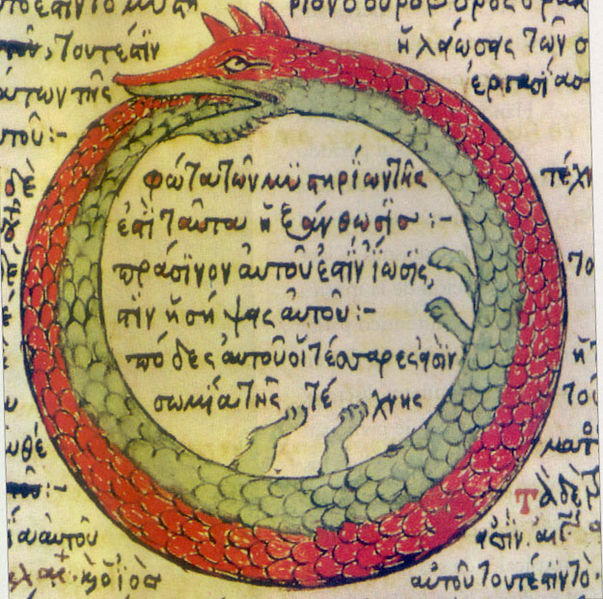
However, in the Middle Ages the concept of cosmic development acquired a somewhat simplified form of “eternal return,” symbolized by the Ouroboros — the snake biting its own tail. This image goes back to the Egyptian Mehen, the Many-Faced Serpent, who, protecting the Solar Barque, holds his tail in his mouth — symbolizing the cyclicity of the cosmos’ laws, their eternal repetition.
Only the Rosicrucians reintroduced to the West the forgotten idea of spiral development, elaborating the concept of “planetary cycles,” ideologically analogous to the Hindu concept of yugas succeeding one another.
The “end of the world” of which the Rosicrucians spoke most likely refers specifically to the end of one of many worlds — that is, civilizational cycles. They believed that pre-Christian religions, which transmitted knowledge of Reincarnation and the law of cause and effect, had vanished, and a time had come when the knowledge of that doctrine was no longer useful for humanity’s further advancement. This one life was to acquire paramount significance. Therefore the new religions, as presented to the masses, do not include notions of reincarnation and cycles. According to Rosicrucian teachings, the evolutionary scheme runs through five Worlds over seven great Periods of Manifestation, during which the pure spirit, or developing life, must first become human and then become Creator. Each of the Periods corresponds to a certain planetary principle. The first three Periods (Saturn, the Solar and the Lunar) are regarded as already completed. Humanity is now in the fourth, or Earth Period. When this Earth Period is finished, the Periods of Jupiter, Venus and Pluto will successively follow before the Great sevenfold Day of Manifestation comes to an end and all that now exists will sink again into the Absolute for a period of rest and the assimilation of the fruits of evolution, only to arise again for further and higher development at the dawn of another Great Day. When the Cosmic Night comes, all manifested things are transformed into a homogeneous mass — the Cosmos becomes Chaos again.
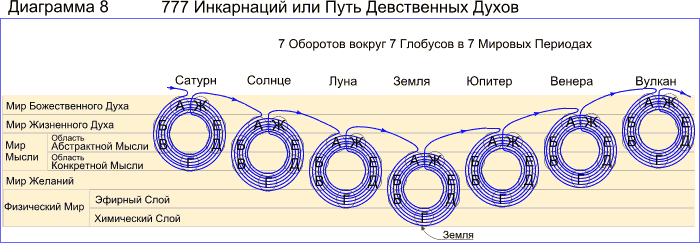
It is precisely this periodic return of matter to the primal substance that makes the development of Spirit possible. If the crystallizing process of active manifestation continued without end, it would constitute an insurmountable barrier to the progress of Spirit. Each time matter crystallizes to such a degree that Spirit finds it too difficult to work within it, Spirit retreats in order to restore its expended energy.
The interspaces between Periods and Turns are, in fact, far more important for growth than actual existence, although the latter serves as the foundation of the former and cannot be dispensed with. The importance of the Chaotic interspace lies in the fact that during this period beings at all levels of development are united so closely that they are, in essence, a single whole; as a result, those who are less developed during the period of manifestation are in intimate contact with the more developed, thereby experiencing and benefiting from vibrations far above their own. This gives them the opportunity to relive and assimilate their past experience in a manner impossible when form creates interference.
Yet the Rosicrucians revived and developed what had been known since ancient times: the development of worlds is uneven and discontinuous; it alternates periods of growth and expansion (the accumulation of experience) with periods of deepening (the assimilation of experience).
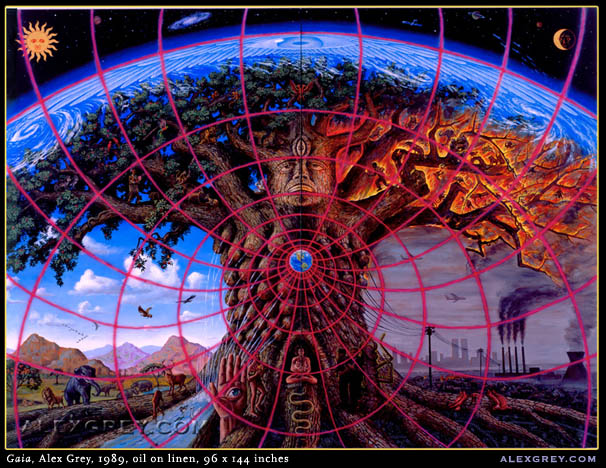
After the universal destruction, ruin and death of the world comes rebirth. After Ragnarök, Baldr and his killer return from the world of the dead, reconciled; Thor’s and Odin’s surviving sons return to the sites where Asgard once stood, the city of the gods. The human pair that hid during the gods’ battle in Hoddmimir’s grove and endured all dangers there will give rise to the human race.
But that is not all. Only after Ragnarök will people be admitted to the heavenly abodes (Gimli). In other words, the rebirth after Ragnarök is a rebirth on a new, higher level, which precisely corresponds to the Rosicrucian notions of world cycles.
Note that pagan conceptions of period-ends are entirely devoid of any idea of a “judgment” separating “sheep from goats.” The world moves from one state to another; the transition is catastrophic, but it is not selective, any more than war is selective: in war those who die are not the “undeserving” but those who are poorly prepared. Therefore Odin’s primary task is preparation for Ragnarök, the daily training of the einherjar and the replenishment of their ranks with the finest warriors.
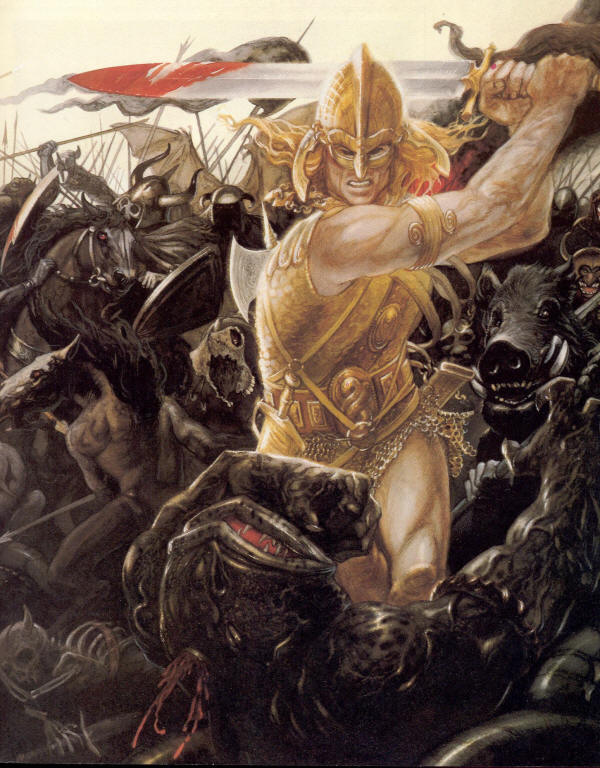
At the same time, the idea of the Last War and of a Messiah appearing before the end of the world is also widespread: Kalki-Vishnu in Hinduism, King Arthur among the Celts, Saoshyant among the Zoroastrians will enter into battle, but this battle is not a judgment — it is a last effort to make the Transition involutionary rather than evolutionary: when the world reaches an extreme degree of destabilization and is about to pass from one cycle to another, its position is extremely precarious, and thus it represents the most tempting prize for the inverse, Qliphothic Forces, which in their final fury attempt to seize the world’s stores of power. And the Great Warriors merely ensure the correct unfolding of the Transition, sustaining the normal course of evolution.
Hello, En!
If we set aside the global processes of changing the World, and take the life of one being, it turns out that the conscious ‘sacrifice of oneself’ to follow one’s Destiny is a way to move to a new cycle of development, giving Forces to go through this Path and a kind of preparation through inner Ragnarok for the Global Ragnarok? If so, does it mean one can become an einherjar even in life? Or have I misunderstood something?
The question of ‘sacrifice’ is quite ambiguous; I have mentioned it in one of my posts already. Now I’ll just add that you can sacrifice anything, but not your Path, as losing the Path means losing individuality – the only thing we really have. As for einherjar, I want to say that becoming an einherjar was not reserved for the best warriors: the best warriors lived to old age and… ended up in Hel (unless Odin intervened, cutting their lives short).
An impressive article! Much has fallen into place, including in the understanding of the Scandinavian myth.
Once, long ago, a phrase popped up in my mind: ‘The manvantara is exhausted when it comes to balance.’ At that time, I didn’t even know such a word. And I periodically remember it, but the mystery remains. And now, after reading the article, I found some correspondence between the exchange of energies in the ‘Chaotic Interval’, leading to some kind of balance, and ‘balance’ in ‘my’ phrase. Perhaps the respected Enmerkar has something to say about this?