
Nagas and the Depths of the Mind
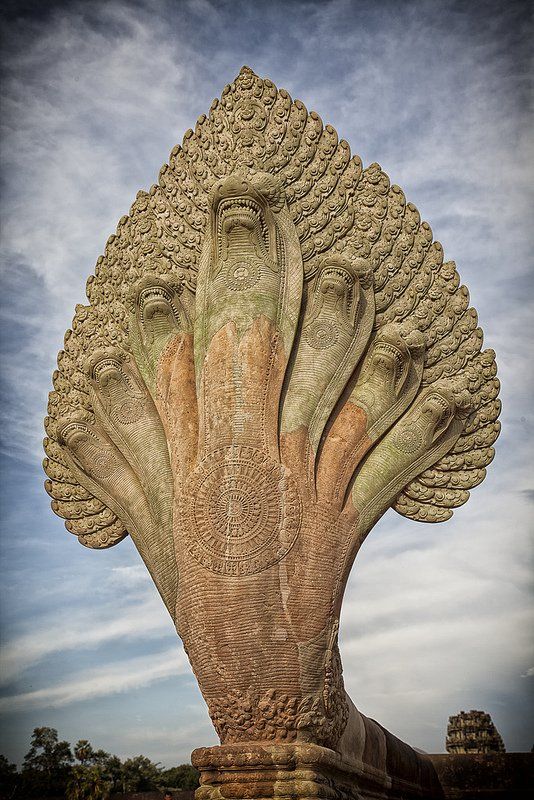
We have already discussed in the Magical Myth, each form of mind manifests on both psychological and macrocosmic levels. Each stable mode, each “macro-matrix” of mind is expressed at the level of the psyche as certain currents, tendencies, impulses, subpersonalities, etc., and at the level of the manifested world — as particular groups of beings or phenomena, and these two ways of manifestation are closely connected and interdependent.
One important manifestation, reflected in the universe and the psychocosmos, is the deep level of the mind at which what later becomes thought — that is, mental patterns for describing reality — have already emerged, but have not yet taken shape and become conscious. This is the deep level of the psyche known as the “reptilian brain”; it is responsible for important behavioral reactions and provides the substrate that later serves as the basis for the emergence of thought.
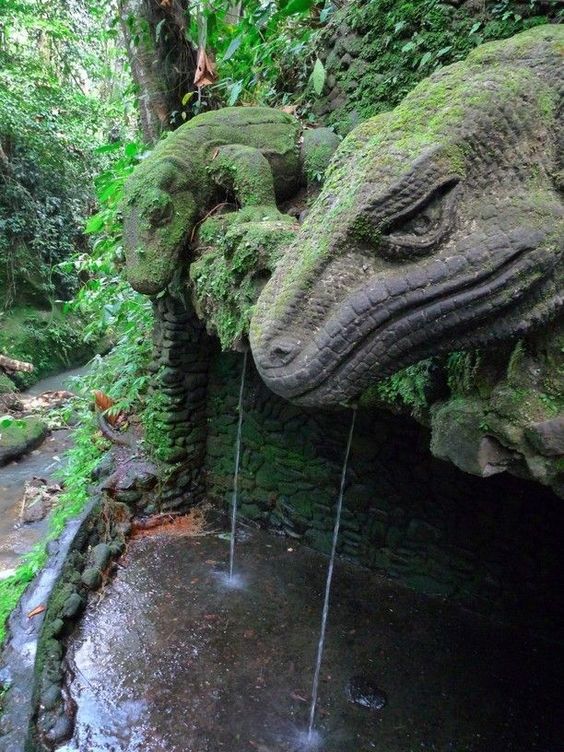
Such a mode of being/mind manifests in the psyche as the archetype of the snake, and in the metacosmos — as a group of beings known as nagas.
Note that the Magical myth clearly distinguishes between two groups of “reptilian” manifestations of mind — dragons, which are an expression of the elemental forces of desire, and snakes, which express the primordial, deep rudiments of conscious activity. That is, if dragons are a force accessible to ‘daytime’ awareness and control, then snakes are manifestations of the psyche (and the world) that do not belong to the ‘daytime’ world, and act in relation to it as fundamental, supportive, or antagonistic impulses.
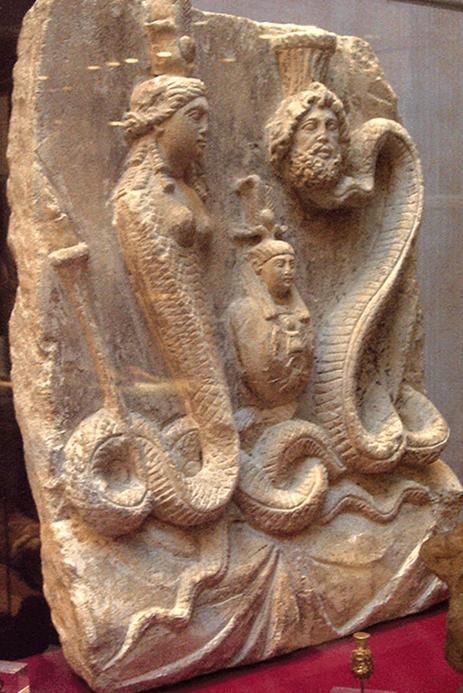
For example, Scandinavian mythology speaks of the serpent Nidhogg, who opposes the Eagle of Yggdrasil, and Jormungand — the fatal antagonist of the God of order — Thor; the Sumerian epic describes the forces of chaos in the form of the serpent Asag, and the Egyptian one — Apophis, and so on.
This World Serpent, in turn, manifests as a set of reptilian forces dwelling in the roots of the World Ash tree, or, as described by Eastern mythology — in the world of “Pata-loka” (“That which is under the feet”).
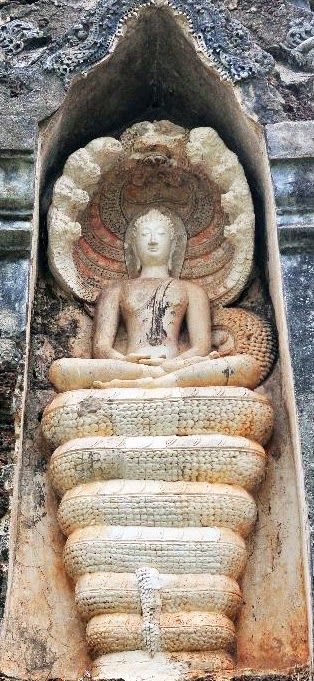
At the same time, the Eastern myth clearly notes that Serpentine forms of being/mind are forces that can be both hostile and supportive of divine manifestations; in particular, the god Vishnu rests on the world serpent Shesha, and the king of the nagas Muchalinda protects and shelters Buddha Shakyamuni.
From a Buddhist point of view, the entire earthly landscape can be viewed as the body of a gigantic reptilian being that experiences the planet as its ‘self’. Despite the formal claims of various beings to certain parts of the Earth, these reptilian spirits perceive the whole planet as their body, as part of themselves, and perceive any attempts to claim part of this space for themselves as an attempt to divide their body. Thus, nagas (Tib. — lu) are in fact the “guardians of the Earth”. At the same time, nagas are associated with water and purity, since their world, Naga-loka, is closely connected with oceans, rivers, lakes, and springs, and therefore nagas do not tolerate pollution of their environment or polluted; they become very angry if harm is done to water sources and punish violators.
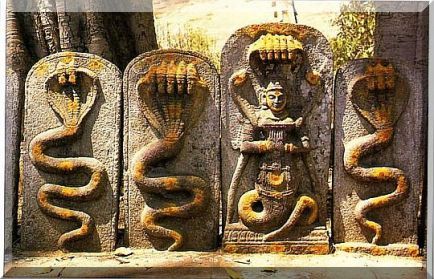
There is a developed mythology of nagas, describing their various castes, morals and customs, giving the names of their kings and leaders, since for people the nagas long served one of the objects of contact, and such contacts could end well or badly depending on their cause. Legend has it that an enraged naga, merely releasing fiery breath from its nostrils (nasavata, nasikavata), is capable of killing all nearby living things in the surrounding space. There is also a belief in the wrath of a naga, capable of taking a life with a single poisonous glance (visha drishti).
Accordingly, for ordinary people, nagas guarding water sources, rivers, or lakes were appeased with offerings; otherwise they could cause disease or death; the draining of swamps was always accompanied by the ritual of “relocating the nagas,” in which they were offered a new habitat, while the construction of canals — by contrast — required the invocation of nagas, who were supposed to guard these canals.
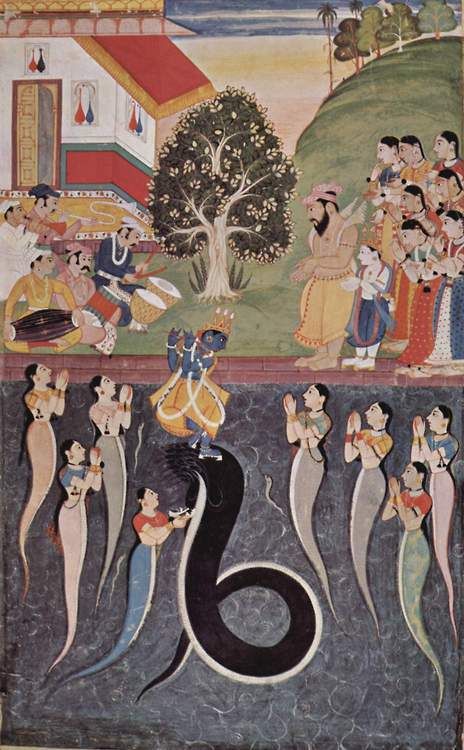
Hindus revere snakes both in sacred temples and in their natural habitat, offering them milk, incense, and prayers. Causing harm or even killing a naga (cobra) is considered the gravest of sins. There is anxiety that snake wrath can affect descendants from generation to generation. Rituals to neutralize naga-dosha (the curse of snakes) are complex rites.
At the same time, for sages, nagas were a source of wisdom. It is well known that, for example, the early Buddhist sage of our era — Nagarjuna — meditated on the image of a naga for 17 years, after which he was able to pass through the element of water into Nagaloka, where he received the highest wisdom — gnosis (prajnaparamita). Similarly, the father of yoga — the sage Patanjali — is often depicted in the form of a naga whose upper half has a human appearance. The same image was characteristic of Egyptian pharaohs, with the cobra on their crowns as a sign of attaining wisdom.
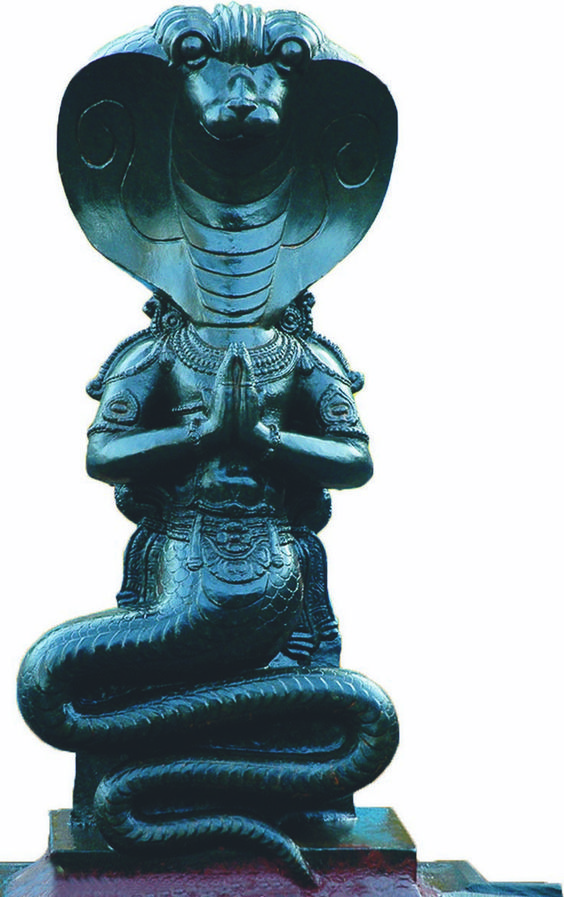
However, it is incorrect to say that nagas are wise in and of themselves; they only guard wisdom that is intended for people and gods, and this image is closer to hidden, concealed — meaning, not yet accessible to the mind — gnosis. For example, a story is known that nagas needed the teachings of the Buddha; for instance, one of the river nagas — Apalala — was converted to Buddhism, and another naga even took on human form in order to become a monk, but the Buddha refused him.
In other words, the mythological symbol of the snake or naga does not primarily reflect the wisdom of the snake or matter itself, as it symbolizes the wisdom of the one who was able to overcome and imbue this matter with soul, thereby gaining access to the source of the highest gnosis. Wisdom, as the highest inner knowledge, arises only when the interaction of spirit and matter reaches harmony or rises to a higher level — synthesis. In such cases, initiates or victors are marked with the symbol of the matter they transformed — the snake.
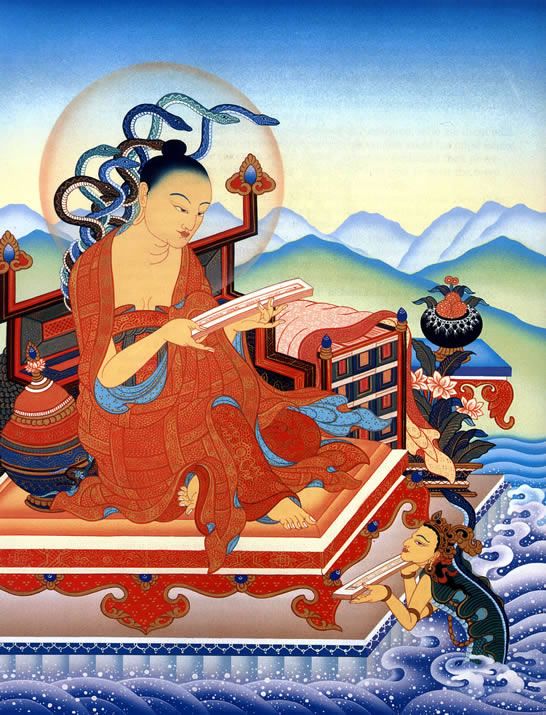
This is precisely why, without proper purity and strength of mind, nagas are more a source of unformed rudiments, and therefore for most people contact with them ends badly. The well-known ability of nagas from myths to take on various forms and guises speaks of the same thing: mind expressed in reptilian form is not yet finalized; it can “adjust” to various descriptions and interpretations.
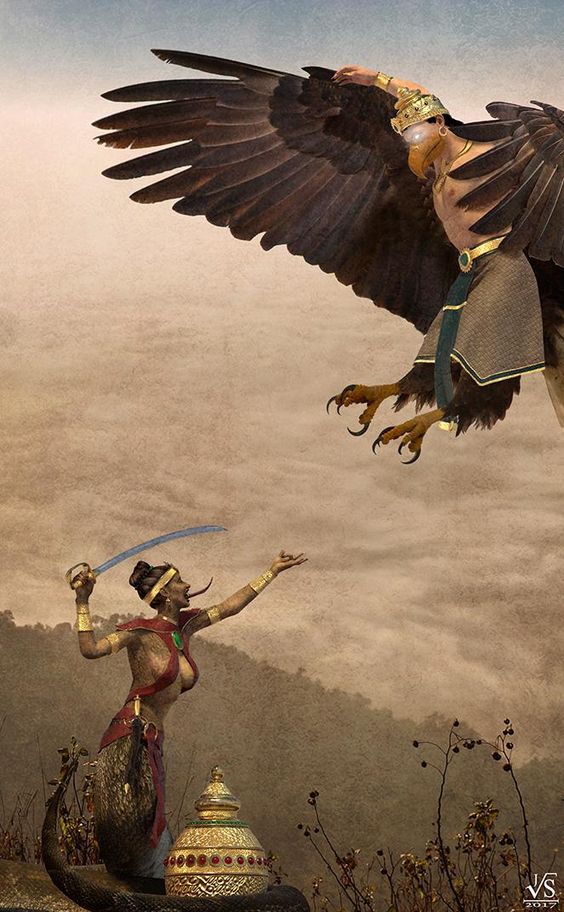
In this connection, it can be said that at the level of an unprepared mind, nagas more often manifest as false thoughts and intellectual delusions, since a literal reading of their manifestations rather hinders correct understanding. In this sense, it is not surprising that the myth describes as the enemy of the nagas the divine bird Garuda, which in the psychocosmic aspect expresses the force of intellect, analytical reason, “devouring” nagas as food, as a substrate needing processing, and extracting the hidden wisdom from them.
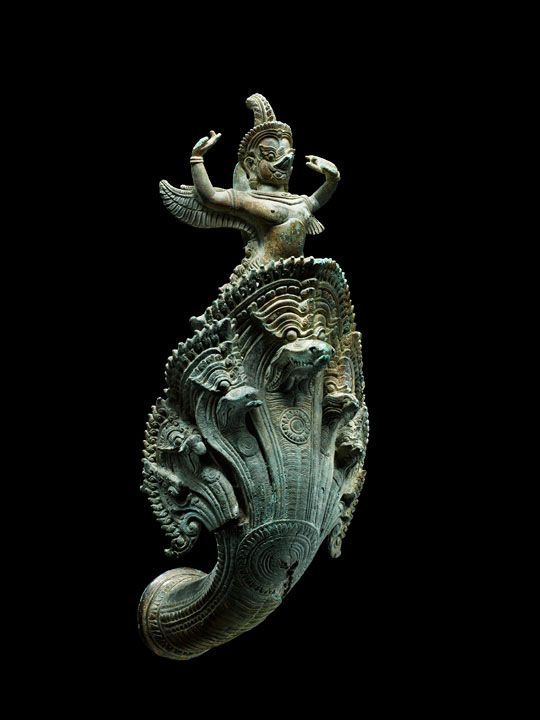
In various cultures, the interaction of bird and snake was described as an image of the interaction of spirit and matter. According to this concept, spirit should not destroy matter, but should influence it in such a way that it can evolve and strive for transcendence, overcoming its own limitations. Therefore the sphere of the union of opposites, symbolized by the union of bird and snake, is so important.
Thus, it is important to understand that the primordial root reptilian manifestations of mind are, on the one hand, a source of wisdom, but on the other — also the basis of delusions. Just as pure physical water is desired by nagas, a pure space of mind makes them “peaceful,” that is — amenable to becoming wisdom; in a clouded mind, however, nagas are “wrathful,” and therefore are hostile forces, which requires a higher spirit — Garuda.
Hello, Enmerkar. Who do you think the Garuda bird and its analogs in other mythologies symbolize in the macrocosmic aspect – who defeated the titans?
Hello. As stated in the note, Garuda is a differentiating mind that overcomes delusions. From a Buddhist point of view, Garuda is the manifestation of Buddha Amoghasiddhi, expressing enlightened wisdom of knowledge in interactions, eliminating the need for further karma. In other words, Amoghasiddhi is “complete knowledge,” perfect interaction, while Garuda represents the corresponding clear understanding.
As always—very interesting! Thank you.
Good day. Is it true that the influence on the nagas of Garuda as an emanation of Amoghasiddhi and Hayagriva as an emanation of Avalokiteshvara (who is in turn an emanation of Amitabha) differs significantly in method, but is quite similar in the final result? The wisdom of Amitabha as a dharmakaya of the Padma family is the wisdom of discernment; its activity is attraction, charm, inspiration, and subjugation. Avalokiteshvara is sambhogakaya, active compassion, and Hayagriva, as the wrathful emanation of sambhogakaya of the Padma family, expresses its most active form, enchanting, subjugating, and transforming the nagas as unenlightened, elemental, chaotic, and unformed guardians of wisdom, guiding them to a constructive and active state.
The Padma family, including Hayagriva, embodies the wisdom of the elemental feelings, and thus, in relation to the nagas, they perform a different function – cleansing desires that underlie the streams of wisdom that can be spawned by the nagas.
Thank you. In that case, Vajra is the wisdom of the elemental mind, Ratna is the wisdom of realization, and Karma is the wisdom of desires?
The Vajra family is the wisdom of reflecting reality; Karma is the wisdom of creative activities, and Karma is the wisdom of liberating (untangling) activities.
The images complement the text. Well selected. Interesting. Relevant.
Can Shakti be attributed to Nagas/matter in this context? In one of the posts (Tantra; Wisdom and Method), it was written that Shakti, energies contain wisdom, but a method (the eagle Garuda) is needed to sort of unpack it? I got carried away with this topic. I read that Shakti in its initial state is an amorphous and shapeless mass that begins to transform under the influence of the gaze (of Shiva). Can parallels be drawn? Is “Shakti energy” and the Substance of Desires different “things”?
Yes, such a parallel can be drawn, but with a caveat. One can say that the element of Nagas is the “passive” component of Shakti (although, of course, it has no components), since Energy itself is “flowing fire”, “shamaim”. Accordingly (very conditionally), one can highlight the “flowing” component (which is Wisdom) and the “burning” (which is Passion, the basis of desires). And yes, one can say that Shakti is the “substance of desires”.
Are Nagas service spirits or free?
Strictly speaking, Nagas and other inhabitants of the Between Worlds are neither free nor service spirits, as their existence is not related to maintaining the functions of the worlds nor to independently accumulating awareness. However, if we still attempt to draw parallels, they can be regarded as one of the groups of ‘gods of the Between Worlds’ (https://en.enmerkar.com/myth/bogi-miry-i-mezhmire) and, thus, conditionally considered free beings.