
Dragons – Elemental Forces
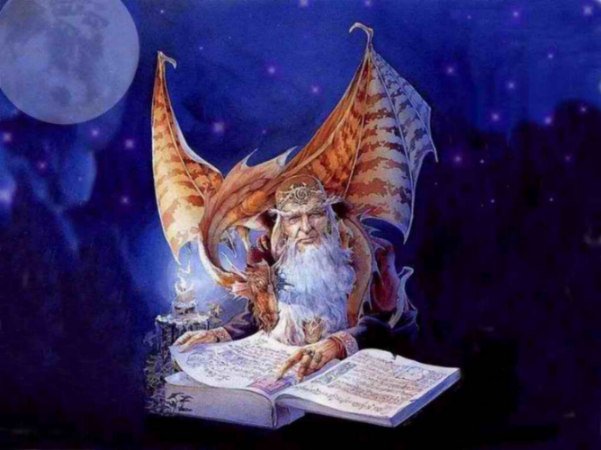
In our discussion of the animal powers we already mentioned the greatest among them — the Dragons.
We established that they are born as an expression of the active aspect of the Elements — mighty and unbridled, yet wise and ancient.
For the Magus, dragons are not merely a fundamental symbol found in almost every culture; they are a living reality with which he sometimes seeks to interact and sometimes is compelled to interact.
Let us emphasize again that, for the Magus, Dragons are a living reality, not mere symbolic images, and that battles with dragons are just as real.
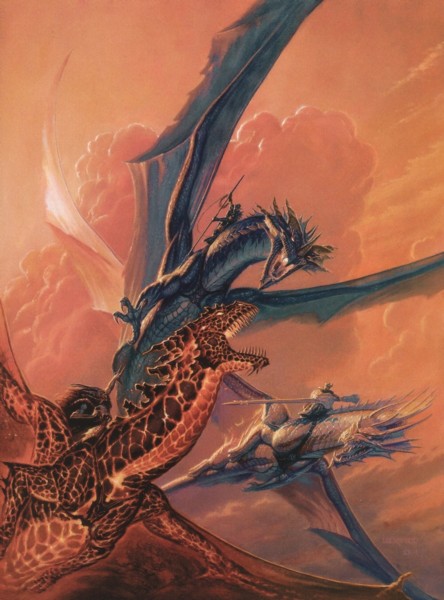
Many spirits — from all three hierarchies — take on the form of a dragon: dragons serve the gods and often incarnate them. In all these cases we are speaking precisely of the elemental aspect of Power — the Power of a god, angel, demon or other spirit.
Moreover, many Magi have encountered their own power, when expressed in an elemental form, manifesting as a Dragon.
A crucial point about dragons is that, as with all elemental forces, one of the Primary Elements predominates in them; accordingly, regardless of their origin — whether from the heavens, the depths of the earth, the sea, or the mind — dragons always bear predominant features of Fire, Air, Water, or Earth.
Yet, regardless of which element a dragon belongs to, it is always winged — that is, active; it is able to overcome the forces of gravity, and therefore it is free. It is precisely this freedom that makes dragons such valuable objects of interaction for Magi.
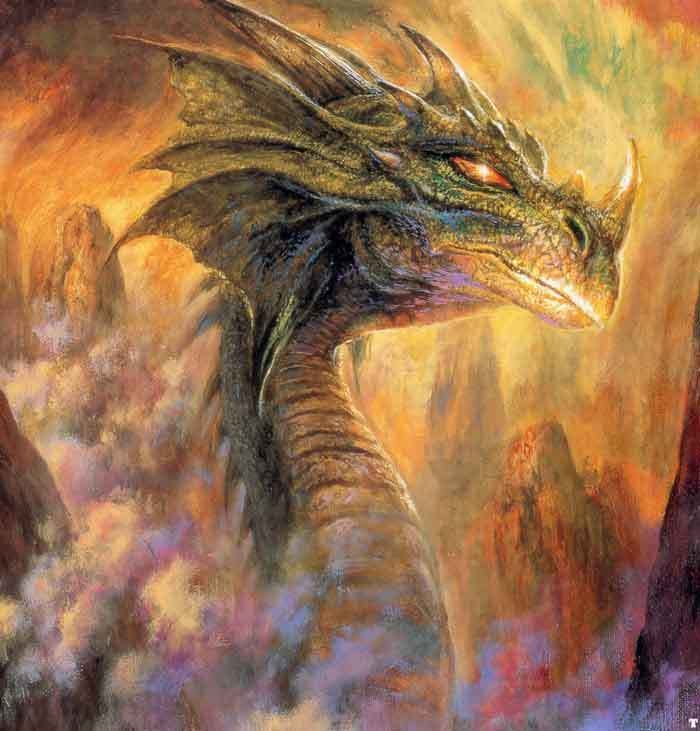
The progenitor of all dragons is the Great Serpent, the Fiery Dragon of the earth’s entrails; he is the expression of the Element of Prime Creativity. We have already noted that the Dragon appears in almost every creation myth. The sacred texts of ancient peoples identify him with the primal force of the earth, the original Chaos that struggles with the Creator.
Being elemental beings, Dragons dwell in the Interworld, only rarely manifesting in our world.
Note that in any active manifestation an elemental component is present. In fact, any act of creation can be seen as an element brought under the control of the will — whether we speak of the element of Fire, Water, Forest, Intellect, or Feeling.
Thus Dragons are the common form of expression for any elemental Forces. Nevertheless, like any individualization, Dragons are not merely the otherworldly being of the force that spawned them; they are independent entities, with their own character, personality, and sometimes their own aims. Moreover, accounts of dragons’ reincarnations as humans, animals, or other beings are not uncommon. In other words, a dragon serving a god, though it embodies that god, is essentially distinct from the god himself; and a dragon born from a Magus’s power will not necessarily serve him in all things. Often it is even the opposite — the Magus who spawned the dragon becomes the dragon’s slave — he falls under the sway of the elemental forces of his psychocosmos, and escaping that sway can be very difficult.
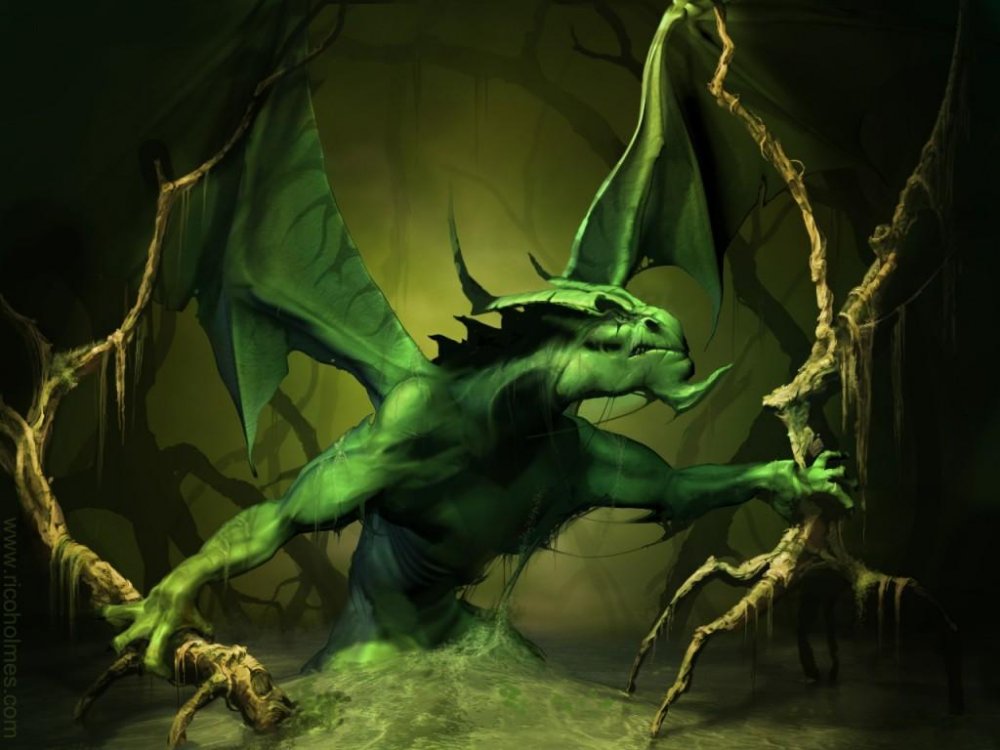
The mythological motif of serpent-slaying essentially expresses the mind’s efforts to overcome elemental forces that have escaped its control.
On the other hand, the taming of a dragon reflects taking these forces under control, thereby opening a vast reserve of power and possibility through which the Magus multiplies his effectiveness many times over.
That is why the subjugated dragon has always symbolized bravery of the warrior: the dragon emblem adorned Parthian and Roman standards, served as the badge of warriors, appears as the national emblem of Wales, and as the guardian carved on the prows of ancient Viking ships. For the Romans the dragon was the standard of a cohort, whence the modern term “dragoon.” The dragon symbolized supreme authority among the Celts; it was the Chinese emperor’s symbol — his face was called the Dragon’s Face, his throne the Dragon Throne. On Agamemnon’s shield (Iliad, Book 11) there was a blue three-headed dragon.
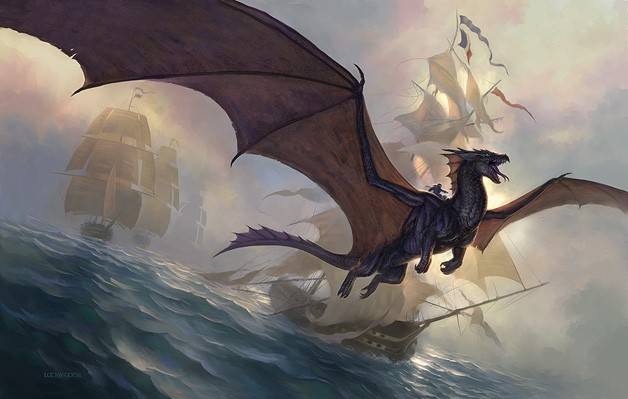
Nevertheless, a hero’s victory over a dragon and a Magus’s mastery of a dragon are completely different things. The hero kills the dragon. The Magus tames the dragon — he does not reject elemental forces; he subjugates them. The Magus understands that these forces, once controlled, become his invaluable allies in the struggle for freedom.
But however difficult it is to defeat a dragon, to tame one is far more difficult. Thus civilization has chosen the safer course of serpent-slaying — the path of removing elemental forces from its worldview; Magic, on the other hand, seeks to expand that worldview and thereby to widen the circle of accessible powers.
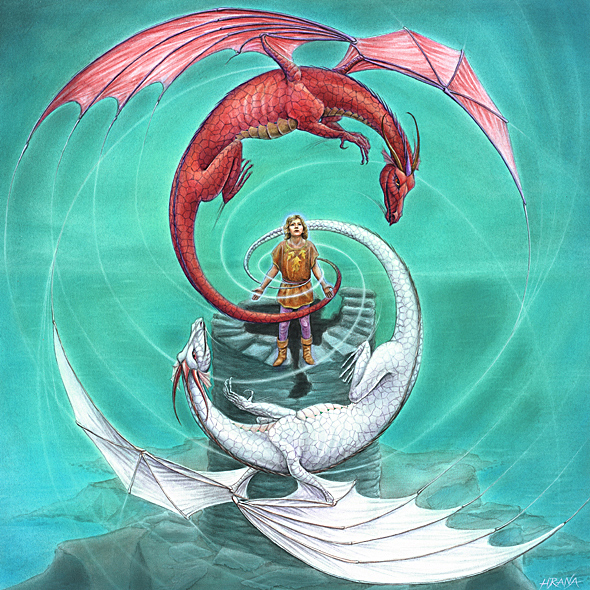
How to determine what lies behind the dragon, what spirit, essence? The dragon, as I understand, is the elemental manifestation – of the power of a god, angel, demon, or another spirit, so there is a second side. How to determine it?
Definitely – unless you ask the dragon itself. Or by indirect signs – attributes of this god or spirit.
ANCIENT UNIVERSITY…
I was left according to my desire in a large room, a library, some ancient magical study, whatever you call it and the doors were closed…
In the center stood a triple mirror – I approached… becoming aware… looking into it I saw myself… I raised fury, anger… turned red!!! And began to transform… into a Dragon… Demon-Dragon… I am calm… no negative emotions… having transformed I spread my wings… the rhythm of wing flapping is automatic… with a desire I quickened the flaps… intent and takeoff, I-the dragon rose a little higher… and descended…)))
En, how do a magician or hero meet a dragon? Is it necessary to enter the ISS or are there other ways?
I had a dream long ago where I was riding a horse towards the forest, and behind me, a Dragon was rushing, in my hands, I clenched two magical rings. I rode toward a transition place from one world to another; it was a kind of tunnel made of ancient trees, and behind me, I heard the breath of the Dragon, I looked back, and saw Him in all His Majesty, He was so big that His head barely fit in the tunnel, and He spewed fire, and at that moment, I passed through the portal and found myself in another place which I defined as a border zone between the world I was in and our world. The dream was so real that I woke up “in a cold sweat” with a clenched fist, as if I were holding something in my hand, a lot of time has passed, but I remember the dream in all details. What is this – a banal theft of a magical artifact or something else?
Tuning into the related element, entering into resonance with it, strengthening while ‘taking its energy’ – isn’t that similar to riding a dragon?
Very interesting topic! I have two questions for you: 1) Can a Dragon be one of the stages in the development of a Monad? 2) If any Deity can incarnate in the form of a Dragon, can a Bodhisattva also be born as a Dragon in the form of an Avatar?
The Dragon is an independent being, even when expressing someone else’s elemental nature, so the answer to the first question is – yes. As for the second, I don’t know much about bodhisattvas, but as far as I understand, the task of a bodhisattva is to help save worlds, while dragons do not facilitate this. Therefore, the answer is – unlikely.
Enmerkar, please tell me, how to resolve the confusion arising from comparing the Scandinavian ‘serpents’ (Old Norse orm, ormr) with the later dragons (Old Norse dreki) of European tradition? The beings, in my opinion, are completely different. Scandinavian ‘serpents’ are often called dragons, even though, based on their descriptions, they do not have wings. At the same time, for example, Nidhöggr, who gnaws the roots of Yggdrasil, does have wings (according to the Poetic Edda), therefore is a dragon. But, somehow, his ‘functionality’ does not align with the properties of dragons you describe.
Nidhöggr is undoubtedly a dragon, as stated directly in the last verse of the ‘Prophecy of the Völva’: “There comes the dark flying dragon, the serpent from below from Niðafjöll; it bears in its feathers – it flies over the field, – Nidhöggr will attain.” And it, of course, expresses the elemental Power of Yggdrasil. So, in my opinion, there is no contradiction here. Regarding Serpents – there was a discussion about them in another post – serpents are forces that oppose creation. Jörmungandr is one of such ‘enemies’ on which the universe rests.
Thank you, Enmerkar, for your website and the great work on it for the sake of people… Nowadays, people have forgotten about true ancient magic, about the Forces of the Elements… The wise are leaving – there are no students… On this website, you have done a tremendous job trying to separate the seeds of knowledge about true world Magic from the weeds of modern-day sorcery, which walks under the Forces of darkness, hiding either under gray or white, while the essence of all is one – black… I hope your selfless work on the site will awaken many and free them from the false path of black sorcery and self-deceit…
Is it correct to understand that the nature of a person has several spheres – body, emotions, mind, intuition? Each sphere has a deep internal source, which can be designated by elements, using alchemical language the primary elements – earth, water, air, and fire. Finding and managing these sources gives a person great power.
Hello! Enmerkar, my gratitude to you for your work; its fundamentality speaks of continuous effort in many lives. Moreover, mentions of the reincarnation of dragons into humans, animals, or other beings are not uncommon. Is there any information about this? Thank you! I assume it’s your case.
Hello. Thank you, I’m glad to be of help. Regarding the embodiments of Dragons – the situation here is the same as with the changing nature of fairies and other Magical beings. Dragons are the most elemental manifestation of Motherly powers, they are, strictly speaking, not beings but entities, although they can gain a certain form by ‘flowing’ into a more stable, less elemental form, that is – moving into another life wave. In ancient times, among kings and priests, there were such ’embodied Dragons’, one example of which is considered to be Ramses the Great.