Fairies and Dionysus
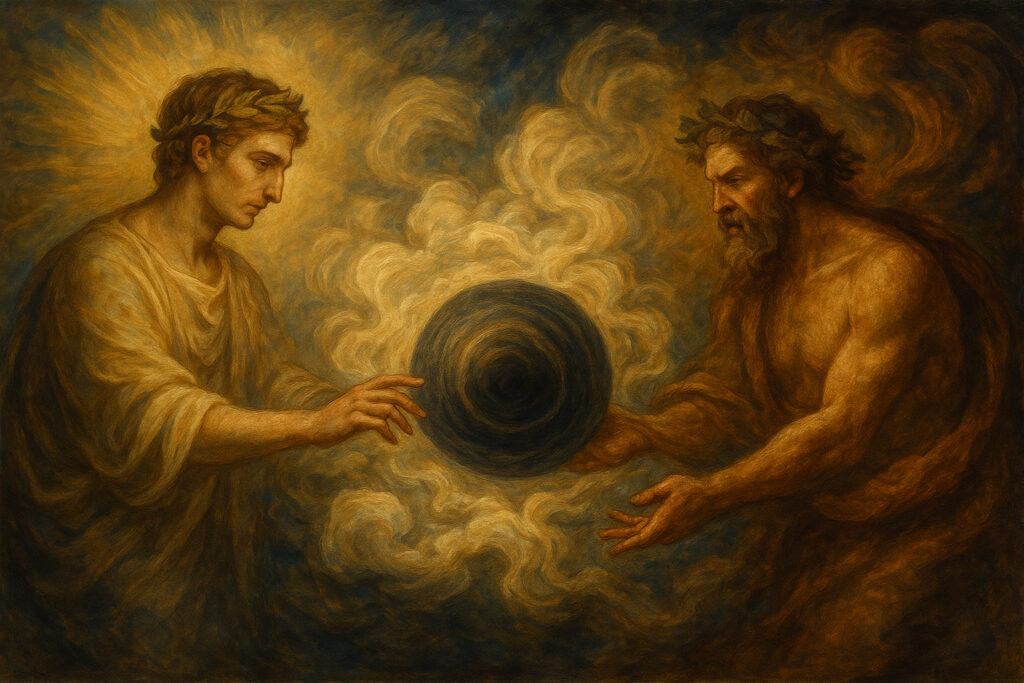
We have already discussed that both the macrocosm and the psychocosm are formed by two forms of manifestation — differential (Apollonian, logos-based) and integral (Dionysian, flow-based).
However, the Dionysian (Vanir by nature) is not the only type of flow: alongside it, one can also notice a faerie flow (Alvish-angelic in origin, threshold in its mode of existence). These two integral ways of experiencing the world are akin in their sense of life as movement, yet they differ in “what exactly” is flowing, how the integrity of the flow is maintained, and how this is experienced by the psyche.
Thus, the overall picture becomes tripartite: Apollo (nomos/counting), Dionysus (the living continuum), and faerie flow-ness (krus — a living form irreducible to reason or to affects) constitute three independent first principles, reflected in the three types of the creative forces of the universe — among the Aesir, the Vanir, and the Alvs.
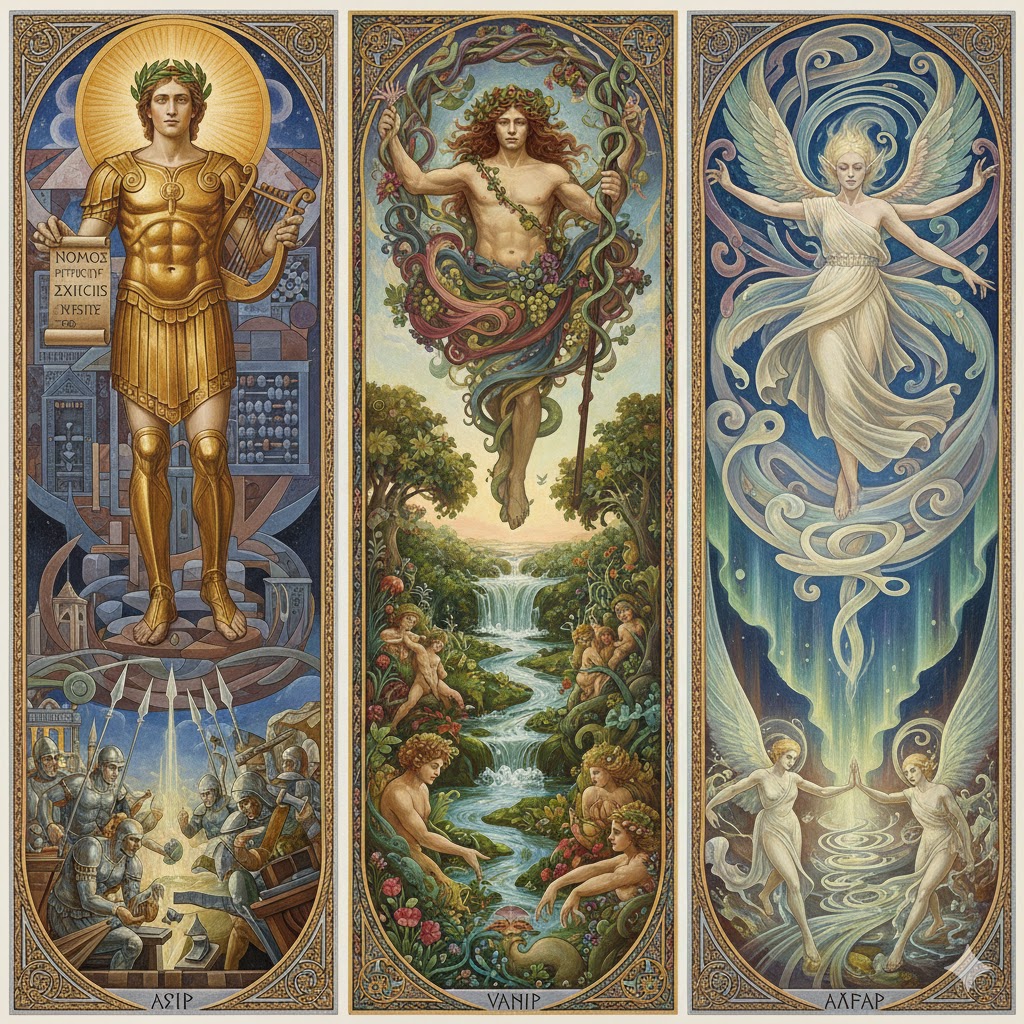
Dionysian flow-ness is the primary continuity of becoming, that side of reality where events are not yet separated from energy, where form “flows” together with process, and where the world is experienced as music and dance, resonances and vibrations. In this sense, Dionysus is what precedes counting: while there are no distinctions and numbers, the “bare” impulse toward being surges, the very continuous fabric from which events are then locally “extracted.” That is why the Dionysian principle is so easily expressed in the body (dance, intoxication, ecstatic union), and just as easily degenerates into addiction if it loses supports such as clear forms and discipline.
Apollo, by contrast, makes the world comprehensible and repeatable; he turns the “music of life” into a scale and a mode. At the same time, one-sided Apollonian tendency leads to a “cooling” of the mind: a person may think impeccably in formal terms, yet feel the content less and less, and then the flow returns to them either as a storm of the unconscious, or — as simulations of experience.
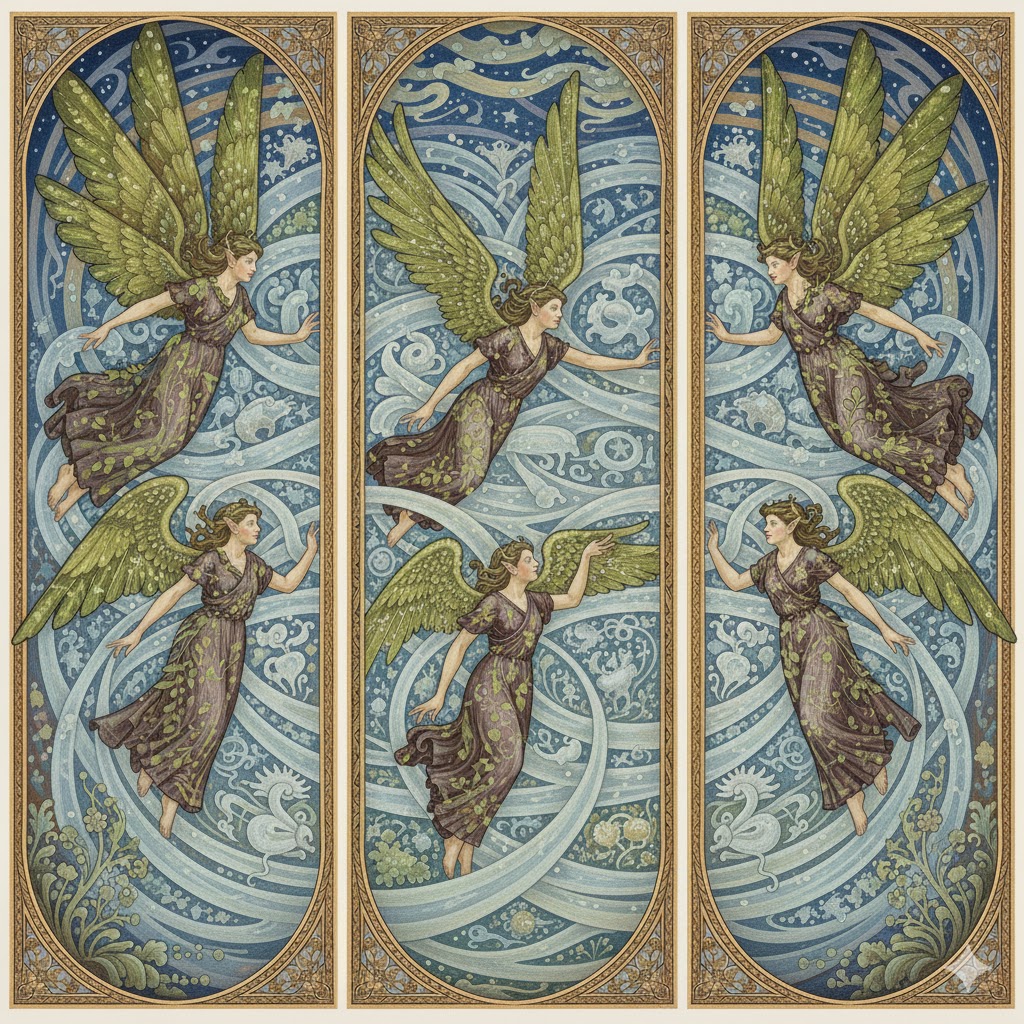
However, “between” and “beyond” these poles there is also the “field of the Alvs” — faerie flow-ness. It resembles the Dionysian in that it is likewise “nonlinear” and does not follow discrete “steps” of perception. We said that faeries perceive reality as whole and continuous; they are nonlocal, and for them information is a multidimensional “canvas.” Yet the faeries’ flowing consciousness is not a Dionysian continuum of libido; it is the flow of form as becoming, what is traditionally called “krus,” form before structure, the “inner resonance” of an object — its capacity to become itself without external pressure, but also to resist disintegration. Krus is poetic and fluid, but it does not imply excessive emotion; it is closer to the Daoist art of maintaining integrity while reality changes and “flows,” yet still remains recognizable as “the same” in its foundation.
Thus, one can say that Dionysian (Vanir) flow-ness is a flow of the content and energy of life (the experience of involvement, “symphony-like unity,” ecstasy of becoming), which at the manifest level is expressed in strong corporeality and instinct, and on the level of the psyche — as a tendency to “overflow” and engulf the mind, if there is no suitable vessel of form for this “tsunami.” The Dionysian flow strives to dissolve any boundaries, manifesting as bodily-emotional unity; it is an overwhelming and unrestrained “wave of life” in the literal sense. As immanent creative forces, the Vanir act within worlds; they bring metabolic impulses, symbiosis, “inner movements,” and — what is especially important in this conversation — a proto-magic of feeling that renders matter receptive.
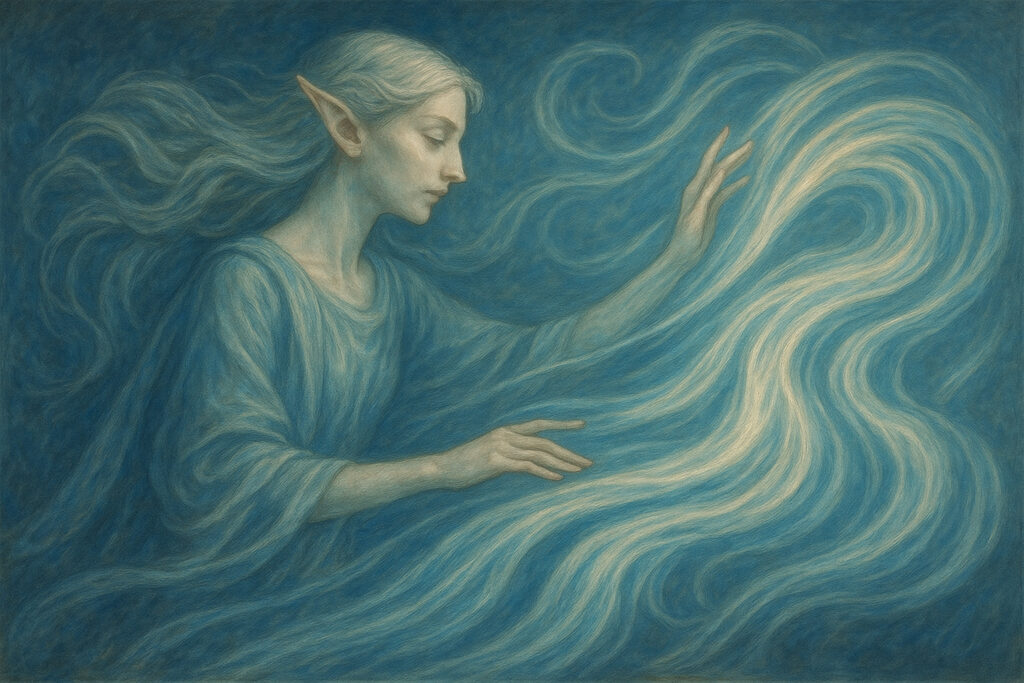
Faerie (Alvish-angelic) flow-ness, by contrast, is primarily a flow of form, the shaping of fluid reality — through krus, the ability to live in a multiplicity of variants without losing integrity across all branches of variation; in it there is less “intoxication with life,” but more precision of tone and skills of navigation through the Interval. It is a fluidity that can be a wave without falling apart into chaos, and therefore remains suitable for navigation, transitions, and preservation of self-identity.
At the same time, both Dionysian and faerie krus flows allow a person to experience the world as a living process, as an intrinsically valuable flow, rather than as a resource or an object of exploitation. Both flows by their very nature are incompatible with icy fixity: one because it is too alive and metabolic, the other because it is too fluid and nonlocal.
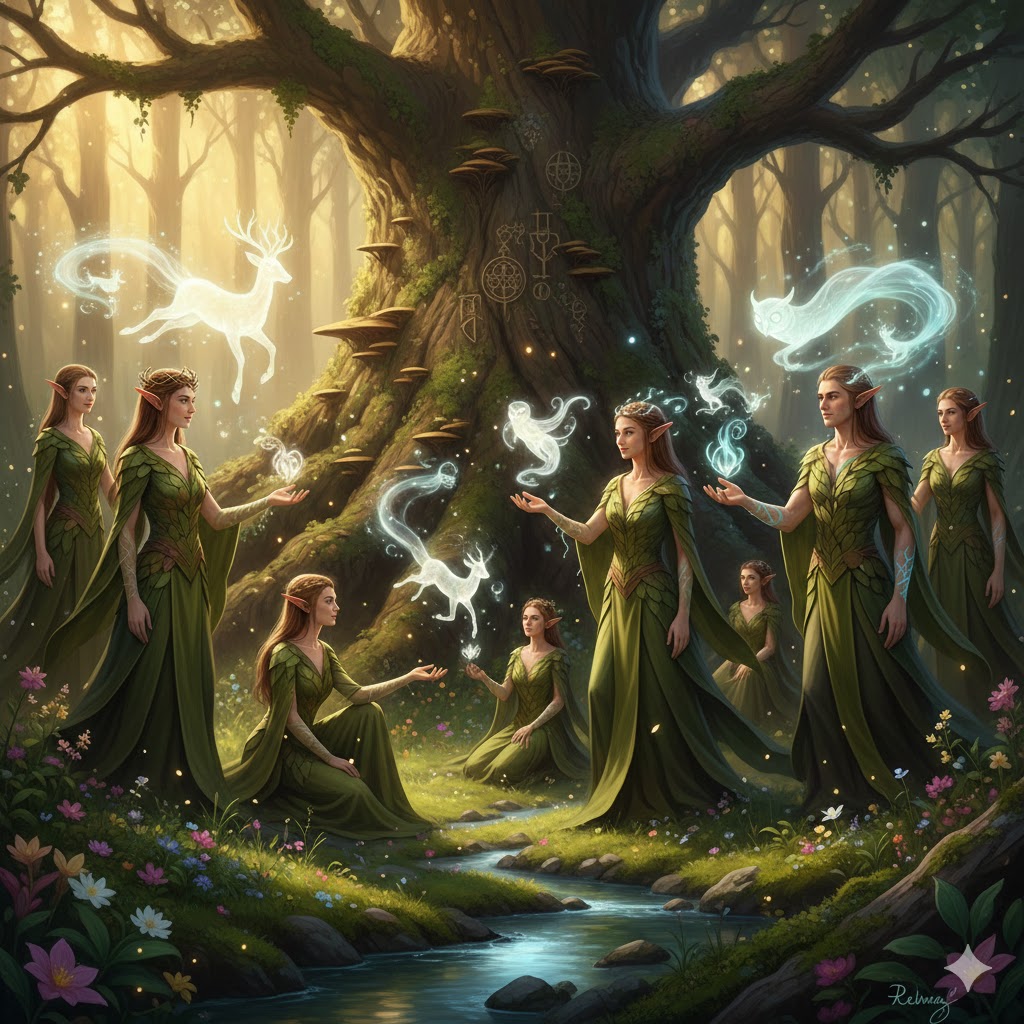
And due to such a shared “life-orientation” of both flows, in real encounters, as we already mentioned, it can be hard to tell whom you’re dealing with — with an elemental (a Vanir/spirit of place) or with a faerie. Being related and consonant, these flows easily tune to each other, and therefore faeries historically and ontologically interact extensively with the Vanir; in many landscapes they live in close connection with local spirits, so external manifestations are often indistinguishable. We already said that sometimes even hybrid and transitional forms arise, emerging from the intersection of energies: for example, satyrs as a product of the “wild fertility” of fauns combined with the fluidity of faeries and liminal warlikeness.
However, the fundamental difference still remains: an elemental is, to a significant extent, a function or organ of a natural process; it is always tied to a place and processes, whereas a faerie is a being with free will and a social nature, capable of independent choice and play, making and breaking agreements at will. Therefore it is very important not to confuse these two kinds of beings, especially in magical practice, because faeries cannot be treated as “servants of nature,” and elementals — as whimsical “magical humans”; and if faeries may take grave offense at offerings, then elementals, on the contrary, always demand “gifts.”
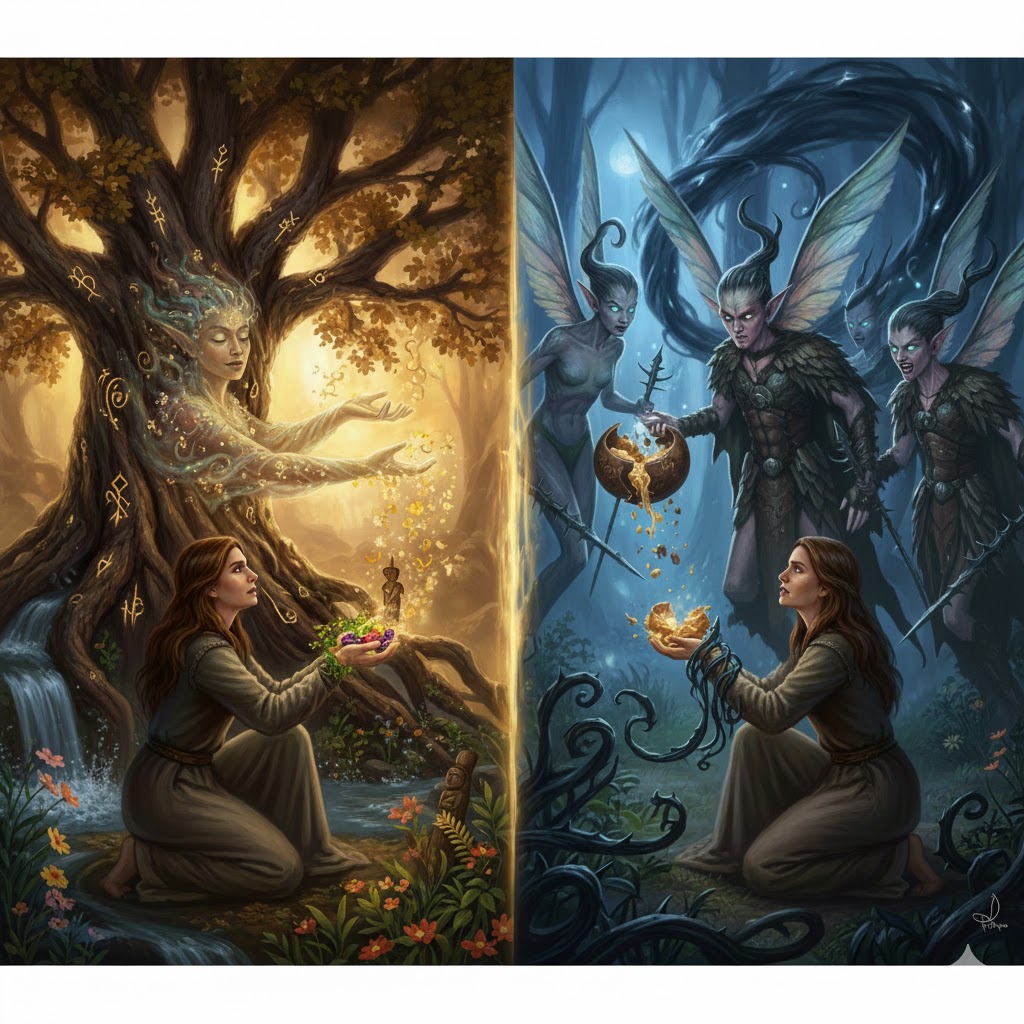
If a person interacts with elementals and the Dionysian flow, they perceive the given place as “nourishing”: one breathes more deeply there, the body warms, energy becomes smoother and more stable, and after leaving, a feeling remains of “rootedness,” a steady tone of both body and mind. If, however, there is interaction with faeries, then the place is perceived as unstable, threshold-like: the perception of time changes there, shifts in attention and strange coincidences arise, a sense of being watched and “an alien presence” develops; and after contact there arises a need to “regain one’s stability,” to return one’s stability.
Another important practical point is that, due to the human microcosm, faerie flow-ness manifests not only at the level of “physics,” but also in the psychocosmos. And alongside the Apollonian (the element of reason) and Dionysian (feelings) first principles, above their conflict, a third principle is present the Alvish structure-forming flow-ness — the ability to experience form as living and fluid, and the flow — as possessing its own inner foundation. In a human this manifests as instinct, a natural striving not to destroy the living — by analysis (logos) or by ecstasy. We already said that such striving is the ability to preserve the vessel without turning it into a cage: morphe is needed, but it must not shackle the flow; the flow is needed, but it must not dissolve the self.
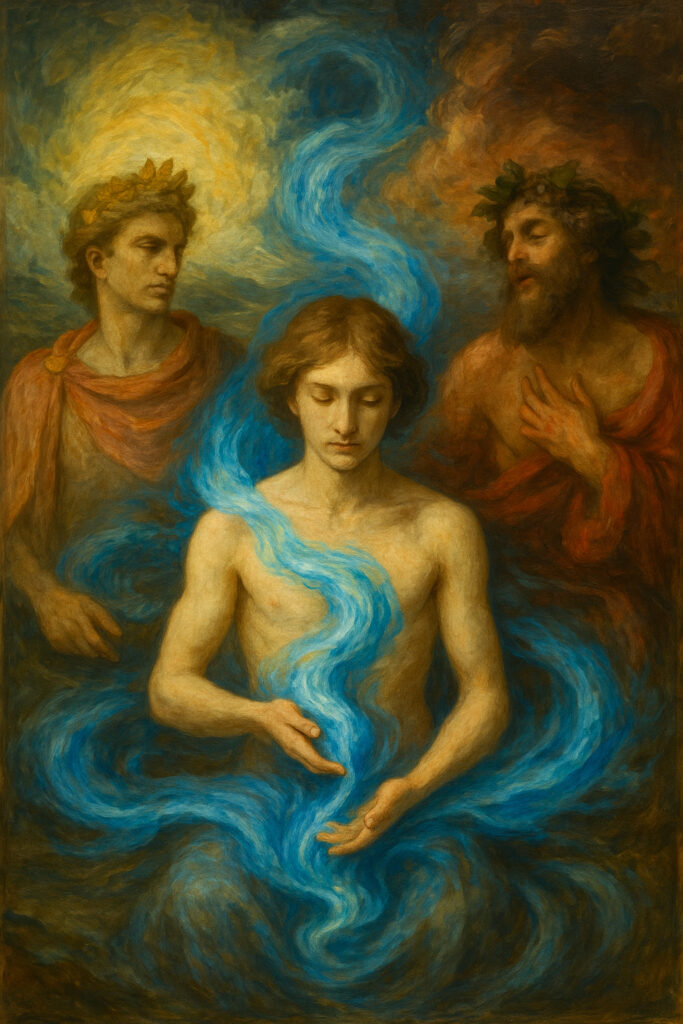
A similar integral principle on another level is the Orphic principle in nature and the psyche — the ability to connect what has been separated. The Orphic approach of “integration after dismemberment” (sparagmos) makes it possible to attain a new wholeness, to return form to the flow so that it does not crystallize, and at the same time to give life to form so that it does not dissolve. Therefore faerie flow-ness manifests as the natural Orphic quality of nature: it inherently keeps form fluid without turning it into either ice or vapor.
From a practical point of view, different courses of action can be distinguished. By activating Dionysian flow-ness in oneself or in the environment, one can restore liveliness, sensitivity, bodily resonance; at the same time it is important to remember that if this lacks moderation, the mind will be swept away. Activating faerie flow-ness will sharpen threshold perception, the play of coincidences, shifts between sleep and waking; however, if inner honesty and an anchor are not built within this, one can dissolve in too-easy changes of form. At the same time, while the Vanir flow helps one live fully, the faerie teaches one to stay on course.
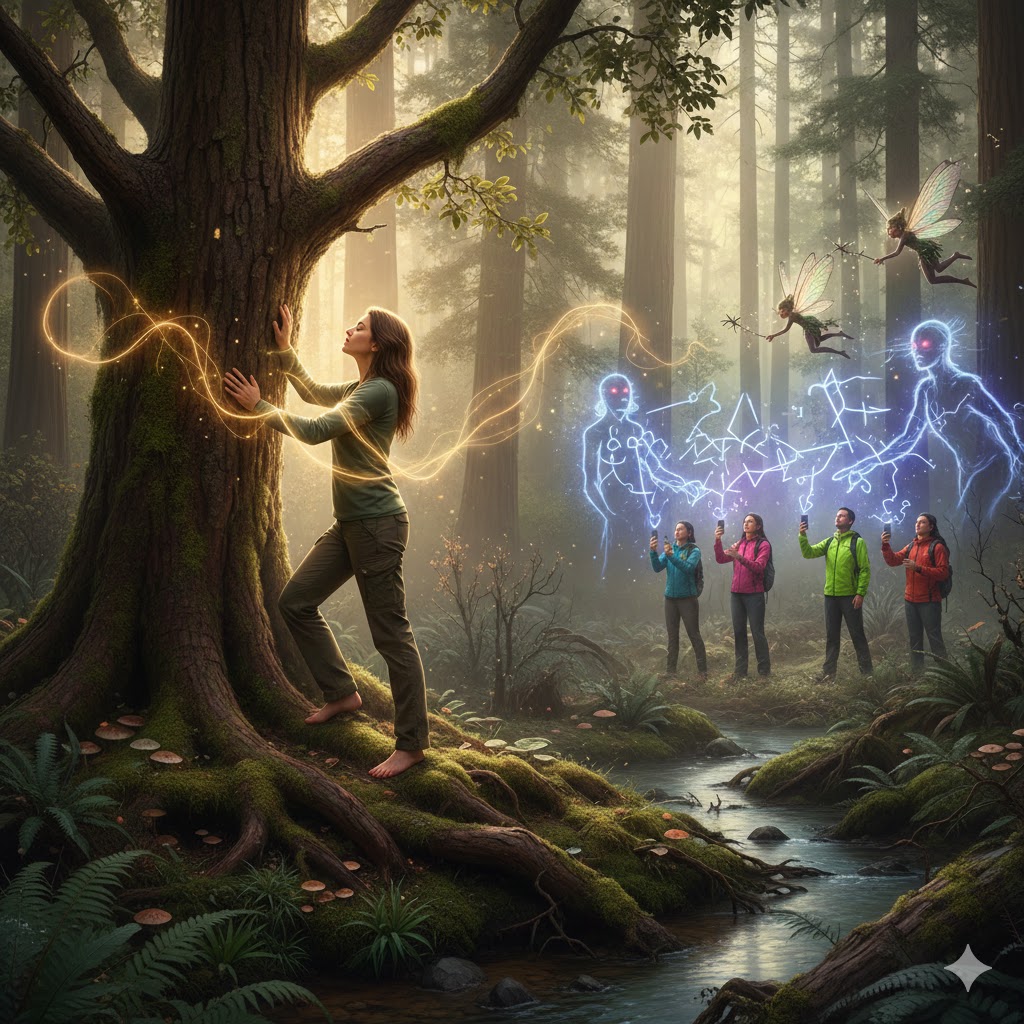
From this one can draw a practical conclusion: to restore strength and health, working with Vanir energies, corporeality, seasonality, and nature, is better suited; for carrying out transitions (crises, change of path, creative breakthroughs, navigation along probability lines) — faerie flow-ness may be more useful, which, however, is also riskier: it is easy to lose sense of measure, time, and clarity. Accordingly, the traditional approach is to cultivate Orphic wholeness — the ability to be alive (Dionysus), sober (Apollo), and fluid, like a song (faeries).
This is precisely what makes it possible to interact with nature so that it restores strength rather than depleting it under the guise of “dissolving in the flow.” At the same time, modern people often try to act like consumers everywhere, explicitly or implicitly demanding “signs,” “wisdom,” “effects,” and so on. And such an attitude can spoil both flows: the Vanir see it as parasitism, and faeries as intrusion.
Cool article. Especially the conclusion at the end. Thank you.
Hello! Thank you for the article. How should one correctly behave with the Fairies? Kindness without expectations? Why are gifts offended by them, hinting at limitations?
Hello!
The main thing that fairies expect from people is a proper understanding of their nature and respect for boundaries. Therefore, when meeting them, it is important to avoid names (both your own and the interlocutor’s), do no harm to nature, and demonstrate creativity. And fairy gifts are intolerant since they consider it ‘payment’ or ‘bribery’, and they do not tolerate market relationships, only free exchanges, so instead of gifts, a contribution to nature (clearing a stream, picking up trash, etc.) would be more valuable to them.