The Shield of David and the “Hexagram Rituals”
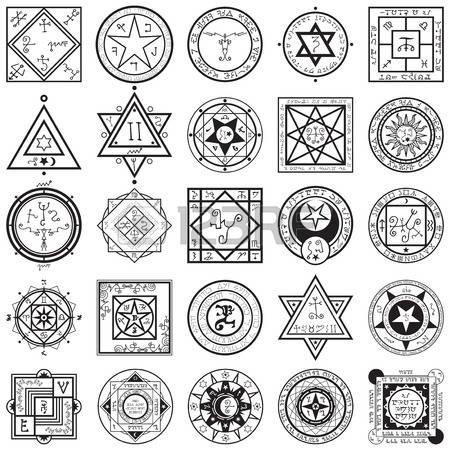
It is not hard to notice that at the base of all Rituals of Western Magic lie six basic symbols — three “nonspecific,” “auxiliary” ones: the circle, the triangle, and the square, and three “semantic,” “operative” ones: the cross, the pentagram, and the hexagram.
And while the semantic field and applications of the first group are fairly obvious — the circle delineates the “personal space“, the “Universe of the Ritual”; the triangle denotes the spirit active within it, the triune mind; and the square fixes the “manifestation,” the “materiality” of the realization toward which the Ritual is directed — the situation with the second group is more complex, especially given the diversity of the symbols used as “tools.”
Although the meanings and functions of these “operative” signs are also quite clear (the cross symbolizes the perspective of spirit upon matter, its entry into and habitation of the manifested world; the pentagram reminds us of the spirit’s capacity to transcend that matter thanks to its inherent freedom; and the hexagram asserts the binary structure of any realization), the internal nature of these symbols differs.
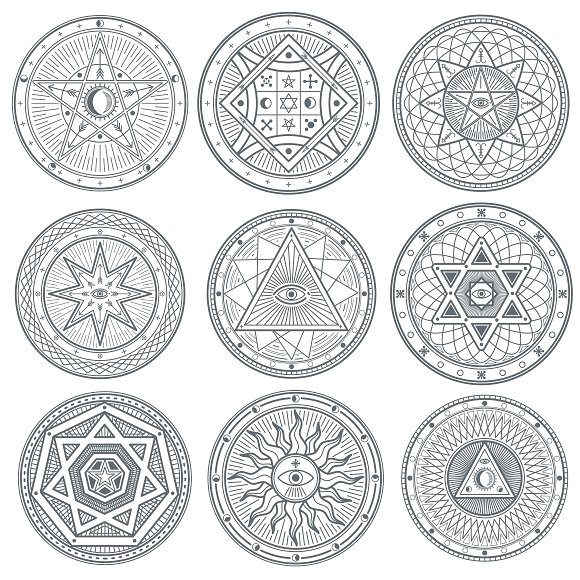
The Cross and the Pentagram are by their nature Sickles, realization symbols, possessing an “internal,” inherent activity rooted in the foundations of primordial, unmanifest consciousness. We have already mentioned that the “mechanism” of the realizational activity of the sickles consists in special graphic structures’ ability to influence the general energetic state of the Environment, “buying out,” that is — releasing into it a certain quantity of free energy, which is then used for the needs of the Ritual.
At the same time, the Hexagram itself belongs to the so-called “semantic” symbols, which do not possess realizational power without an anchor in the operator’s mind. From this it follows that the realizational power of the hexagram depends, firstly, on the degree to which the Magus understands its symbolic field and, secondly, on the strength of the Magus himself.
It is well known that historically the six-pointed star dates back to the Bronze Age across many peoples and cultures, signifying essentially the same idea: the union of two equal, yet opposite principles — spirit and matter (or mind and energy), masculine and feminine, heaven and earth, and so forth.
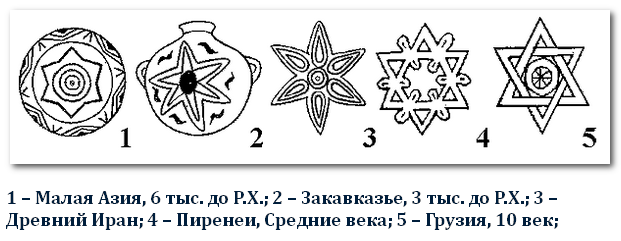
At the same time, the magical use of this symbol was almost always limited to protective functions, which is reflected in the relatively recent (appearing only from the 12th century onward) name — דָּוִד מָגֵן — Magen David, “Shield of David.” This name emphasizes the symbol’s function as a support, a “passive defensive role,” which brings the symbolic field of the hexagram closer to the Scandinavian Aegishjalmr.
Another symbolic content of the hexaculum is its magico-astrological correspondence with the seven planets (with the Sun at the center). The “planetary” symbolism of the hexagram is also widely known in various countries (in India the six-pointed star corresponds to the Heart chakra, which also has a “solar” nature, and in Kabbalah this symbol is associated with Tiferet). Such a celestial interpretation of the symbol corresponds to one section of the hexagram’s “macrocosmic” symbolism, describing the manifested cosmos as the result of the interaction of two principles (matter and energy, matter and spirit, etc.)
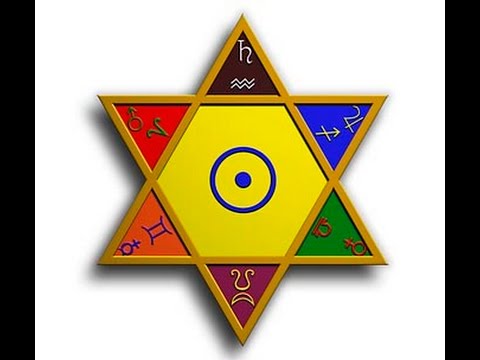
It was precisely this understanding of the symbol that prompted the Magi of the Golden Dawn to develop the so-called “Hexagram Rituals“, whose task is to activate in the operator certain planetary forces, secondary causes.
At the same time, the very first Magi who tried to use the “Hexagram Rituals” encountered obvious difficulties rooted, of course, in the lack of realizational power of the symbol itself. Not fully understanding the sources of these difficulties, the pioneering Magi assigned the use of these “Rituals” to the degree of the Lesser Adept, asserting that a prerequisite for their success was a preliminary balancing of the “four primal elements.”
To simplify this task, the last Great Magus, Aleister Crowley, devised the “unicursal” representation of the Hexagram, reducing this symbol to the activity of the Macrocosm itself, to its “self-generation” from the “seed-point”, and thereby endowing the sign with realizational power.
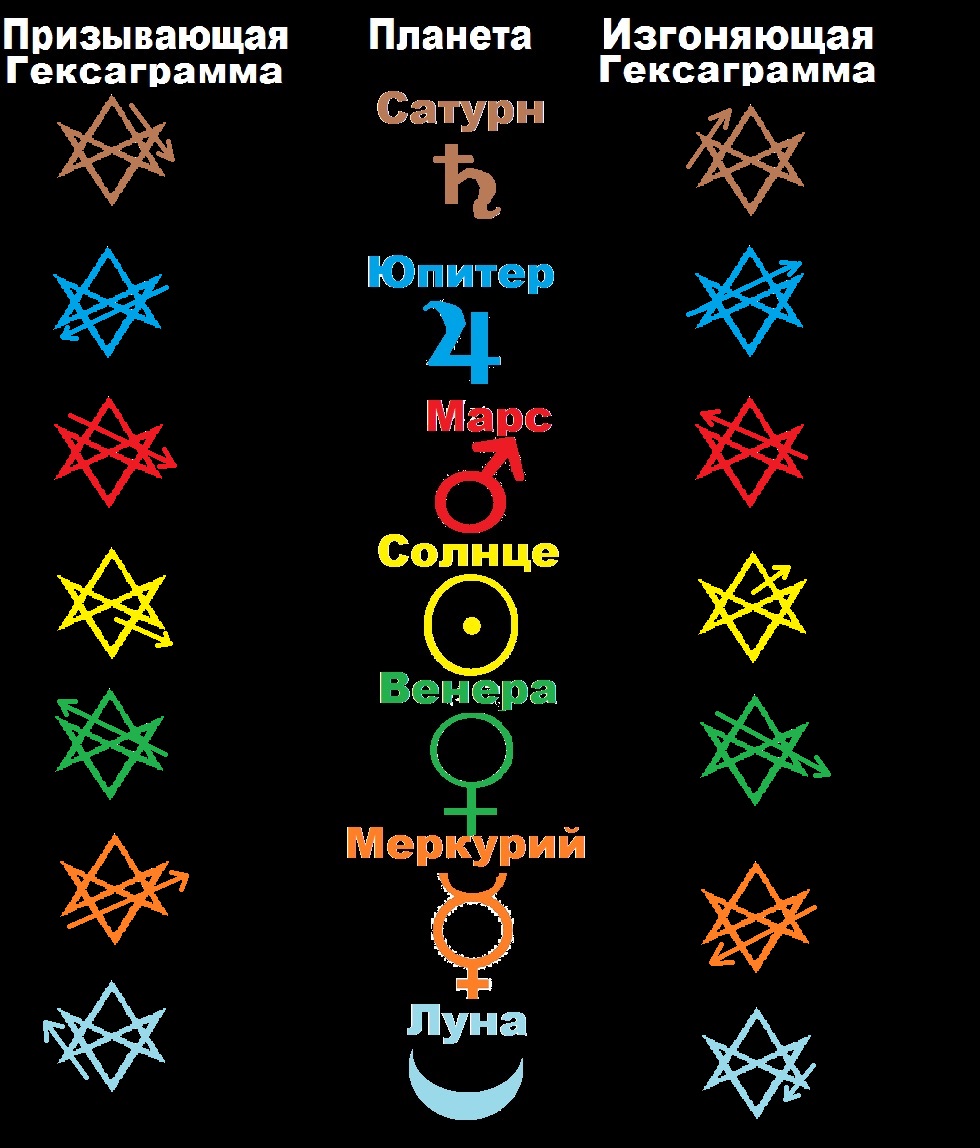
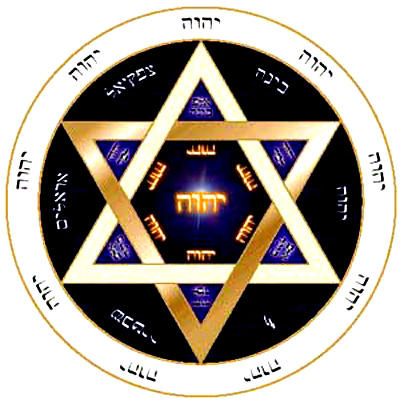
In this rendering the Hexaculum becomes not merely a “sign of the Macrocosm”; it expresses Crowley’s idea of the First Will (Desire), creating manifested reality. It is clear that this force is highly active and difficult to control, which is why today Hexagram Rituals more often employ the “ordinary,” traditional depiction of the six-pointed star, to which realizational power is given by placing within it or combining it with kabbalistic Names of the Most High.
However, in any case, unlike the Rituals of the Pentagram, using the six-pointed star as the structuring “skeleton” of a Ritual, as opposed to the hexagram’s “direct,” “shield-like defensive” application, requires much greater additional energy expenditure and is unlikely to be recommended for wide use by novices.
In general, it is necessary to remember that every element of a Ritual, whether sound, image, or gesture, must be clearly understood, its functions precisely defined and coordinated with the overall flow of the Ritual. The clearer the operator understands the role of each element of his action, the more effective the action will be, and the more successful the operator’s development.
As usual – thank you for the article!
“The hexagram itself is one of the so-called ‘meaningful’ symbols that do not possess realization power without relying on the operator’s consciousness”.
So does this mean that realization symbols have ‘their own activity’ without relying on the operator’s consciousness?
From my experience, I considered the effect of any symbol dependent on and stemming from the operator’s consciousness, rather from his unconscious (psychocosmos). A symbol simply induces some processes in the psychocosmos, and they, once initiated, influence reality by one mechanism or another. Until the Magician reaches the level of Ipsisimus, Master (in different traditions called differently) – their will needs some kind of trampoline to launch the command into the depths of their boundless Inner Strength. Such a trampoline can be various rituals, symbols, and I won’t go further than that or I might get into trouble. Reaching a certain High level – the trampoline ceases to be necessary – the Magician turns Programs of Power on and off already directly with pure Will.
But for a symbol to directly influence reality?..
I recall my first magical experiments. Of course, these were Runes. I collected all the scant information on how to select them, compose rune scripts, carve, color (yeah-yeah, with my blood) and “sanctify” ritually. I did everything according to the instructions) Naturally, there was no effect at all. Although Runes are considered realization symbols. Later I understood that everything depends not on the symbols but on the development and states of Consciousness. Everything else simply helps as long as it is needed. But I still cannot use Runes, negativity remains. So, for neophytes to just take realization symbols and think they will work like in Harry Potter – that’s unlikely, and the negativity may remain, retreating into the shadows, hindering development… I’m not talking about folk visionaries who for one reason or another can decide to enter the required states of consciousness and activate symbols with their uncontrollable superpowers. But there are not many of them.
I remember that the first clearly noticeable magical effect was given to me by sigils-galdrestafs by O.O. Spear. Thus, I still hold “fondly” toward Chaos Magic, although I have not practiced for a long time. After all, there, individual symbols are used that are entirely based on influence through the psychocosmos.
“Reality” never exists separately from consciousness, and in this sense, of course, no symbol, just like no point of support, can “act” without consciousness. However, there is a difference between universal Consciousness as such and the manifest, acting consciousness (more precisely, this difference is perceived by individual consciousness). This is one of the key aspects of the traditionally magical description of the world, differing from the widely prevalent “Jungian-magical” perspective today. Therefore, the symbols that are activated by universal Consciousness are referred to as “realizational,” while those that depend on the individual flow of consciousness are termed “meaningful.”
Yes, I finally understood. It turns out that the Universal Consciousness activates the realization symbols of all Magical traditions. After all, Runes are realization symbols of one Tradition, Fu Zhou of another Tradition, and Sunghus of a third. But then two questions arise. First. What is the (original) origin of realization symbols? Why does the Universal Consciousness activate some symbols while others can only be activated by individual consciousness? Second. Can any person use a realization symbol from any Tradition without initiation into that Tradition and still achieve an effect? That is, the main thing is for the matrix of this symbol to be “registered” in the Universal Consciousness as a realization symbol? And then, is this effect more dependent not on the initiation, but on the personal Power of the operator?
So the second question is understood as: how to increase the effectiveness of using Realization Symbols? Build personal Power and then any realization symbol can be applied as needed; search for realization symbols and traditions to which one feels an internal attraction and affinity (possibly having a reincarnational origin or distant connections through the ancestral egregore); or seek initiations?
It is possible to increase understanding of the specifics of working with sickles, and accordingly apply them where and when their influence is most relevant.
If observation that a stylized and abstracted image of the human body activates the energy of self-assertion, free will, and a similarly stylized image of sun rays dispersing in cardinal directions attracts the energy of involving consciousness in the management of matter can be considered the “original origin”, then these symbols probably “appeared” in this way: people depicted what they saw in a symbolically-abstract form, and then fixed what changes these images induce. These symbols rely on that layer of consciousness which is still undifferentiated, not expressed in specific streams and psychophysical manifestations. Of course, the graphics of the symbols matter: something in the very drawing of the Sign descends it to the very depths of the universe. Accordingly, the answer to the second question is affirmative – realization symbols “work” independently of Myth, geography, and cultural environment. It is only important to be able to see the nature of their influence, what specific energies these sickle “redeem”. Both initiation and even personal power are secondary here – they rather allow to discover and identify this influence and, if necessary, redirect it, but do not determine the very fact of this influence.
Only now did I suddenly realize that Symbols can attract energy “from the outside”, so to speak. That is, as I understand it, they are not just capable of modulating the already existing undifferentiated Life Energy in a person, replenished by food, etc., but can introduce additional quantitatively energy of a certain quality into him or into the field of his ritual. And maybe there are Symbols that will attract that very Energy that is lacking to “return home”.
I found out that I have the sickle Ψ – the Greek letter psi assigned to me. I was having a terrible energy drain. The most interesting thing is that I only discovered this sickle when I reduced the drain.
As far as I understand, the hexagram, like the number 6, has curious properties that stem from the causal origin in the evolution of basic principles of the universe.
Thus, if 5 (pentacle) symbolizes the elevation of Spirit over Matter (4 – Matter, border), then 6 indicates descent, immersion (sleep, hypnosis), a necessary measure of involution for the spiritualization of lower levels (the sediment of worlds). A side effect of involution is the emergence of fears, phobias (the 6th letter of the ogam ‘huath’) due to distanciation from the Absolute and loss of resemblance to it (5 – the center, 6 – the periphery).
A person systematically utilizes this ‘self-immersion’ during the period between embodiments (the term ‘videha’ in Hinduism – studying one’s structure and openness to structures in principle, the sleep of the monad; the 6th letter Vav – a symbol of the continuity of life; the 6th Eon ‘Life’). In such a disembodied state after death, the soul enjoys the attained state but does not develop.
Another important and widely known property of 6 is merging, creating connections (for example, hexagonal carbon lattices), equality, acceptance.
Regarding the cross, I can say that it corresponds to the number 22 – an image of projecting the vertical onto the horizontal and neutralizing contradictions between Spirit and Matter, leading to abundance. The psychic effect on consciousness is reasonable doubts in moving forward caused by the need for a more thorough analysis of one’s desires (since even in this case the Spirit is not inclined to support all impulses of the material ‘self’), plus a value transition from the material to the spiritual.