
Seal Magic
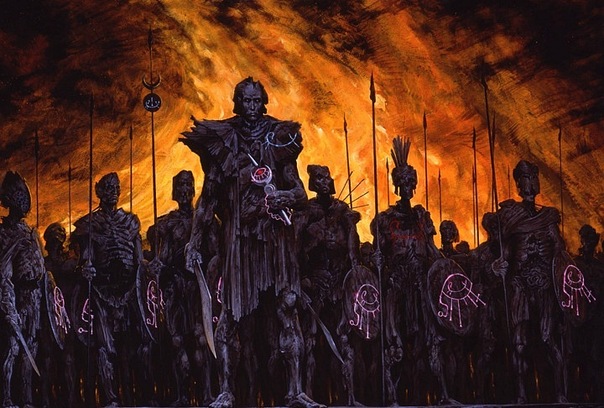
Every phenomenon of nature, every flow of Power, is formed as the consequence of a certain potential difference — that is, as a process of mutual attraction between the poles of a given binary.
Traditionally, Western Magic calls the positive pole of such a binary an Angel, and the negative — a demon. In other words, in every phenomenon, in every object of the manifested world one can discover its own “Angel” — the expansive component, the source of the manifestation of power, and its own “Demon” — the attractive component, the cause of the movement of energy.
We have also discussed that magical intervention in the energy flow of any binary can occur either as a theurgic interaction with the Angel, or a goetic one — with the demon.
Any such interaction requires the release of a certain amount of energy, since the very nature of attention requires an energy flow. In other words, to enter into interaction with an “angel” or a “demon” — that is, a ministering spirit — it is necessary to free up part of the energy that this spirit normally expends on its “usual” tasks. For ordinarily a ministering spirit uses all its available resources on carrying out its direct “work,” and simply has no free channels through which one could make contact with it.
The most effective means of such “release,” or, as they say, the “buying‑out” of energy, is the use of the Seal or Sigilla of the corresponding spirit.
Being constructed as a sign of power, the Seal (By “Seal” the Myth we are considering means a “bridled” sigil, is — a Sigilla to which a controlling will has been applied) precisely extracts part of the energy from the world’s system of interactions and thus opens the possibility for the application of the operator’s will to the vortex of the ministering spirit.
In fact, the basis of the Seals’ action is that they are psychocosmic counterparts of macrocosmic forces — the Spirits. Just as the Names of the Most High used in Magic and religion are psychocosmic reflections of the original creative emanations, Seals are creative agencies of the operator’s personal will. Put differently: by creating or simply using a Seal, the Magus asserts the authority of his will over the Sigilla in the Psychocosmos and, by the law of Analogies, correspondingly — over the vortex in the Macrocosmos. In doing so, the Magus gains the possibility of a creative influence on the flow of energy in the relevant binary, and thus the possibility of aligning reality with his will. Like any graphic object, the design of a Seal contains many nuances; altering them permits one to change, to a greater or lesser degree, the nature of the Seal’s eventual effect. Thus, to use a Seal as effectively as possible, one must first understand as clearly as possible the meaning of its elements, and second, find that proportion of those elements which will bring the Seal’s power into best alignment with the operator’s personal power. In this respect Seal Magic is in fact very similar to one branch of Galdr — the art of weaving Runes and creating galdrastafs on their basis. One could even say that these are simply different expressions of the same understanding, developed, respectively, in the Near East and in Northern Europe. The only difference lies in the set of elements used — most Sigilla are built upon proto‑Phoenician — “Enochian” — symbols, while galdrastafs have a Runic basis. In any case, the successful use of graphic sigils that allow the release of the energy necessary for a Ritual requires the Magus to have a clear understanding both of the nature of that sigil’s action and of its individual elements. Accordingly, simply copying book illustrations, as well as thoughtless tinkering with Sigilla elements, can have the most unexpected and unpleasant consequences.
Why do you call proto-Phoenician symbols Enochian? They are quite different.
Moreover, many seals consist of combinations of simple symbols such as cross, oval, rectangle, etc. Are such seals universal? Should it follow from your reasoning about realization symbols that these seals can behave differently, depending on the operator’s affiliation with a particular tradition?
In spirit, the ‘Enochian’ alphabet, in the form in which it is presented by Dr. Dee, is largely a stylized and somewhat modified Middle Eastern alphabet. Or, to be more precise, they originate from a common source, which, however, is not significant in the context of this conversation. And, of course, the Sigils and Seals, besides these symbols, also include a set of other signs – pentagrams and hexagrams, crosses, circles, and generally intersecting lines. Likewise, the Galdrafstaves can be supplemented with non-alphabetic runic signs. The idea is that a specific combination of elementary (letter-based, expressing a simple intersection of a certain flow or vector of Power) and complex (expressing a whole composite idea) symbols forms a certain structure in the Psychocosmos, just as in the Macrocosmos a vortex is formed from its constituent elements. The clearer the correspondence of the elements of the vortex to the elements of the Sign, the fuller the analogy, and, accordingly, the higher the realization power of the Sigil.
Regarding the individual action of the Seals – unlike the Galdrafstaves, interpersonal variations in the use of the Seals concern not so much the direction of their action (as the vortex structure is more stable in relation to small fluctuations than the vector one), as the intensity, effectiveness of that action. In other words, if the same Galdrafstave can have a completely different effect for different people, then the Seal will act approximately the same way, but with varying effectiveness.
Enmerkar, in the post about Enochian magic (https://en.enmerkar.com/myth/dzhon-di-i-magiya-angelov) you write the following: “Another point that supports the stated assumption is the ‘enochian language.’ All goetic spells are composed in human languages, which means languages suitable for describing the human world. ‘Enochian’ Calls, however, are composed in ‘angelic,’ foreign to humans, language, suitable for describing another world, finding a foothold there and external to the operator. That is, unlike traditional goetic evocations, in which the spirit speaks in a language understandable to humans, in the ‘enochian’ ritual, it is the human who speaks in a language understood by the spirit.” You also state that the Enochian language belongs to human language and in particular to proto-Phoenician. Could you clarify this point in more detail?
Isn’t it strange that by increasing awareness we generate a demon within ourselves? After all, the demon must be stronger than all parasites if success is needed.
By developing awareness, a being becomes more ‘attractive’ to predators, as they begin to operate with larger volumes of energy. Therefore, the stronger one is, the more enemies they have.
I do not entirely agree with the applicability of the term ‘Theurgy’ to work with Angels. Theurgy is an invocative interaction with Gods, while Angels, just like Demons for a Magician, are objects of conjuration but not Invocation.
Theurgy is the management of forming forces. In the situation of Hellenistic Egypt, where this term arose, there was no clear understanding that such forces are divided into two groups – free (gods) and servile (angels). So, magical influence on angelic flows can be both theurgical (invocational) and goetic (evocational). However, in practice, evocation and conjuration of angels are much more complex and dangerous than those concerning demons. Therefore, in reality, a large number of ritual schemes are limited precisely to invoking angelic forces, which in its ideology is theurgical.
In this case, if we analyze the most classic and basic of all rituals of the Western Tradition, the ritual that most practitioners of the Western Tradition start with these days – the Lesser Ritual of the Pentagram, where should we place its scheme in the part where it proclaims: ‘Before me – Raphael, etc.’ – as summoning or evocation? I remember you once said that in the LRP, Archangels are indeed conjured by Divine Names. Moreover, the Archangels appear outside the Circle, which is more characteristic of conjuration rather than summoning. In summoning, after all, the entity is invited into the Circle, as if to guests, and ideally, there should be a temporary possession of the Magician’s consciousness by this entity (as in the invocation of Thoth from the Book of Israfel).
Correct. In the LRP, Angels are conjured, but not evoked, as, by the same token, they are not summoned. In this case, there is actually no talk of interacting with the spirits themselves; the operation is carried out with their resolutes.
You spoke of the necessity to prepare a vessel, and that awareness will come by itself. The vessel is the same attractive force; it is also a demon. Am I wrong?
You are mistaken. The vessel is not a demon. A demon is the absolutized desire of the vessel to receive.
What should the work with entities of this kind, such as those entities mentioned in the ‘Arbatel’, be like? For instance, is a Triangle necessary in such work, or do the same rules apply to these entities as in working with Angels? (That is, evocation into a Triangle here is extremely undesirable.)
And what approach should be taken when working with entities of such intermediate character as Geniuses? Once we invoked Iophiel, the Genius of Jupiter. We did not create a Triangle. For contact, we used a sphere placed on the Altar. The visionary received certain visions. According to him, he contacted an entity that figuratively stated that we did not address the proper place. We interpreted its response as meaning that the goals for which we conducted the operation were too materialistic (and indeed they were) for this entity. ‘Where there is Earth – there is no me’ – such was the answer.
Some of my acquaintances used a Triangle (with a medium in it – generally risky) when invoking the Elders of the Earth Tablet (Enochian), corresponding to the Planets. Is the application of the Triangle correct in this case?
Enmerkar, you said that “a demon is an absolutized desire of a vessel to receive.” Does this mean that an angel is an absolutized desire of a vessel to give? And does the interaction of these aspects determine the quality of the vessel itself and its readiness to be filled? And can it be said that, for instance, the free goddess Ishtar is a combination of such binary desires, while Astaroth is an expression of her desire only to receive? Provided that, in general, the goddess can be considered a vessel?
“Angel” and “demon” do not constitute a full binary, I have already written about this. Rather, they are two sides of the same coin. If considered in the current context, an angel is an absolutized desire of a vessel not to lose, which manifests as an obstacle to any flow of power through the boundary of the vessel.
Thank you for the answer. And thank you for sharing Knowledge with those around you. You have an amazing ability to “translate” the complex language of the Universe into simple human terms. What you do is very important.
Enmerkar, what can follow after the removal of the Seal? Is this even possible? Who can remove the seal – only the one who imposed it or not? And what can guide someone who advises to break the Seal?
Proto-Phoenician (Proto-Canaanite) language is the first known example of an ‘inter-world’ way of communication. Even in ancient times, a system of ‘mutual recognition’ of ancient Semitic and ‘inter-world’ writing was formed, and Proto-Canaanite symbols were used to record the ‘Enochian’ language. It is not precisely known whether the inhabitants of the Interspace used the writing of the ancient Semites to record their language or whether the inhabitants of the Middle East ‘peeked’ at the sigillaries and ‘overheard’ the vocals of the Grey spirits, but it is this language that became common (hence the sacralization of later Semitic languages – Aramaic and Hebrew). Throughout the development of civilization, medieval Latin has repeated this path, becoming yet another language of ‘inter-world’ communication.