
Inscriptions and Images
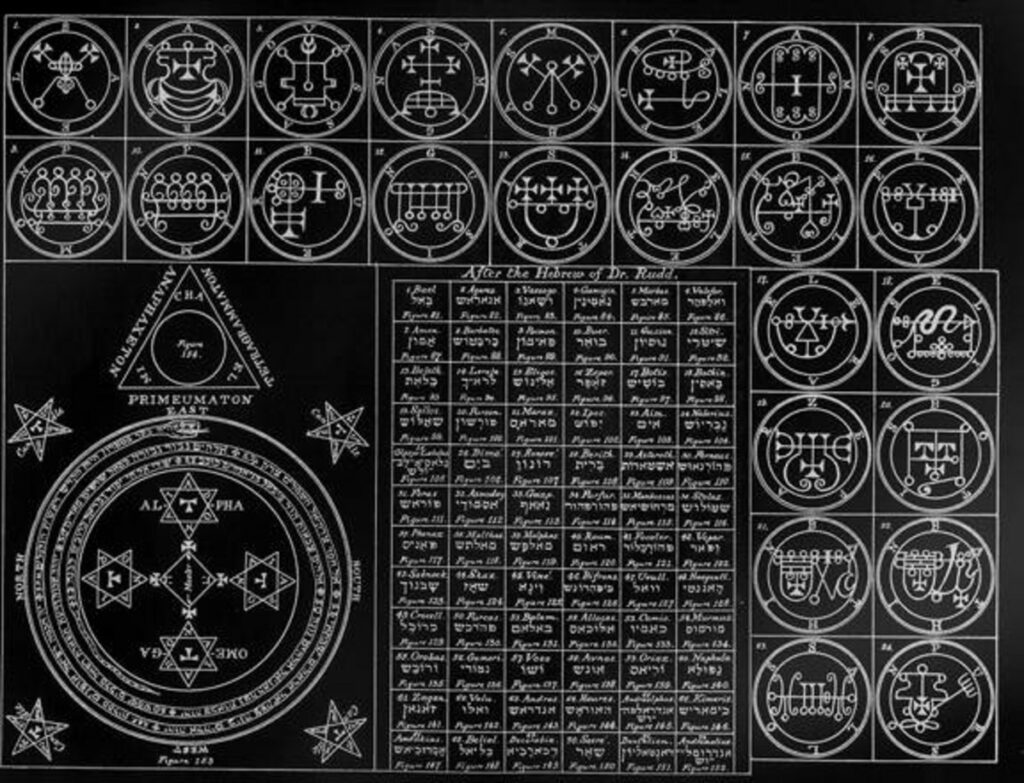
As we recently discussed, any sigil, a vortex-like depiction of an act of will, can be considered on two levels: as an inscription and as an image.
These two aspects are interdependent and complementary, and therefore, when composing or reading a sigil, both must be taken into account. In other words, the text, the “motto” (Lat. motto, Heb. “sisma”, סיסמה), encoded within the sigil, must match its visual form, and vice versa: the sigil’s overall design must support and affirm the sisma.
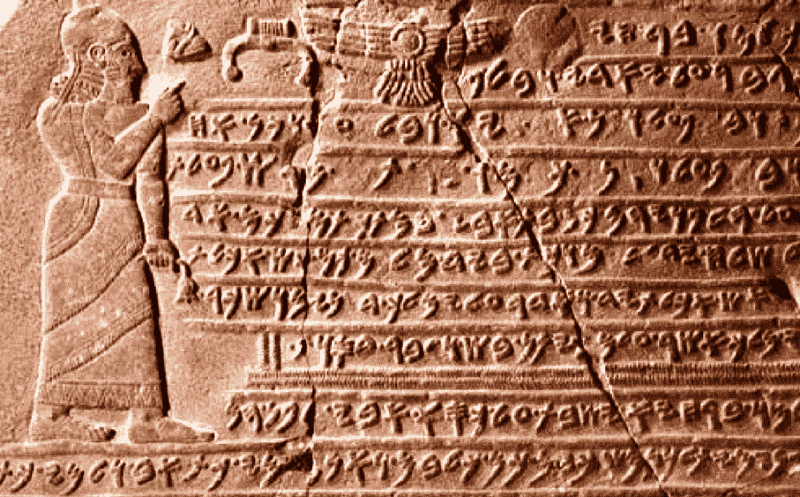
In the course of discussing the forms of the sigils of Goetic spirits, which we presented in our book “New Lemegeton, Volume 3”, we focused on the overall image, the general impression that the sigil and the Seal that restrains it carry. At the same time, examining the peculiarities of manifestation of a particular destructor, diagnostic and therapeutic needs may require a more thorough examination, a search for individual components and semantic units contained in the sigil and reflecting anatomical features of the corresponding vortex.
For this, we will need knowledge of three levels (the Phoenician alphabet, the principles of sigil heraldry, and the meaning of individual semantic and functional symbols included in the sigil), as well as, of course, magical intuition and inspiration.
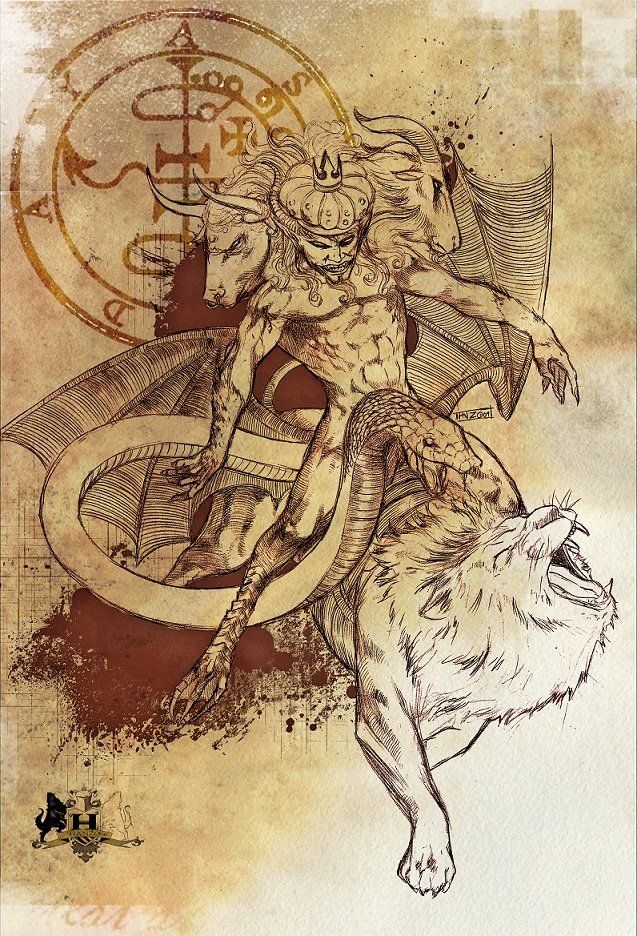
In the ideal case, of course, one should verify the results each time of one’s research in practice — in a Goetic Ritual, by directly questioning the spirit; however, with sufficient experience, the skill in correct interpretation is usually well developed.
Consider as an example the sigil of Asmodeus — one of the invincible Goetic Kings. We found that the sigil’s design is based on the image of a serpent entwining the Tree — the first tempter and false god.
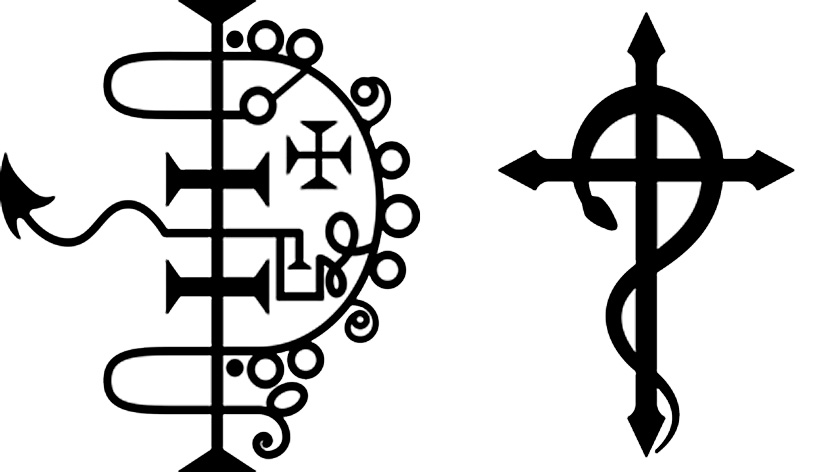
Indeed, this image is perfectly suited to conveying the general impression of the the Possessive King, and the abundance of crosses in the sigil points to significant material activity by the demon. In addition, the overall structure of the crescent moon suggests duality, the separateness underlying his power, and the central axis symbolizes the egoism he instills. Two crossbars on the central axis are the two basic illusions by which Asmodeus disrupts the natural flow of force: the idea of “rationality” (in the realm of the mind, “life taught me to be a predator; if I do not consume — they will consume me”), and “the fear of the heart” (in the realm of feelings, fear of losing control). The third cross, lying “to the side” of the central axis, is that very “reliance on material things”, “common sense”, which leads away from the sense of unity, hollowed out by Asmodeus.
Reading the text written in the sigil reveals the word “לנפל” (lamed-nun-pe-lamed), “stillborn”, “fallen”, which, of course, can be regarded as one of the names of the Demon. Thus we obtain the epithet “Nefel”, showing effective as a form of address to the demon in the Ritual, and imbued with nominative energy.
Thus, the sigil clearly and comprehensively describes the vortex of the King of Cold Hearts, demanding worship, instilling grandeur and a need for recognition, making one dependent on an image and instilling fear of genuine emotion.
The skill of comprehensive analysis of symbols and signs associated with energetic manifestations is one of the most important skills and one of the foundations of a Magus’s effectiveness, and therefore one should spare no time or effort to master it.
Leave a Reply