The Problem of the Moon
Since ancient times the Moon has evoked highly ambivalent feelings and attitudes in people: it inspires and moves some, oppresses others, and destabilizes everyone to some degree.
Scientists and philosophers, each from their own standpoint, have tried to explain this evident influence — whether by the effect of gravity on the body’s waters, by the polarization of reflected light, or by the psychological impact of night and mystery. Magi, of course, have developed their own view of the matter — less hypothetical and more practical.
We will not dwell here on the well-known matters regarding the influence of the Moon’s phase or its position in the zodiac on the advisability of conducting magical operations. Let us speak of another thing — the Moon’s power itself.
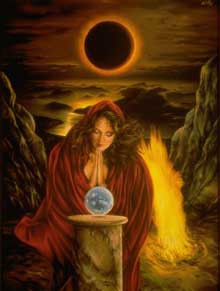
Treating the Moon as a source of a particular kind of power, Magic does not ask whether that Power is carried by gravity or by the Moon’s light; it deals directly with the Power itself, its source and its effect on the mind.
Like any source of Power perceived by the mind as external to it, the Moon, from the standpoint of Magic, has two hypostases — the White (Tanit) and the Dark (Lilith). It is clear that both hypostases are feminine, as is the Moon’s physical aspect — passive — merely reflecting the Sun’s light. As mentioned, the divine feminine triad is presented as a lunar triad. The waxing Moon symbolizes the Maiden, the Muse, birth; she is young, free, belonging to no man. The full Moon is the flowering of female beauty and Power; it is a symbol of carnal love and motherhood; a woman in this phase is either a wife, like Isis, or a treacherous seductress, like Circe. The waning Moon, the crone — she is the witch, the keeper of the secrets of death, a destroyer, but also a mother of mysteries, like Hecate.
But nothing is more contradictory than the Moon. She does not merely transmit the Power of the Great Mother; she transforms that Power, sometimes into its opposite.
It is precisely the extraordinary intensity and importance of the Moon’s effect on the mind that takes this factor beyond ordinary dual femininity, adding a masculine active principle to its influence.
The ancient Sumerians considered the Moon a more fundamental source of existence than the Sun, and the Moon god Nanna (Sin) was regarded as the father of Utu (Shamash) — the sun god — and of Inanna (Ishtar) — the goddess of generation, love and death. Sin’s popularity throughout Mesopotamian history is attested by the many personal names that include his name. The chief center of Sin’s cult was the city of Ur. Nanna was the firstborn of Enlil and Ninlil. He was born in the underworld and then rose to the sky. Only at the new Moon does he descend to the underworld.
A similar situation applies with the lunar hypostasis of Veles — he belongs simultaneously to two worlds, separating them while also ensuring their unity.
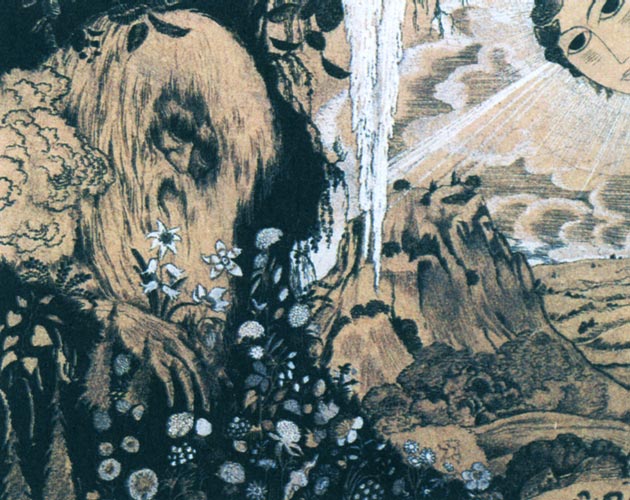
And here lies the key to understanding the magical attitude toward the Moon — although she dwells in the sky (in the “upper” world), she was born in the nether depths, the depths of death. Incidentally, it is precisely in this way that the Moon has at all times been considered conducive to dreams, divination and prophecy (and to “sleepwalking”) — by crossing the threshold between life and death herself, she helps the mind to do the same.
According to tradition, Gabriel — the Moon’s Angel — destroyed Sodom and revealed the Quran; he also joined Adam and Eve in marriage.
However, this masculine hypostasis of the Moon has always faded before the power of her attractiveness — even in Sumer the power of Inanna affected people far more than that of her father. And over time the situation worsened — the Moon brought increasing turmoil and fewer revelations. By the time of the Greeks, Selene was identified with Artemis and Hecate (which is why incantations were addressed to her when one wished to attract a beloved). Even then it was observed that sorcerous manipulations were especially effective in Selene’s full radiance, i.e., at the full moon.
People often say that the Moon controls the emotional sphere, and to some extent, this is true. But this control occurs simply because Selene weakens the mind’s control, and emotions gain greater freedom. She can link a person’s physical world with the world of their illusions.
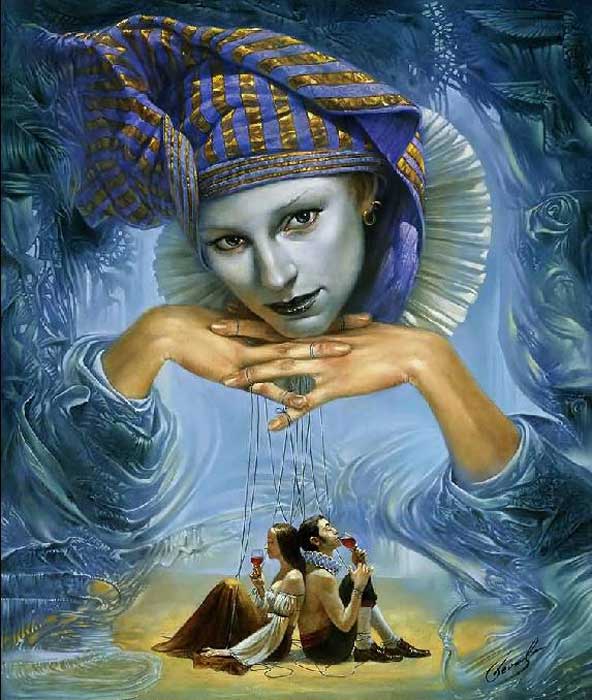
By joining life and death, the Moon often mixes them, creating strange and dangerous hybrids — no wonder vampires and other undead so love moonlight.
The Moon’s influence is especially strong in crowds and masses — like the sea, it plays upon the collective mind, tossing it from side to side.
At the same time, this influence is characteristic of both the White Moon and the Dark Moon. Only the White Moon casts the mind into the whirlpool of productive feelings, while the Dark — into the whirlpool of destructive feelings. But in any case she deprives the mind of stability, focus and sobriety.
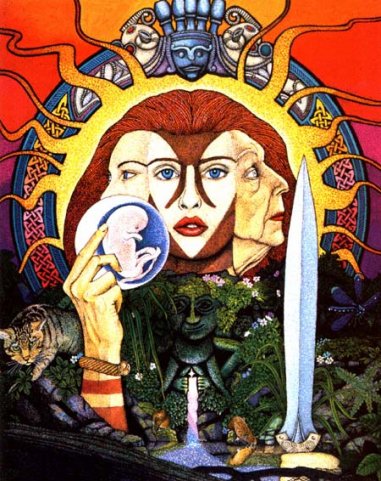
In Astrology, the Moon, Selene, and Lilith are three different planets, i.e. their energy is physically located in different places in the World. Regarding Lilith, it can be said that she tests us with extremes… she can cause severe illnesses, but she can also help, because she, despite her appearance, is a woman, and one can try to negotiate with her.
But I said nothing about astrology. And the idea that one can “negotiate” with Lilith can be very, very costly. More than one person has fallen into this trap…
But a magician is no longer a human:)) And one who has seen Lilith will not deceive themselves with illusions about the ease and profitability of agreements with such Forces… I mean that interacting with different Forces implies not only struggle…
It is indeed so, but in the specific case of Lilith (not just with the Black Moon, but with the Black Mother herself), the less one interacts with her, the better. Especially for a magician.
I agree 100% – I couldn’t watch for long, just 10-15 seconds was enough:)))) Although sometimes I still made contact, but the sensations and image are always the same… therefore, not recommended for general use:)) As for Selene, I probably don’t seek easy paths:)))
Enmerkar, is the productivity of feelings determined by Selene, or does the person themselves make them productive? I’m not being difficult, I’m just interested in your experience.
Of course, “productivity” depends on the person themselves. But Selene still contributes to changing this productivity, complicating control.
Enmerkar, can you please tell me if the influence of the Moon’s phases on a Magical operation is really critical and fundamental? For example, if a life situation requires the creation of a talisman, and the Moon is waning, will this not lead to an opposite effect of such a talisman?
It all depends on Power and Authority. If they are enough to overcome natural currents, time and other factors can be neglected.