Runes as a Support for Intention
The most important distinguishing feature of the Runes as a tool for realization is their close connection with the energy of the eril who carves them.
In other words, one may assert that the Runes are among magic’s most personal symbols.
Being vector entities, the Runes gain concrete manifesting power whenever and to the extent that they resonate with the flows of intention generated by the eril’s will.
As mentioned repeatedly, this very feature requires, to use Runes, a clear understanding of the nature of the vectors they symbolize.
This means that the “external” manifestation of the Runes’ power appears only to the extent that their vectors are reflected in the mind. From this, in turn, it follows that the application of the Runes must be preceded by lengthy, serious work to identify the psychocosmic correspondences of their flows.
At the same time, among contemporary connoisseurs and enthusiasts of the Runes, a “practical” approach to their vectors is common. That is, if, for example, Sigrdrifa recommends carving Nauthiz to prevent deception, then one should do exactly that, “without bothering” to try to understand why Nauthiz produces this effect. Such an approach is not only “ideologically” unmagical; it is also ineffective precisely because of the personal nature of Runic power.
At the same time, consideration of the nature of Nauthiz‘s flow, even without the “Words of Sigrdrifa,” leads to the same conclusion: this Rune’s field includes inertia, resistance to change, and therefore it helps return objects to their “original” state, removing, for example, changes caused by falsehood, or, as in the well-known story, preventing the eril’s poisoning.
Similarly, the Rune Jera provides fertility but also removes travel obstacles, and Sowilo can cleanse an object. Understanding these less obvious areas of Runic application requires not only inspiration but also intellectual effort and intense feeling aimed at bringing the mind into the semantic field of each Rune, of the Futhark as a whole, as well as non-alphabetic Runes and Runic symbols.
At the same time, let us stress again that the active principle in all these cases is precisely the will of the eril, and the Runes merely provide support for the will’s intent in the form of corresponding vector tensions in the world’s flow of power. Accordingly, understanding Runic flows is primarily necessary in order to choose the right supporting vector as accurately and correctly as possible, and thus to bring it about effectively and harmoniously.
The same can be said about other realization symbols.
Yes, but not entirely. For example, a pentagram will act uniformly for everyone, a hexagram will also carry approximately even semantic load, but the section, say, of Fehu will have a strong individual coloring: for one, it will mean – gold, income, for another – the necessity of care, for a third – primary creative fire.
In one of your articles, you wrote about signs that influence reality, runes, the pentagram, etc., and you say that the Christian cross is also such a sign. What influence does it have, in your opinion? Thank you.
The cross is a sign of power over matter, symbolizing its movement and development. Therefore, its areas of application are reduced to the harmonization of matter at its dense level.
Is there any Russian word that can express the essence of the Fehu rune, for example? I can’t generalize and understand what vector gives so many realizations.
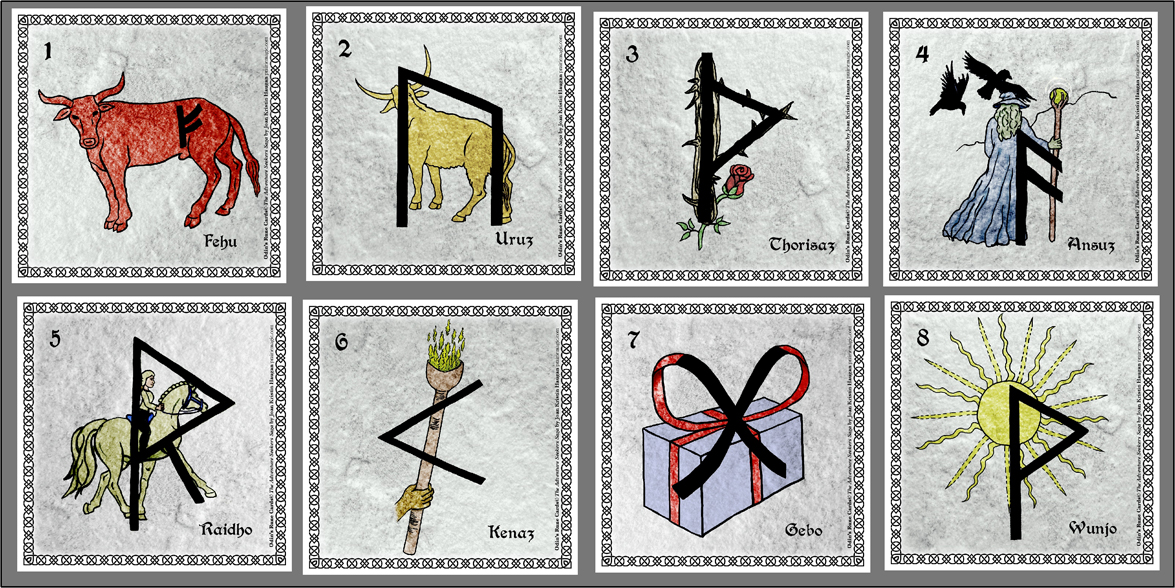
Of course, there is – that word is the name of the rune – ‘Skot’. However, to understand its semantic load, one needs to know well what the ancient Normans put into this concept. Knowledge of the cultural environment in which the Myth is formalized is essential for understanding the cognitive system in which this Myth found its expression. Only by understanding how the Scandinavians saw the world can one adequately interpret the names of the Runes given by them. Otherwise, one will have to rely solely on intuition and inspiration, discarding all traditional descriptions, as one cannot approach a Myth created in one cognitive system with another. In the case of Fehu, it refers to the materializing power that translates specific objects (the birth of a calf, etc., earning or conquering gold) across the Boundary; accordingly, this power can both change material wealth – both towards improvement and loss (cattle require care) – and be used on its own – in the form of Primordial Fire.
Thank you very much for the explanation. I use a different tradition, but the principle of the influence of symbols on matter through consciousness has become clear to me… 🙂 When searching for the necessary flow, can one rely on the associative row?
I don’t even know what to say… the day before, I had a dream about drawing runes on an old stone in the twilight, the last of the three runes was Sol (Sowelu)… Is it worth mentioning the others?
Thank you for your answer. Please clarify, did you write about the Christian cross? After all, it is not harmonious, but elongated upwards, and often has the symbol of a crucified body…
That is, does such a cross harmonize matter?
You also wrote that a straight pentagram (like the star of the USSR) is a symbol of protection against evil spirits. I have come across an interpretation that the pentagram symbolizes spiritual subordination of a person’s spiritual forces to those who apply this pentagram.
I am genuinely interested in and, if possible, engage with symbols; I understand that I cannot check everything through my experience, and since your point of view differs from what I already know, I would really like to understand it.
Thank you.
I am extremely grateful for the description of the rune of the cross. The thing is, I have it on my body, it appeared many years ago in the area of the solar plexus. And just literally 3 weeks ago, there is the rune Isah on my left hand. I don’t even know what to think anymore. Who is marking me with such things? That’s how things are.
2 svetlana: Tell us, if it’s not a secret, how the drawing is presented. Redness? Scratches? White lines on the skin?