Nine Staves of Odin
Fragmentation of the Flow of Power into separate streams of energy has many important consequences.
And one of the most important consequences for Magic is the concept of Power’s direction, regardless of its form – as a vortex or as a vector.
Moreover, thanks to this differentiation it becomes possible to create a variety of energy blocks, that is, the perception of worlds and objects within them.
However, for the Magus direct perception of energies is also of considerable importance; although it does not by itself lead to an expansion of the mind, it does enable the development of effective strategies for that expansion.
One such strategy, born of the immediate vision of the Flow of Power, was the use of Runic symbols. As among the most effective operative signs available for use for the human mind, Runes and related signs are precisely a graphic reflection of the basic streams of energy, the perception of which shapes the field of human consciousness.
In fact, not only rows of runic symbols but many sigils and other practical signs are constructed on this principle. People long ago noticed that certain combinations of lines intersecting at angles, when they come into contact with a perceiving mind, provoke profound rearrangements in both the psyche and the macrocosm. And the ability to find and compose such graphic pentacles was the sacred art of ancient erils.
And the so-called “Runic matrix”, as the result of divine inspiration, proved a magnificent fruit of such inquiries. Odin, the Great Aesir, god of mind, brought into the worlds an algorithm for creating effective signs suitable both for divination and for manifestation, and with a wide range of possibilities. One can argue at length how traditional the scheme of this “matrix” itself is, how much Scandinavian or insular erils were involved in its final formal consolidation, but its supreme effectiveness is absolutely clear — not only as a convenient tool for understanding relationships among the Runes, but also as a broad field for developing inspiration and manifesting power. Therefore, taking practical significance as the measure of value, one can confidently assert the full correspondence of the idea of the “matrix” to the spirit of the Runic myth.
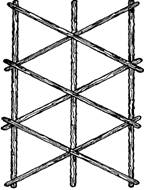
At the same time the idea of the “matrix” is extremely simple: three vertical streams, “columns”, forming the first balanced system — separating and at the same time connecting levels of reality — are complemented by three ascending and three descending streams, forming in sum the enneadic cosmos of the Northern Myth. It is worth noting that it can be very useful for the development of mythological thinking to compare these nine streams with the nine worlds of Yggdrasil, and also with the key figures of that myth.
Perception of the inner life of the “matrix”, of the currents of energy through it, and the extraction from it of new effective combinations can be most useful for all who are close to the spirit of Galdr.
It would be good to correlate the schematic representation of Yggdrasil with this matrix, where there will be 9 worlds/haymas and another 4 additional energy centers of the Microcosm.
Thank you.
Why, for example, is the rune Tiwaz drawn from the midline and not from the first (left)? And if this makes sense, which flow out of the three basic ones is descending and which is ascending?
Tiwaz – the Hammer, is depicted from the handle (left). Perhaps, you meant Teyvaz – this is the spear, and therefore it is logical that it is drawn from the shaft.
As for ascending and descending activities – this does not mean that each Rune contains all three. For example, for Teyvaz, all activity is ascending, while for Algiz – the request is ascending, while the force is descending.
Thank you! On your page https://en.enmerkar.com/runes/probuzhdenie-sily, where the rune (in red) is shown on the matrix of sticks – it is on the middle flow. Should it be on the left or am I not understanding something?
Yes, I understand that not every rune contains all flows (only the drawn channels, as it seems to me), the question is, for example, how to draw Algiz – from bottom to top or from top to bottom. And is there a dependence of drawing from top to bottom and vice versa, based on which channel is being traced – left, right, or middle?
The runic matrix is a principle, while the tyt is a fixed structure; there is no rigid ‘place’ for the Runes in it, just a principle of their construction. As for the order of cutting each Rune, it is mainly determined by the water (inspiration) of the erily, as it directs its energy.