Elements: ternary, quaternary and quinternary
We have noted on several occasions that the European concept of the four primary elements, which has its roots in Egyptian cosmogony, is based on identifying four properties of the material world: energy (impulse), plasticity (capacity), mobility and inertia (resistance). At various times and in different cultures other conceptions of the world’s primal principles — also called “elements” — were developed. That apparent similarity can be misleading about the identity of what “elements” mean across different descriptive systems. In fact, despite the similarity (or identity) of the terms used, different systems assign entirely different meanings to them.
Generally speaking, such descriptive systems boil down to three principal views or approaches:
· if the medium is regarded as a the creative activity of the spirit, then three kinds of response are found within it;
· if “matter” is considered a substance, then four basic properties are attributed to it (sometimes adding a fifth — “ether” or “space” — as some abstract totality, either in an inclusive or exclusive sense);
· if the world is viewed as a process, then five stages or phases are distinguished.
Ideas of a ternary structure of the world (“upper”, “middle” and “lower” worlds, corresponding to spirit, medium and being) found expression in the Near Eastern concept of three primary elements. The ancient inhabitants of the Near East (the Sumerians and the Semites) regarded the world as the result of the impact of spirit on matter. This was first described as the marriage of Heaven (An) and Earth (Ki), Creator and Created, with Wind (Lil) acting as their son and the connecting link. Thus the first ternary concept arose: the Creative Impulse (fire), Generation (earth) and Continued existence (wind). Here fire was understood as the presence of creative force in being, earth as the potential foundation that gives birth to reality, and wind as the manifest, mobile aspect of existence. In fact it is in the “air” that all worldly reality unfolds, and in it all living creatures dwell. In other words, from this point of view everything we see in the manifested cosmos is “the play of the wind,” and in that sense the notion of “lil” is identical to the later alchemical term “salt” as a designation of all actual materiality, and the notion of “to exist” proves identical to the notion “to breathe.” At the same time water was perceived as a manifestation of the primordial forces: the Heaven’s life‑force on earth appears as fresh, sustaining water (Enki), while the Earth’s deep foundation that provides the medium for existence but is unfit to drink appears as the saline waters of the subterranean primal ocean — Abzu.
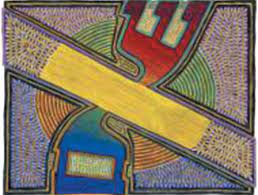
Unlike the Sumerian view, which describes the “contemporary” state of the world, the Semitic cosmogony emphasized the process of creation, the “beginning of times,” and conversely regarded earth as derived from water (the primary elements were taken to be fire (Heaven, Creativity), water (chaotic, elemental potentiality) and air (the active space in which creation unfolds)): “The heavens were created first from fire, the earth was created from the waters and the air balances between the fire and the waters. The head was created from fire, the belly from the waters and the body was created from the wind that balances between them” (the Zohar).
It is obvious that the difference between these two ternary conceptions lies only in the “time of description,” while their underlying ideology is the same.
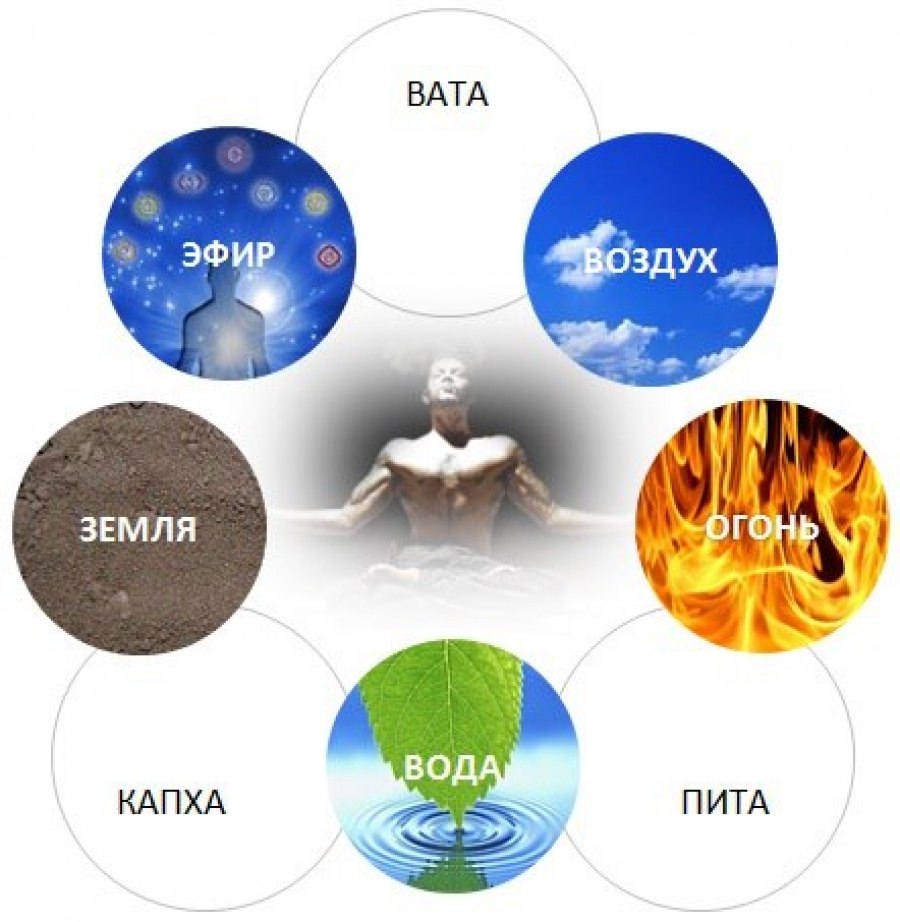
From this Near Eastern perspective, the Hermetic concept of the four elements describes the four properties of “air” — the manifested cosmos. It follows that our world, in this sense, is a kind of composite projection of four Elemental Cities — distinct modes of “air” (aer, “Or”, is — the Light of the Cosmos). Similar systems are found in Hinduism (five elements — mahābhūta: bhūmi or pṛthvī (earth), apas or jala (water), agni or tejas (fire), vāyu, vyāna or vāta (air or wind), ākāśa, vyom or śūnya (ether or void)) and in Buddhism (four mahābhūta: solidity, fluidity, heat and mobility, which are characterised respectively as earth, water, fire and air).
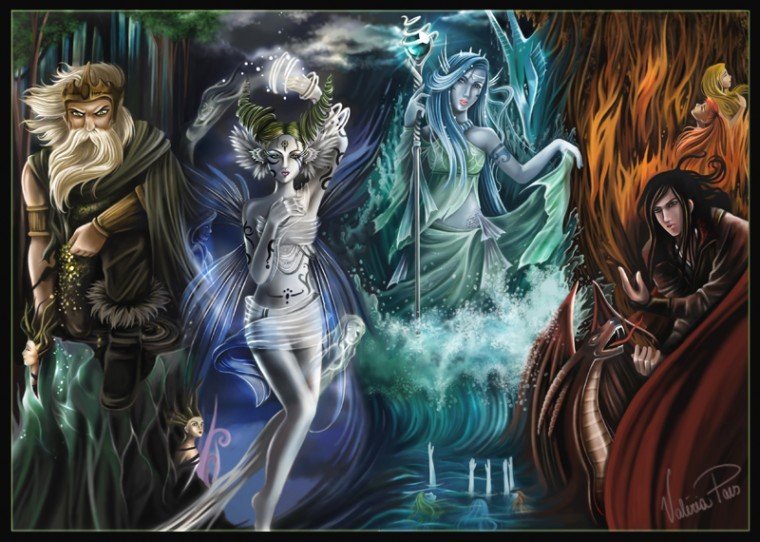
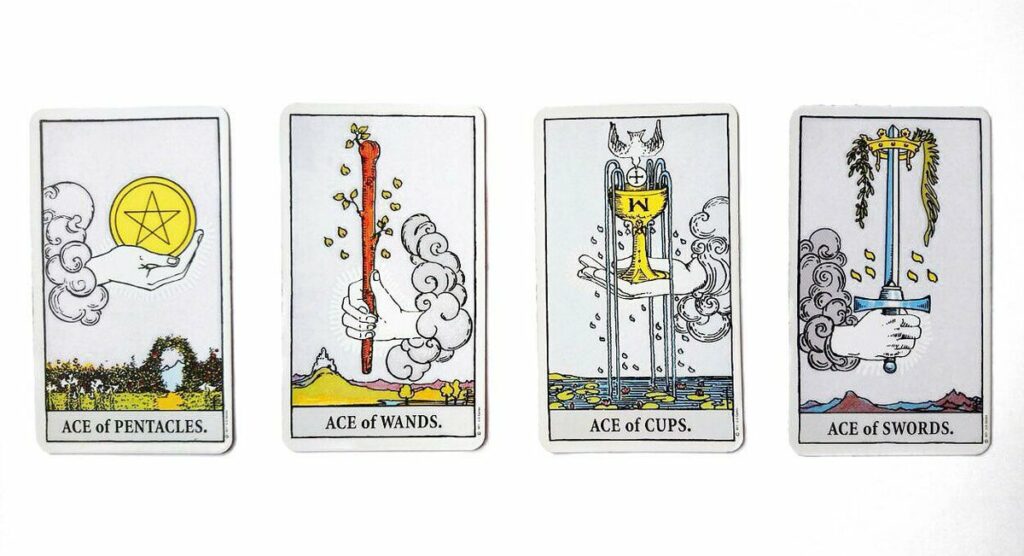
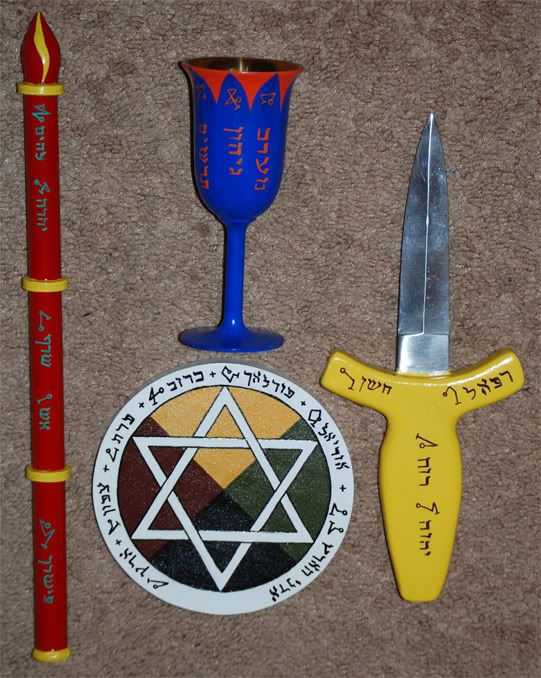
Because the modern Western magical tradition is the heir to both Egyptian and Chaldean systems, it uses both ternary and quaternary systems — ternary and quaternary — not always drawing a clear line between them. This, in particular, is connected to divergences in assigning elements to Symbols of Authority, the suits of the Tarot, and so on. This variability in attribution, called the “shimmering” of the elements, is related to the fact that both Elemental tools and the suits can describe either the process of creation or the state of the created world. For example, if the Wand is used to direct creative force, it may be associated with fire, whereas if it is used to order the created cosmos it may be associated with air. It is therefore important to be clear about which “element” is meant, what the attribution refers to, and how it functions.
The peoples of the Far East perceived the world as a process, a flow of energy (prana, qi), and therefore focused on the qualities of that flow, also calling them “primary elements” (wu‑xing — lit. “five movements”). Many authors therefore prefer to call these properties not “elements” but “phases,” since they are associated with process and change. Wu‑xing are considered a continuation or dynamic manifestation of the world‑duality of yin and yang. Maximum activity (yang) corresponds to fire, passivity (yin) to water, the balance between them to earth, the transition from yang to yin to metal, and the transition from yin to yang to wood. All the “movements” can form two cycles:
· the cycle of generation or creation (sheng), also known as “mother–son”: Water nourishes Wood, Wood becomes fuel for Fire, Fire leaves ash and turns into Earth, Earth in the process of purification and refinement forms Metal, and Metal in its purest form becomes a liquid (mercury), which is associated with Water.
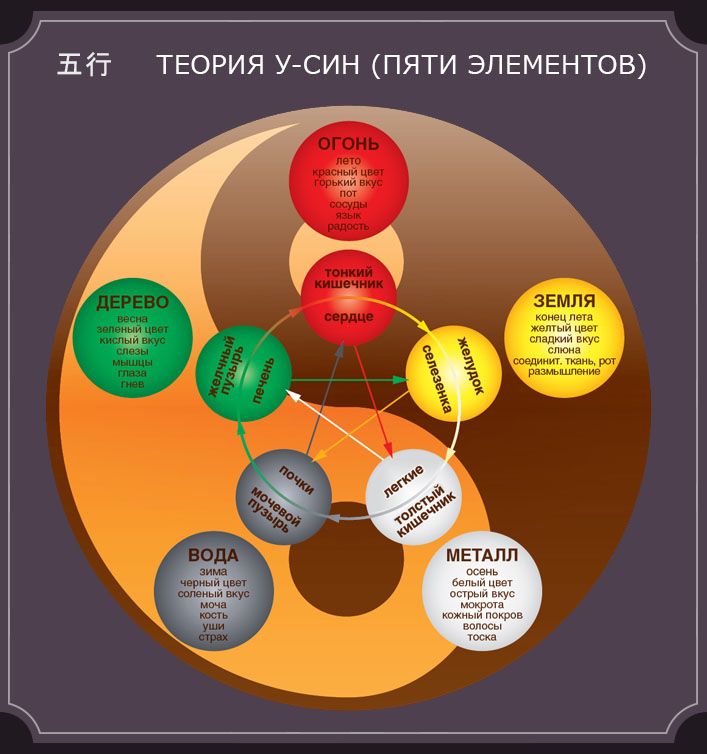
· the cycle of overcoming or destruction (ke), also called “grandfather–grandson”: Water extinguishes Fire. Fire melts and destroys Metal. Metal cuts Wood and destroys its vitality. Wood feeds on the juices of Earth and bores holes there with its roots. Earth absorbs and confines Water.
A strong interrelation exists between these elements, and disturbing the balance of one negatively affects the others. Moreover, many other types of interaction are described among the “movements”: softening, regulating, counteraction, and so forth. Each phase has a complex series of associations with various aspects of nature on both macro‑ and microcosmic levels; colours, seasons and forms are linked to them; so too are bodily organs and processes, and all of these interact with one another.
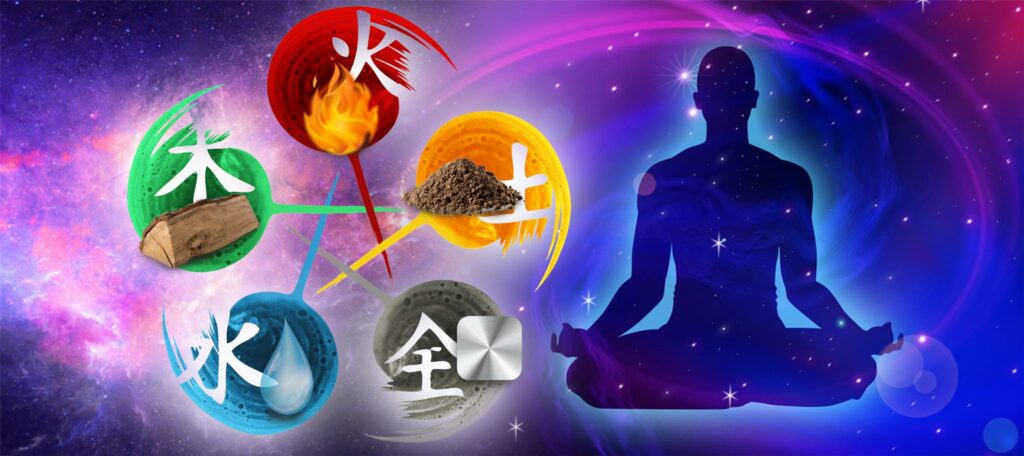
We will not go into the details of this system here, which is itself quite coherent and comprehensive; it suffices to note that Metal and Wood, as manifestations of “transitional” forces, may be correlated with the Western “air,” and that the entire system describes the cyclical processes of the cosmos. In general, the “movements” are not a means of describing natural substances but a way of identifying processes and changes occurring in the universe.
For a Magus who seeks not only clarity in his description of the world but also adequacy in his practice, it is very important to understand what he means by any given term and within which descriptive system he operates. It is crucial not to confuse symbolic systems, and if they must or are intended to be mixed, to be explicit about exactly what is being joined and why. In that way, one can avoid disputes (for example, about the attribution of Symbols of Authority), misunderstandings (for example, from the mistaken identification of the fire element between systems), and, above all, confusion in practice.
I am studying the tatvas – I stopped at the 4 primary elements. It’s an interesting meditation to imagine genesis, how one element ‘flows’ (transforms) into another. How correct is this? Do they even have a genesis? If so, what is the sequence, what comes from what? With 4 elements, meditating (imagining) works out, but with the 5th element, ether, it is a dead end. It is, in a sense, the foundation for the other four, right? By elements, I mean principles (hardness, direction (fire), fluidity, mobility). Fire is also tricky – I don’t fully understand the principle itself. Can one meditate on the elements? You wrote that each element carries all 4 principles (elements), but just one is expressed more strongly?
Of course, the simplest path to understanding the Elements lies through the knowledge of the Elements.
Hello Master! I have the impression after some events that the colors of the rainbow correspond to the numerical series of numbers up to 7. For example, red is 1, violet is 7. The ones in between are more complicated; orange I get as 2, sometimes 2.5. The white one is unclear; is it 0 or 10? What do you think is the role of color in a magician’s ability to accumulate power and share it with their surroundings?