Planetary “Demons
We have already discussed that the “inner” activity of any system, considered as a set of motivational patterns, can be described in the form of a field of so-called “secondary causalities”, which are traditionally correlated with “planetary” forces and influences.
In other words, depending on how the system’s fertilizing, governing, capturing, drying, dampening, absorbing, and adaptive activities relate to each other, it is customary to speak of a corresponding distribution of planetary manifestations within it.
In turn, each type of activity, any creative impulse arising within a system, is also commonly considered from seven perspectives, as:
- an idea, a principle and the possibility of manifesting such activity (expressed by the image of a planetary god),
- a potential, revealed by manifestation of this activity (manifesting as the influence of an archon),
- an “appearance”, a phenomenon, energy subject to measurement and description (reflected in the planet’s image, or the “body” of the planet),
- a direction of influence, the impact of this activity on target elements within or outside the system (expressed by the image of a planetary archangel),
- resistance, inertia that hinders the manifestation of this type of activity, aimed at preserving system stability (expressed as a planetary angel),
- a consequence of such influence, a spectrum of direct, distant, and indirect changes resulting from this activity (a planetary genius),
- the system’s immediate response, reaction to this influence (expressed as a “planetary spirit”).
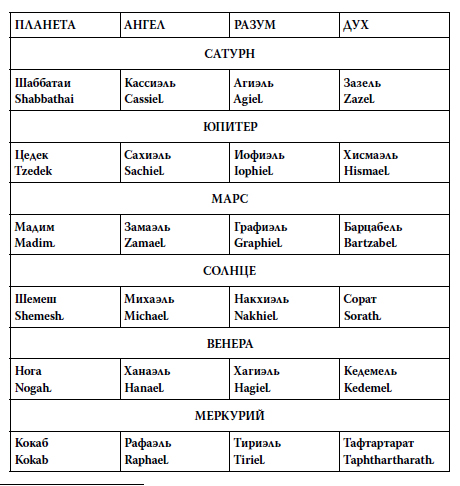
It is not hard to notice that the process of an activity’s development proceeds hierarchically through all the indicated stages: the emergence of possibility — the birth of energy — its direction — overcoming inertia — the development of a reaction. Accordingly, this is exactly the order meant when people say that “the archangel governs the angel, the angel governs the genius, and the genius governs the spirit of the planet”. At the same time, it is clear that the most obvious aspects of such a description are the system’s reaction, since it is precisely this that is often observable from the outside, as well as the spectrum of secondary consequences of this influence, the “planetary genius” and the “planetary spirit”. At the same time, as we have already discussed, systems rarely respond adequately to the creative impulses arising within them; their reactions are always more or less distorted as a result of previous mistakes, imperfections, and inertia. In other words, the more strongly and persistently the “angel” tries to overcome the inertia of the system, the stronger its resistance, and therefore in real systems both the “planetary genius” and the “planetary spirit” take on the character of inverted vortices, transforming into two types of “gatekeepers” — the so-called kidemons (or “goetic demons”) and consiliaries (“counselors”, also sometimes called “planetary demons”).
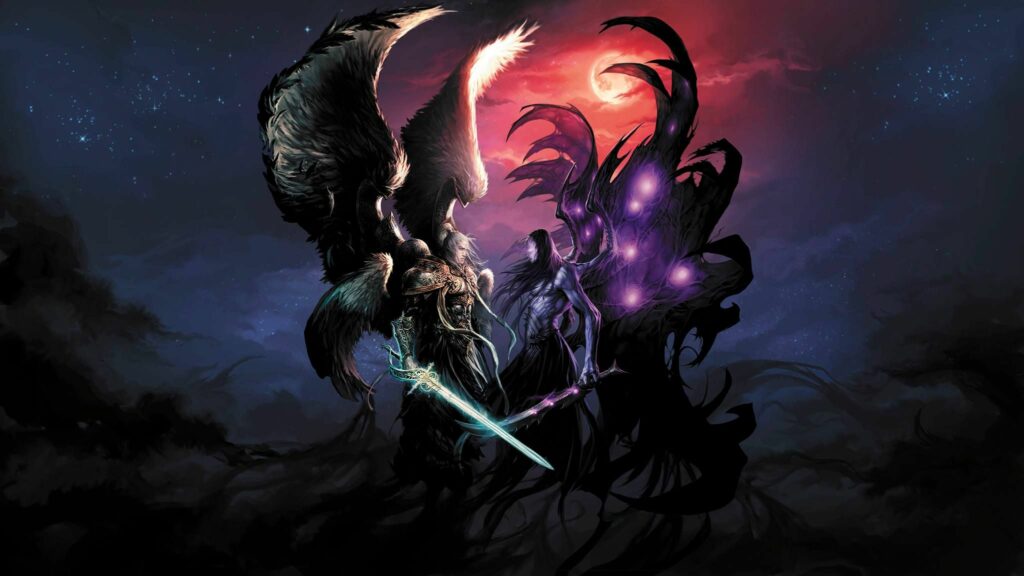
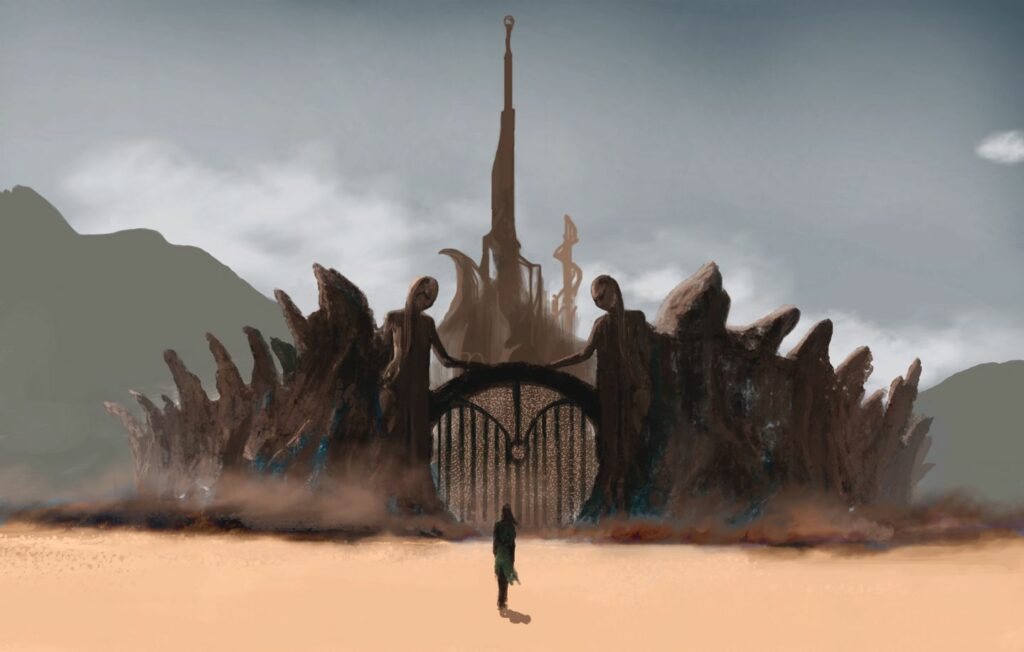
In “physical” language, this means that to perform any action, to express creativity, it is necessary to overcome a certain “energetic barrier”, “Gate”, which has arisen as a result of the ties formed in the past, which accordingly must be untied, “opened”, to allow change. At the same time, passing the “planetary kidemon” implies overcoming the causes that created the old bonds, while bypassing the “consiliary” means breaking the bonds themselves.
For example, to pass the “Gate of sleep” — the sphere of the Moon (Levana) — one should first open the Gate of Shelakhel (or Malka be-Tarshisim ve-ad Ruakhot Shekhalim, רוה שהלים ועד מלכא בתרשיתים, “the Queen who allows spirits to pass”), that is, learn to see things and objects as “reflections” of ideas, “projections” of eidoses, and then the Gate of Nakhyoma, or Shad Barshemot ha-Shartatan (שדברשהמות השרתתן), “the domain of lists of duties”, for which one should learn to correctly determine the directions of forces and gravities, aspirations and attractions.
Overcoming each gate requires special forces and skills, and the Gatekeepers themselves exert a significant influence on both the psycho- and the macrocosmos. For example, as is known, the founder of anthroposophy R. Steiner identified the Solar consiliary — Sorata, סורת, from the Proto-Indo-European “סור” — “Sun” (in another spelling — Storaksa, from “סתור” — “to contradict”) with the two-horned beast from the Apocalypse of John. We have already mentioned that this Gatekeeper expresses the energy of the “Sun of the Interworld”, a relaxing feeling of “life in the flow”, the urge to “accept everything as it is” and “languish”, which easily places a person under the power of predators and tyrants.
One way or another, for the successful realization of creativity any being always has to, consciously or not, overcome the indicated gates, and it is clear that understanding the nature of these barriers and their “Guards” substantially facilitates such a task.
Great article, thank you, it seems I am starting to understand. Although there are still many dark spots) Why: ‘the direction of influence, the effect of this activity on ‘target’ elements in the system or outside it (expressed in the image of the planetary archangel),’ and the resistance, inertia hindering the manifestation of activity (expressed as an angel). Does the angel hinder the activity of the archangel? Perhaps I misunderstood. And I understand, from the links, that the gates “Shad Barshomot ha-Shartatam” are false premonitions (of something) that make us unnecessary worry and lose energy?
The angel and archangel do not hinder but complement each other’s actions: the archangel finds the targets of influence and directs energy there, while the angel finds obstacles to their realization and removes them. So, the angel, as a ‘lower’ force, ‘helps’ in the realization of the ‘higher’ one. And the Gates of the Moon—yes, these are incorrect expectations, false fears that slow down overcoming the Keshet.
In real systems, both ‘planetary genius’ and ‘planetary spirit’ acquire the nature of inverted vortices, transforming into two types of ‘gatekeepers’ – the so-called kydemons (or ‘goetic demons’) and consiliaries (‘advisors’, sometimes also called ‘planetary demons’). Therefore, it turns out that, like geniuses, planetary mind and spirit are abstractions, which place is occupied by a gatekeeper and consiliary, just like the binder genius/gatekeeper. It turns out that conditional Nakiel is not a genius in reality, but a consiliary, and Sorath is the gatekeeper of the Sun? But is it possible then to goetic transformation into their ideal matrices in the psychocosm? Or will such an operation be complicated by concerns of secondary, rather than tertiary, causalities, and in this case different approaches are needed?
Yes, a goetic transformation of any distorted matrices is possible, however the ‘higher’ such a matrix is and the more synthetic it is, the harder it is to reform.
Thank you! Ideally, this type of operation can be broken down into more localized ones. For example, instead of transforming Sorath all at once, it might be more practical to first transform the gatekeepers that have his emanations, namely Agaroth, Paimon, Zepar, Aym, Forneus, Focalor, Haagenti, Gremory, Andras, and Seire, into their corresponding geniuses.
This sounds incredibly complicated, but it might be a more realistic approach than immediately confronting Sorath with all gates wide open.
Yes, this approach is indeed often used – a gradual hierarchical rise through the levels of syntheticity.