
Attention to Being and to the Mind
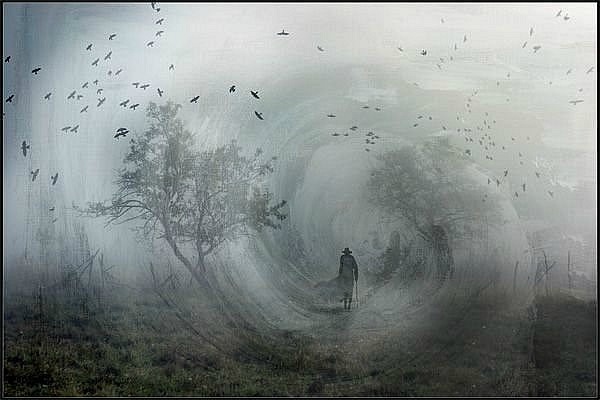
Attention, the mind’s dynamic aspect, determines and creates the world in which any being’s activity and self-knowledge take place. At the same time, although in a broad sense Magi call the mind a system’s general ability to single out its aspects as objects for interaction, the focus of that mind, its attention, is usually directed at the products of description, rather than the process of describing.
In other words, by fixing attention on interacting energy patterns, the mind usually perceives only the final stage of description – as if a momentary snapshot forms – that is, the image of the object. The mind becomes habitually trained to operate this way – and as a result a person lives among objects, among static forms; the flow from one into another completely escapes attention or is viewed as insignificant.
This strange one-sidedness of perception is very convenient for the parasite of the mind – for, wandering among forms, the mind becomes unaccustomed to perceiving the stream of life and therefore does not notice its own energy fluctuations, outflows and losses of energy.

Any perception of an object is assembled from the movement of attention over its separate properties, which are then summed into an overall picture – an image. For example, when a person arrives in another city, in reality they perceive the walls of houses, facades and shop windows, the faces of people met in the streets, the trunks of trees and the asphalt or paving of streets. And often all of this slips from their attention, which concentrates instead on large-scale images connected, for example, with the purpose of visiting the city, the “sights” or other major objects.
Such functioning of the mind rests on its capacity to generalize – unquestionably a very valuable and useful ability, yet, when developed one-sidedly, easily turning into a distractor.
By the way, this very feature of the mind is used by tour guides, who draw attention to particular objects or historical facts while breaking the continuous flow of perception. It seems to the person that it is “interesting”, but in fact it becomes a substitute for living experience and direct perception, by a succession of separate images, sometimes loosely connected to the mind’s flow, which becomes fragmented, loses its unity, and therefore loses energy.
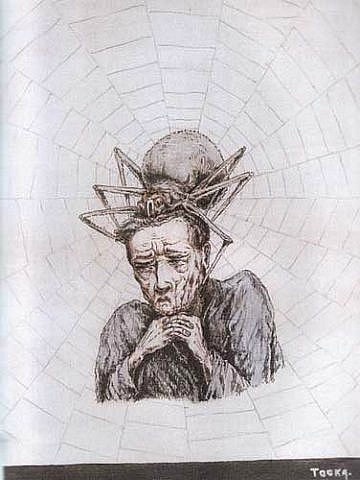
Harmonious development of the mind requires balanced attention to both objects, the products of description, and to the process of awareness itself.
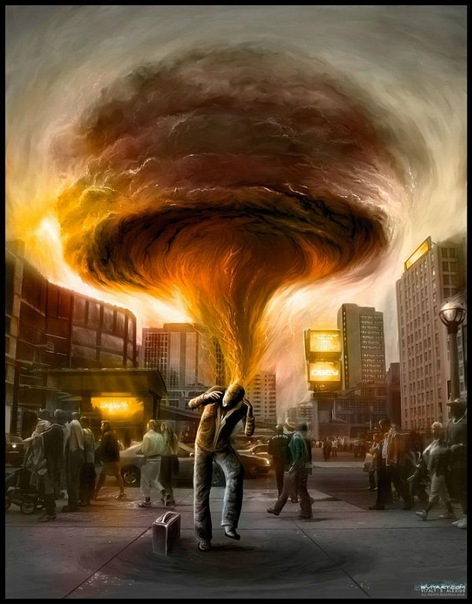
If the focus of attention shifts from static, successive pictures – images – to the very flow of awareness, the stream of ideas, then we say the mind shifts from focusing on Being to focusing on itself – that is, from the Macrocosm to the Psychocosmos.
Put another way, if the mind begins to focus on the individual qualities of energy passing through it, and on its reactions to those qualities, it turns its gaze from the object to the subject of perception.
By tracking which ideas in this stream are dictated by the properties of the object at which attention is directed (whether that object appears “internal” or “external” in relation to the mind), and which are imposed to reduce the effectiveness of the process of awareness, one can discover the sources of energy loss, and thus increase the harmony and efficiency of awareness.
A simple example – people often do not notice nearby objects’ energy, simply because their mind is occupied with other properties. If, for example, a person sees a tree, then in reality they perceive the color and texture of the bark, the color and shape of the leaves, defects and branchings of the trunk, and so on, and besides that, they always perceive the characteristic energy of that tree. But as a result of the habit of focusing on being, an image arises in the mind instead, ‘an oak,’ for example, and the person says: “this is an oak; it has solid wood and will make good firewood” (or something of that sort). The living stream of perception is replaced by the static image of “oak”, filling the mind, and displacing from it everything considered “unimportant” by habit – all that is magical and wondrous, all that is living and immediate.
For a Magus it is very important to shift one’s focus from perceiving whole objects to the process of perceiving and describing, and back, from the Macrocosm to the Psychocosmos, and only in such equilibrium does the mind begin to work at full capacity, reducing energy dispersion and increasing its efficiency.

Hello, Enmerkar. Allow me to give an example. Several people think of me while being far away from me. Can this result in a decrease in my concentration? I felt like I was not here; I was ‘somewhere’ there. The subtle sense of the reality of what was happening disappeared, and consciousness was foggy. If this is possible, then I think their unconscious connection to my channel occurred, and there was like ‘sharing’ of my consciousness. Is there a way to counteract such a leak?
Certainly, any attention directed to a person directs them into the world of the one who manifests this attention, imposing someone else’s Myth to a greater or lesser extent. And, of course, in order to counter this, it is necessary to have a developed selfhood and to clearly see one’s Path and individual characteristics.
Thank you. Now I have learned to cut off attention to myself. The ‘Mask’ practice can be used. Today I spread my consciousness among the forest, communicated with a nature spirit and the consciousness of a bison (I was in a reserve where they are kept). I did not expect such power from their consciousness. Just a little more practice of displacing space. I enjoyed communicating with my powers). Merry Christmas and fruitful development to everyone!
What do you think are the possible reasons for clouding consciousness? For example—you’re walking, thinking about something, and then you catch yourself realizing that you’ve been walking in “the fog” for some time. And usually, even when you become aware of it, it’s not easy to “reemerge” back quickly.
The nuance here is that clouding also happens gradually; you just don’t notice it. And this fog manifests when you try to look “through it”. Your “field of view” simply narrows, and this stuff around appears…
Thank you for your opinion) I write here, trying to find answers to the questions that are still unresolved, it is nice to see a response. So what is the solution here? To track, and then through willpower…?
Ultimately, for the path of Magic, these two concepts are key: consciousness and will. So the solution to any tasks is achieved precisely by increasing consciousness and developing will 🙂
So that’s where the desire comes from to just walk around a new city, on unremarkable streets, to wander into inner courtyards, meet ordinary townsfolk, dogs, cats, frogs, and everyone who crosses your path – to travel.
Thank you, I understand. The most beautiful thing is that starting to understand the subjective perception of the streams of the psychocosm, one begins to notice more deeply the hidden properties of the objects of the macrocosm. And this mutual penetration enriches the integrity of the perception of the whole palette of worlds.
I remembered the thought that the very way of obtaining information is also information. The level of awareness of objects is very important. And the example that people only notice what they are used to is very indicative.
Could you please tell me, which distractor feeds on fear?
Fear is a natural reaction to the unknown. It becomes a distractor when it paralyzes the possibility of action. More details: https://enmerkar.com/en/way/magic-and-fear