
Reflections of Vectors
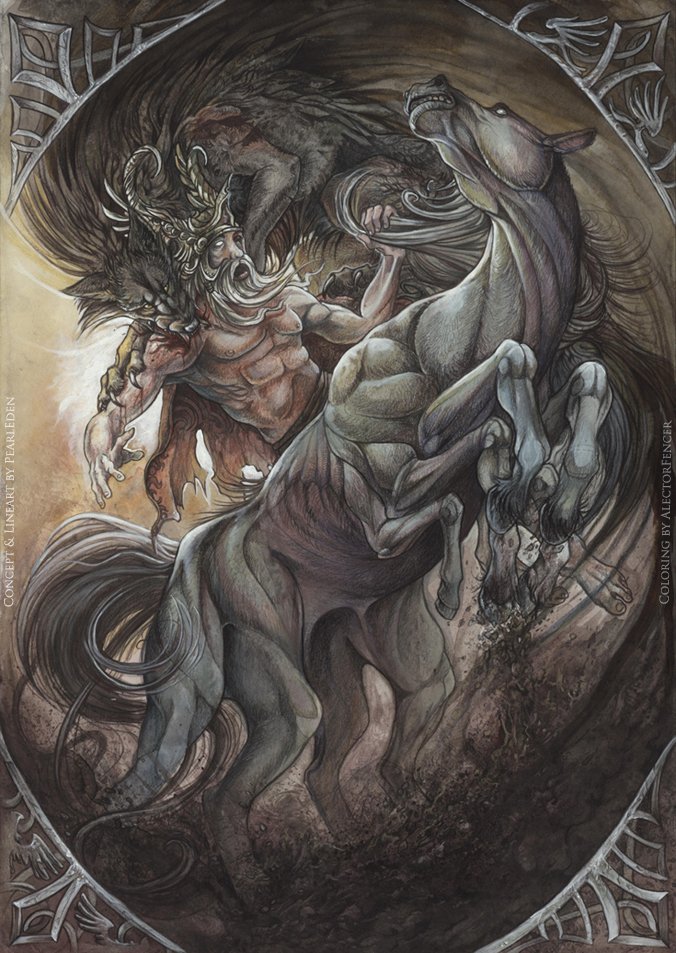
The problem of “reversed” Runes is one of the stumbling blocks for many theorists and practitioners in Vector Magic.
It is often observed that the approach to reversing Runes copies the familiar principles of Tarot, assigning an opposite meaning to a reversed rune.
However, such an attitude shows an unjustified disregard for the differences between the forces manifested by Runes and by Tarot Arcana.
The Arcana express Principles, static “anchor points” on which the framework of the cosmos is built.
The Runes, by contrast, correspond to dynamic, specifically directed (vector) forces operating in the Potential Field of the cosmos.
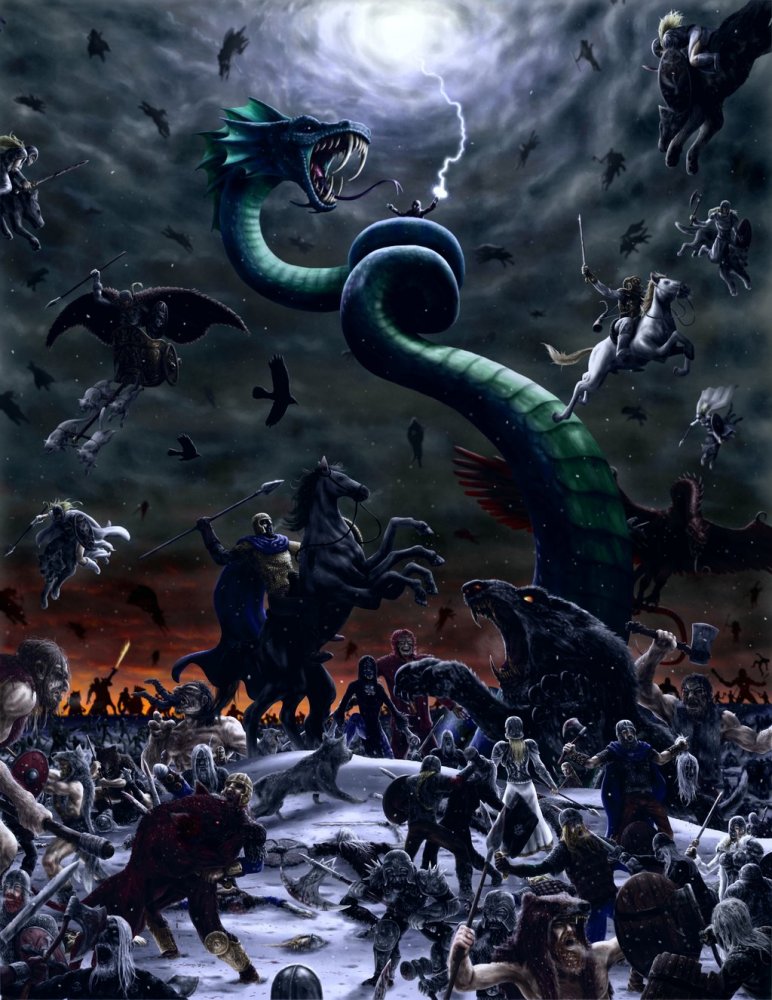
This key difference also allows one to understand the nature of the “reversal” of the power of the Arcana and the Runes’ power. A reversed Arcana indeed corresponds to the opposite principle, and accordingly its meaning — both in divination and in practice — changes to the opposite.
The dynamic nature of the Runes reacts to “reversals” in a completely different way. The force itself does not change; only its direction changes.
Runic forces can change direction in two ways: proper “reversed” Runes and mirror-reflected Runes.
It is well known that not all Runes can be inverted both ways, which is directly related to the peculiarities of the forces that the Runes express.
Vertical inversion of a Rune changes the flow of the force corresponding to that Rune relative to the practitioner: if in the “upright” position the force flows away from the practitioner, then in the “reversed” position it flows toward them, and vice versa. For example, if in the upright position Fehu signifies an influx of wealth, then when reversed it signifies their outflow.
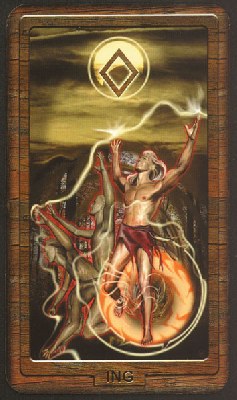
Accordingly, Runes that have no vertical reflection express flows not tied to the direction of the practitioner’s attention — spontaneity of intelligence (Kenaz), the force of inertia (Thurisaz), the principle of indeterminacy (Perthro), and so on. In other words, one cannot say how inertia is directed — toward the practitioner or away from them (Thor’s hammer flies both away from and toward him); likewise, one cannot determine where enlightenment is born — inside the mind or outside it, and so forth.
Horizontal inversion of Runes (that is, their mirror reflection) changes how the vector acts relative to the axis of the practitioner’s intention: for example, a mirror-reflected Fehu signifies valuables flowing to someone the practitioner least wishes to receive them.
This means that Runes that cannot be horizontally reflected pertain to flows independent of the practitioner’s desires: the cessation of movement (Isa), rebirth (Hagalaz in its “maternal” variant), overcoming (Tiwaz), and so on. In other words, when the world “freezes,” it no longer matters what one desired, or when there is absolute darkness around, the desire to orient oneself is futile.
In any case, the inversion of Runic vectors occurs with respect to the practitioner’s point of consciousness, which sets the origin of coordinates in which their direction and strength are described.
Accordingly, both the upright and the two reversed positions of the Runes have highly individual meanings for each practitioner, so the same spread, as well as the same runescript, can mean different things and outcomes in the hands of different practitioners.
Nevertheless, for every Rune practitioner, awareness of the nature of upright and reversed Runes within their own psychocosm becomes not only a powerful operational tool, but also an immense aid to self-knowledge, in directing one’s impulses, motives, desires, and fears.
Thank you very much for the article. It seems you are right: the same runescript can have completely different meanings and influences in the hands of different operators.
I would like to understand something else about runes, specifically about the matter of unity with the World Tree, as I found in one book that this is actually where one should start working with runes. What do you say about this? Is this true? The article is very interesting, I liked it.
The World Tree itself reflects the unity of the world, so “disconnection” from it is the wrong state; being in harmony with the universe, we are in close connection with the Tree, so this connection is important to feel not only when interacting with Runes, but in general – on the Path.
Some things are not entirely clear. For example, by reflecting and flipping the rune Fehu, you can obtain three new forms of it. The article only discusses one. I will try to explain what I mean using the following signs: /-\
By mirroring it, we will get combinations -\ (mirror on the left or right), \- (mirror on top or bottom), and -/ (by flipping the sign along our line of sight, from top to bottom). We got three new variants. The same will happen with Fehu. By the way, in addition to it, the runes Uruz, Ansuz, Raido, Wunyo, and Laguz will also do the same. So, these runes have four flow direction options?
…By the way, it also turns out that the runes Gebo, Isa, Inguz, and Dagaz have only one direction of flow (no matter how you rotate them, you can’t change their appearance).
Absolutely, several Runes have four variants of vector direction. And this provides a very broad field for their influence. It is also true that a number of Runes are invariant. Reflections on the nature, causes, and consequences of Rune graphics can provide food for valuable individual practical conclusions.
Dear Enmerkar.
Each Rune can be drawn in more than one way while preserving its final appearance. For example, Isa can be drawn from the bottom and lifting the vector line upward, or from the top and continuing the vector line downward. What significance can this have and what are the most general rules in the vector when drawing runes that should be followed?
Of course, the order of cutting the Rune matters. In the example you described – from bottom to top, that is – towards oneself, from top to bottom – that is – away from oneself. Draw your own conclusions.
From bottom to top – is that towards oneself? Why? Because in relation to the rune Isa, symbolizing the intervals of being outside of reality, in this way we extract strength from the Navi (below – where the basis of strength is) into reality (which is above) and where the magician is?
Enmerkar, how do you feel about the opinion that in magic and divination inverted runes are not used? A number of authors writing about runes adhere to this point of view. By the way, when reading scientific papers dedicated to the study of runic monuments, I have not encountered inverted runes. At the same time, there are inscriptions with mirrored runes.
Since the vector itself does not change, the flipping of the Rune can be ignored in principle, if you are fully aware of your complete neutrality: after all, when the consciousness (relative to which the rotation of Rune vectors occurs) is completely neutral, this rotation does not lead to any changes.
Dear Enmerkār, I recently encountered an issue with the swastika signs “sunwise” and “counter-sunwise.” The information I find is quite contradictory. I would be very grateful if you could shed light on this topic on your blog.
Best regards, Runava.