Moloch, Devourer of Children
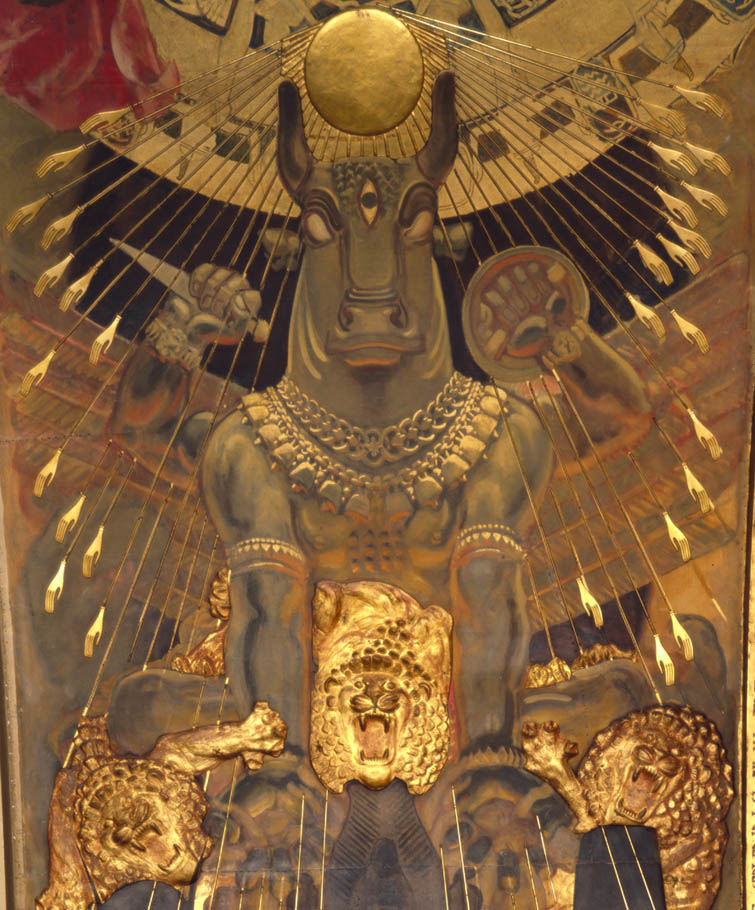 The Western Tradition, in its original, “pre-Jungian” form, was not inclined to regard psychocosmic forces merely as manifestations of the mind, insisting instead on the essential unity of the cosmos, held together by the Law of Analogies. It was held that any power operating in this integral world has both “objective,” that is — “macrocosmic” manifestations, and corresponding reflections within the cosmos of consciousness. Nevertheless, some powers and agents were regarded as rooted in consciousness, while the source of others lay primarily in the world of “objects.” In other words, the relation between “being” and “mind” was seen as two-way, and man was considered at once creator and creature, the author of “external” reality and at the same time its product. At the same time, forces that spring from the mind and then “become autonomous,” merging with some “external” current, acquire “objective existence.” Among such forces there were many known both as constructive and destructive forces. One example of such a force is Moloch.
The very word derives from the Phoenician epithet “Molk,” “Radiance,” which carried many meanings — literal “burning,” a description of fire and of the scorching, searing desert sun, as well as “Radiance of Glory,” whence later arose the Hebrew מולך, Mólech, “regal” or “kingly.” It is important that in biblical times “Moloch” also was used to refer to the rite of human sacrifice (chiefly of children), used in desperate situations to avert misfortune, and apparently the deity personifying this rite, the “King of Sacrifice.” It is well known that in the Old Testament era the rite was at first literal and later symbolic — as “passing children through the fire” — in the famous Valley of Hinnom south of Jerusalem, and the Jewish king Josiah, having forbidden these rites, turned the “Ge Hinnom” into a place for burning refuse and animal remains, which, however, only reinforced the place’s fiery character and gave rise to legends of the “Fiery Gehenna.”
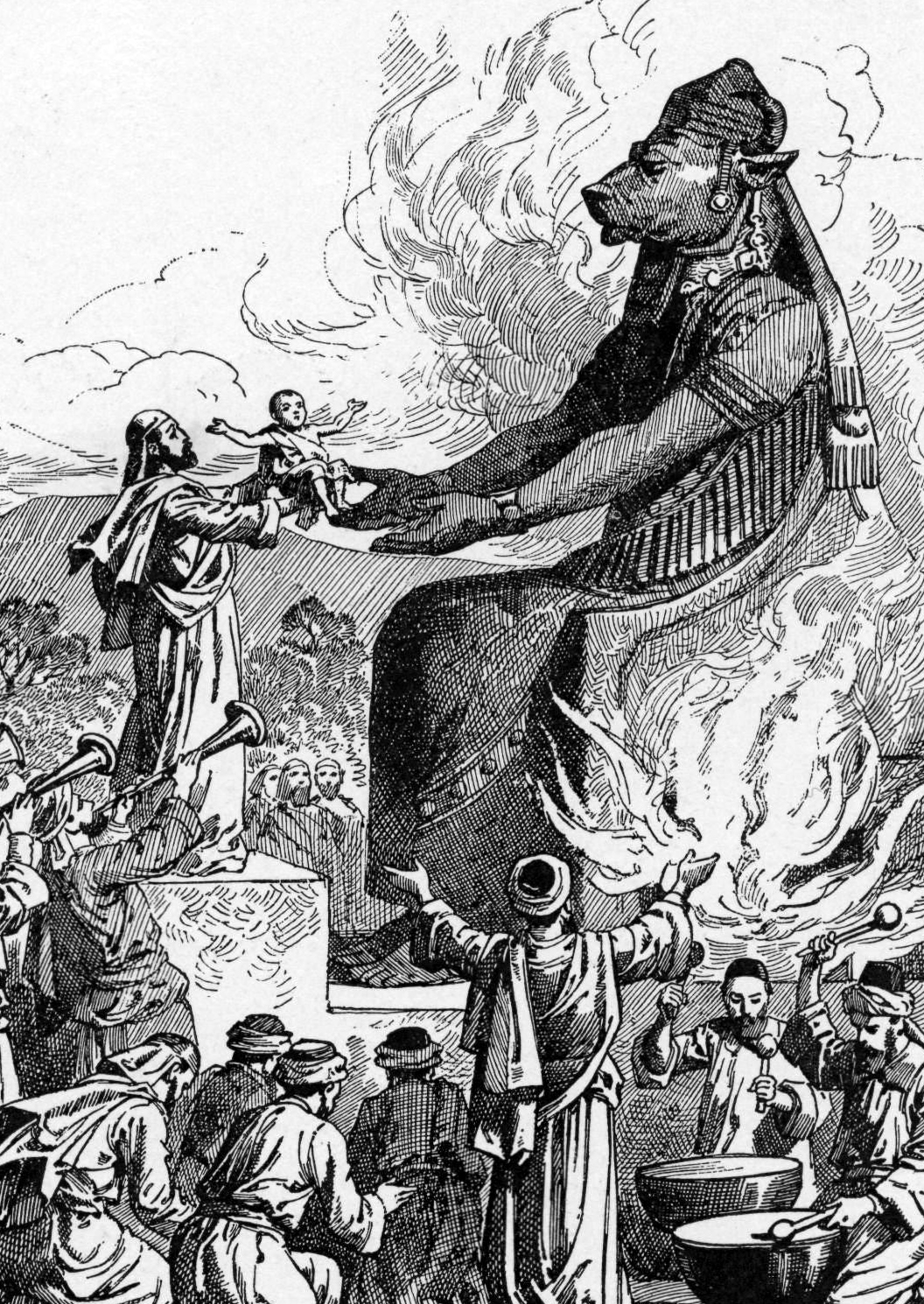
Just as Ge Hinnom evolved from a site of vicarious sacrifice to a place of initiation and then to a refuse-burning site, the fiery spirit summoned there followed a course from protective deity to a child-devouring demon. Such a shift of emphasis was also characteristic of ancient thought, when a power regarded by some as positive and helpful was seen by others in its destructive aspect, who emphasized its “shadow side.” We have already discussed that many Near Eastern deities underwent such a transformation — the Baals, in whom some peoples perceived chiefly protective forces, while others focused on their destructive aspect. Thus occurred the division of the description of a current of force into different components, and that which is described and given form becomes available for interaction; consequently — the destructive influences that the mind felt within itself were matched with the “shadow” image of that current, and so the demon acquired in the mind its image and its name.
Thus, around the 7th century BCE the force “devouring children” began to be called Moloch. Obviously this force existed and manifested earlier, but it was the establishment of its stable image that, on the one hand, made its character recognizable, and on the other — opened ways to oppose its destructive influence.
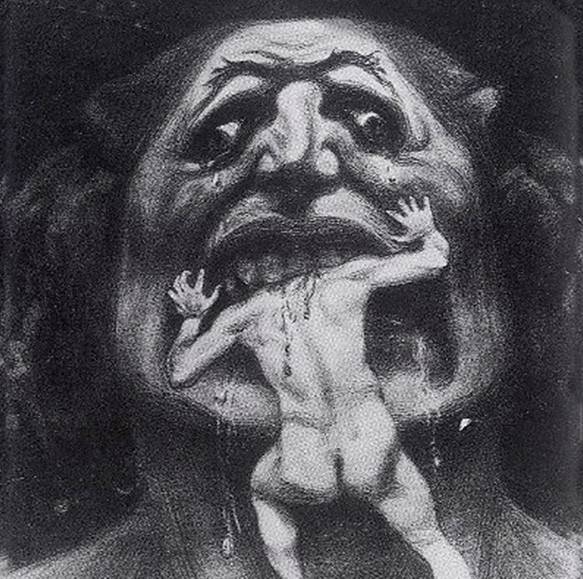
So, Moloch is the force of sacrificing one’s “original impulses.” We have repeatedly discussed this destructive force: in critical conditions, under the pressure of harsh circumstances or social coercion, a kind of “reptilian instinct” is triggered in a person, only instead of losing a “tail,” the mind often abandons that part of itself seen as obstructive under the circumstances, as “inappropriate” or “socially unacceptable.” Unfortunately, in reality this “discarded” part is frequently a valuable personal trait, whose expression is hampered in “standardized” conditions and requires persistent effort. It is precisely this persistence that the person who has chosen the path of least resistance refuses to show, opting for self-denial to gain social or other advantage. And it is this force that is expressed in the image of the child-devouring demon: “children” in this case are those mental potentials, those “seeds” of development, whose germination the mind suppresses for the sake of circumstances. Instead of “consecrating the children” — passing them through the fire, is — to “kindle,” activate, activate the individual’s creative capacities, it “burns” them, rejects them, choosing the simpler, safer route of “conformity,” loss of individuality, and anonymity.
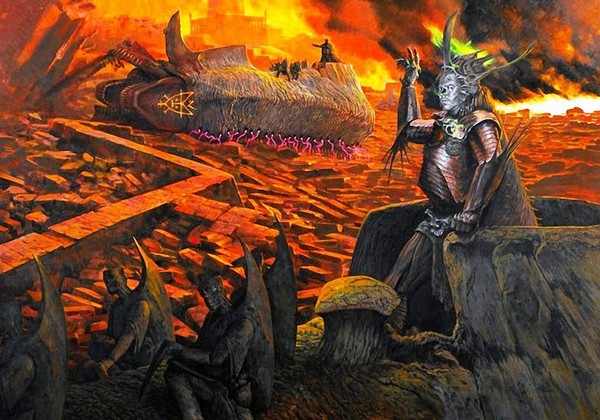
It is clear that in modern society Moloch is one of the active forces at work. The Kabbalistic tradition assigns this demon to the rulers of the Qliphah Taumiel, which distorts the light in its primal manifestations. Many Kabbalists maintain that Moloch is the chief opponent of the Messiah, which is understandable, since the “cult of normality” imposed by this demon directly impedes a person’s self-realization and self-expression, and therefore opposes the gmar tikkun — the repair of the world.
For the Magus, sacrificing one’s individuality is likewise among the worst obstacles. Magic is always a way of manifesting the unique qualities of one’s stream of consciousness, whatever inconvenience those qualities may entail. As a Way of self-knowledge, Magic insists that all agents of the psychocosm be “brought forth into the light,” recognized, ordered, and harmonized; and no renunciation of any — however insignificant — part of one’s true nature offers any prospect for growth.
Hello Enmerkar. I feel guilty for asking so many questions. I am still concerned about the theme you revealed in the article “Love vs. Power”. It states that the cold path is chosen. What choice is being referred to, if in other articles, particularly this one, you talk about departing from true will? So, is there even a choice? Can consciousness arise from preferences in its choice of the cold path? I fear I have a mistaken conception of true desires. For instance, if someone finds the cold path more acceptable, rational, and adequate, do they have a choice? Or could it be the opposite? What if someone wants to enter the flow, but they have no right to do so?
Hello. It all depends on what phase of development consciousness is in: the phase of discovering one’s individuality or the phase of awareness of unity. For instance, in childhood, a child does not feel separate from their parents, from their mother, living in unity with her, but this unity does not belong to them yet, is not realized by them; it is induced automatically and largely stems from the mother and the biological/energetic unity with her. Then adolescence sets in – the phase of individualization, the “search for self”, and at this stage, it is inevitable and desirable to maximize the separation of oneself into an independent, separate unit; the success of such a separation determines the overall evolutionary success of that being. At a later age, both options are possible – to continue self-identification, or to experience a new, conscious, and independent discovery of Unity, already emanating from within, and having psychological/energetic, not just biological roots. On a more general level, such a trend can also be traced: any stream of consciousness, flowing through numerous incarnations, must first detach from the collective World Unity, delineate and realize itself, and only after this, consciously return to the World Completeness (in the form of Pleroma on the Western Path or Dharmadhatu on the Eastern Path). Moreover, phases of self-separation and self-integration alternate multiple times on any individual Path. Therefore, for this being in its current state of consciousness, both the Path of self-definition, Apollonian self-crystallization, and the Path of awareness and realization of Universality, Dionysian solvation, may be more suitable.
One person also wrote to me about the choice “Love/Power,” as if it is a kind of choice of profession, rather than life (spiritual) periods. Those who choose Power – warriors of cold light, consciously avoid love. As far as I understand, this choice arises after passing the first abyss (since… “the love of a magician begins where the first abyss ends”…). Everything before that is “kindergarten” and “adolescence”, so the question of Love or Power is a bit premature during this period, it’s like worrying in adolescence about your growth or voice, when everything can change… “… There are those who manage perfectly without love and do not need it. There are those who cannot do without love. And there are those like you…” 🙂
…and is realized where the second abyss ends.
Why do you doubt the erroneous nature of your perception of true desires? What is the reason for your doubt?
An inspiring article, thank you, very timely.
I respect your point of view, En. Allow me to express my assumption. Complete separation and distinction do not occur. Each consciousness of a magician is a deviation, meaning a certain change in the properties of one of the consciousnesses in the overall stream. It does not leave but remains in it, having only partially changed its individual qualities. It is like the Creator’s view of itself for further correction of itself. A child, having “separated” from the mother, does not exit the general flow of consciousness, and later, I agree with you, by existing separately it enriches the world with its individuality.
Individuality is a feature of the reflection of the macrocosm in the individual microcosm. The refusal to acknowledge the inconvenient part of individuality is equivalent to the microcosm’s refusal of part of the macrocosm, to which the inconvenient part is similar. The difference between a human and a lizard is that the repressed part of individuality does not fall off but goes into the shadows. Repression is an act of aggression by the individual against individuality, forming an internal conflict and leakage of power, in this case to Moloch. The opposition to Moloch is Acceptance of one’s individuality and its unity in all its manifestations with both oneself and the macrocosm. The key to resistance is Love for each aspect of individuality (and the Macrocosm, as its source) and a careful attitude towards it. Love that cannot be betrayed or sold, otherwise, the loss of Identity to the entire Macrocosm is inevitable. Unmanifested properties of individuality stand apart; their manifestation requires special interactions between the macrocosm and the microcosm. Their repression on the level of limited consciousness is the same sacrifice to Moloch, where yet unborn children are sacrificed.
Hello. And in situations where one trait of individuality contradicts, let’s say, to “unborn children”. Is that scenario in which you are a loser, regardless? One of the blog articles talks about remelting, does that indeed give the opportunity to reconcile your tendencies?
Perhaps this “trait of individuality” has nothing to do with individuality at all. Perhaps it is the Fear of One’s Own Power, Fear of Judgment, Fear of Shame, Fear of Expressing Oneself in a way that you consider ugly and ridiculous… and even deeper – it may be the Image of Actions that adults instilled in the child in early childhood. You are a loser, they might have said. Whatever you do – you are a loser… but this Image of Action is probably Unconscious because it’s too painful to admit…
…and then, Dear Q, this is not about the “unborn children” – this is not even about stillborn children – these are “children” who stuff all ancestral passages, “children” that slowly decompose somewhere inside… but this is not about you – this is from experience…
Hello Q, “a loser in any case” – I recognize the song of the parasite of consciousness. Is this truly your “trait of individuality”?
https://enmerkar.com/en/way/knowledge-and-conversation-activation-of-the-higher-matrices In this article, there is what you asked about. The macrocosm is multifaceted and has many contradictory poles. At the same time, the macrocosm is holistic and unites poles both in the context of their neutralization and in the context of the thousands of forms of their fusion without mutual absorption. The microcosm is also capable of this, however after being cleansed of destructive alien forces, as Tavita Shauta writes.
I began to examine the symbol I received 12 years ago. The upper part of the Maltese cross (an inverted pentagram with the sides turned inward). It became a Fish. I see this is the Bull, the first letter of the Phoenician alphabet Aleph. The similarity between Hebrew and the Phoenician alphabet surprised me. It turns out they skillfully use the letters of the Phoenician alphabet. I was thus glued to the last letter Tav of their alphabet (which resembles the Gebo rune). And I thought for 8 years after the ritual of Kolo Veles that I was nailed to the Gebo rune. That’s how sacrifices are brought. Very relevant, thank you.
Is Moloch the embodiment of power? And as I understand it, sacrificing a child is something like humanity? I am studying the topic related to power. I became interested in the topic of the Bohemian Grove, where the powerful of this world worship the Owl – hence their power. As it is written, the Owl is Moloch.
Yes, one can say that Moloch itself is power, demanding the sacrifice of personal for the sake of what it calls “public”, but in reality, it is its predatory desire.