Letters and Vortices
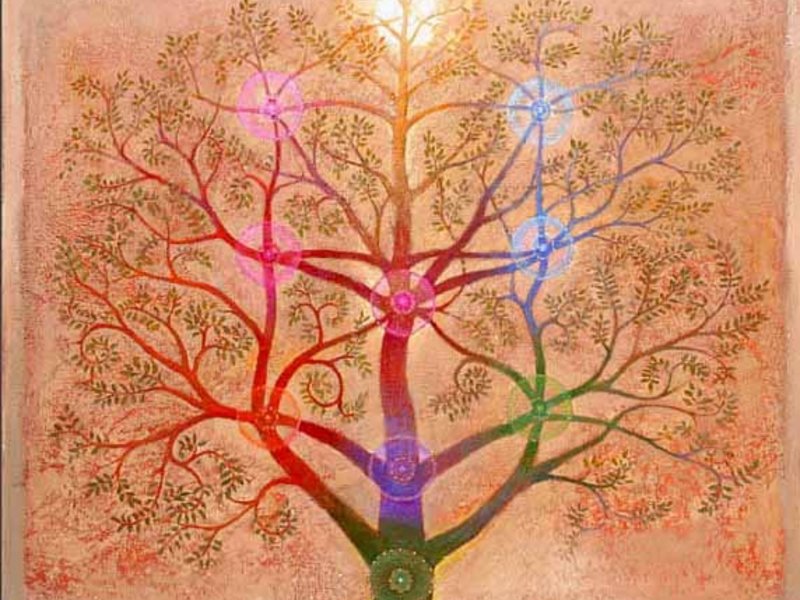
According to kabbalistic conceptions, the “elemental instruments” of Creation are special “lives” (chayot, חַיּוֹת) emanating from the Creator, expressed by the letters of the Near Eastern abjads.
From the Tradition’s perspective we consider, these “elemental dynamic structures” that ensure the passage of Light through the Tree of Life, described as “channels”, “tzinoroth” (צינורות), are “elemental vortices“, since vortical motion is the Medium’s mode of dynamics of the Medium. In other words, every vortex is a channel for the Medium’s movement, how one stationary state transitions or interacts with another. Accordingly, the Tree can be seen as a series of alternating stationary (sephirot) and dynamic (tzinoroth) states of Light.
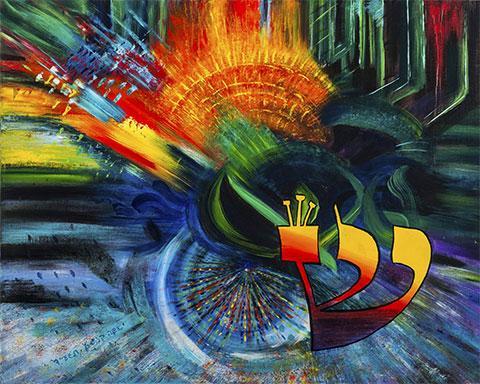
As mentioned, the structure of any vortex can be described by a corresponding sigil, which in turn breaks down into components — letters and their derivatives.
The very structure of Near Eastern alphabets — three “mothers” (primary principles) + seven secondary causes + twelve “tertiary” — reflects the fullness of the manifestation of creative forces in the Medium. Indeed, any vortex has elemental (‘Mothers’), planetary (‘double’ letters) and zodiacal (simple letters) aspects, as well as certain stable characteristics (sephirot, numbers) that sustain it.
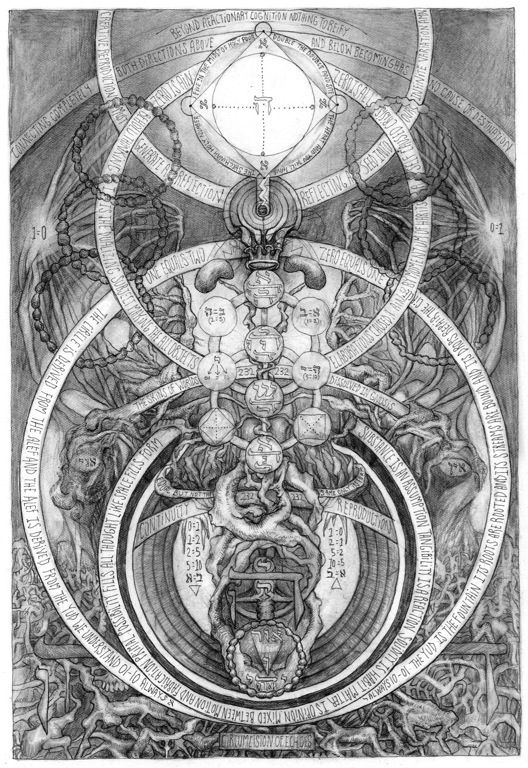
The Western magical tradition, rooted in kabbalistic views, widely uses Judeo-Aramaic approaches to the letter-based identification of elemental vortices — tzinoroth.
From the earliest Phoenician letters down to the “square” Hebrew script, three primary levels are distinguished in these sacred symbols in the terminology of the Sefer Yetzirah — “the book, the number and the narrative“. By ‘book’ is meant the form of the letter, by ‘number’ its numerical value (full name of the letter, known as ‘milui’ (filling)). To the letters’ primary components are added additional elements that clarify the character of the vortex they define — vocalization marks (nekudot, נְקֻדּוֹת), diacritical signs (dagesh, דָּגֵשׁ and mappik, מפיק) and crowns (tagim, תָּגִים). The form of the letter determines the “inner” character of that vortex and also expansive (horizontal) or attractive (vertical); the “points” (nekudot, dagesh and mappik) indicate how it interacts with others (attenuating or intensifying); and the crowns indicate an evolutive or involutionary orientation. Each letter, in its written form, indicates which sephirot’s energies it embodies and conveys — i.e., which dynamic aspects of states it embodies.
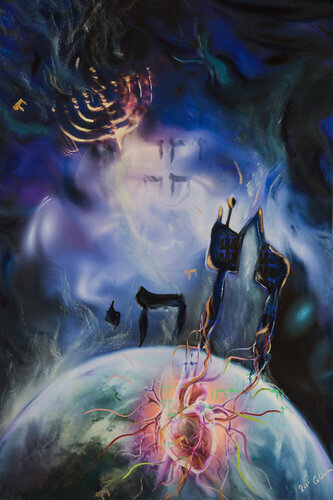
Moreover, each letter, channel, elemental vortex, can manifest in multiple aspects, and therefore each letter is considered to have 22 internal values (one numerical and twenty-one semantic), which is important for kabbalistic studies and for practical purposes in making sigils and talismans.
Accordingly, a Name written in such energy-saturated letters (this applies to other sacred alphabets as well, for example Sanskrit) already carries a powerful activating charge by itself, and a sigil derived from it serves as effective support for the corresponding vortex.
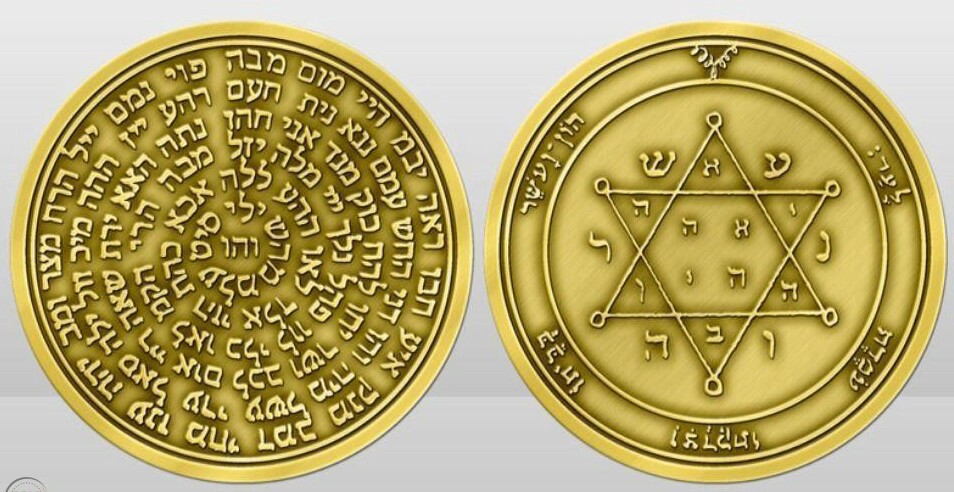
Just as there are “extra-alphabetic” runes (for example, the valknut, the swastika and the wolf’s hook), sigils also include extra-alphabetic symbols — symbols that function like elemental vortices, or more precisely, like vocalizations or crowns, which modify those elements. For this purpose, sigils may include simple symbols (a circle, a triangle, etc.) as well as operative symbols (the cross, the pentagram), which contribute to the resultant vector of the vortex.
Thus, both the arts of creating and reading sigils can be considered from both graphic and nominative magic perspectives, and just as the galdrastaf is an integrated form of a band-rune, the sigil is a distinct, stylized and integrated form of a Name or Word of Power. And just as the band-rune represents the resultant vector of a given operation, the sigil expresses that resultant vortex.
The study of letters’ characteristics in magical alphabets and their interactions is essential for successful application of a realization technique relying on vortical structures.
Leave a Reply