
Guardian Angels
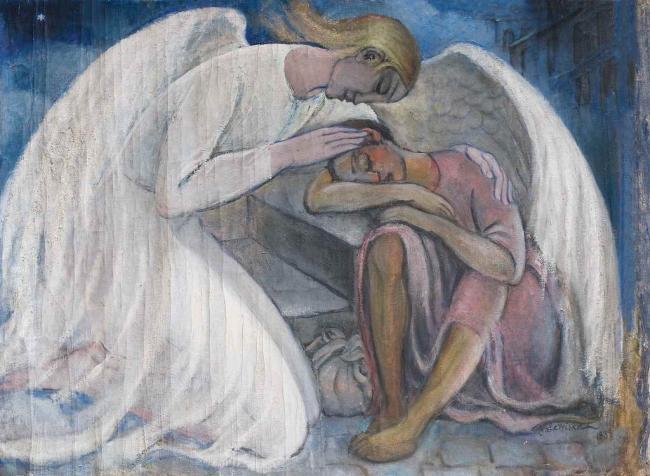
In our discussion of Guardian Spirits we said that the Shedu, in a certain sense, is a product of the embodied being’s mind itself; that is, in essence, it takes on the character of a ministering spirit.
Moreover, because such a spirit typically has a descending orientation — that is, it sustains embodied existence in a stable form — it can quite justifiably be called an Angel. Recall that the Myth we are considering calls angels the ministering spirits that draw energy down to maintain the system in a stable condition.
However, the question of the origin of the Guardian is very important because the answer allows us to see certain ways in which the power of the mind can develop.
We said that, from a certain point of view, the Guardian is an elemental of the Psychocosm, and like any elemental it appears as a result of restriction, tzimtsum. In other words, in response to any constriction of the flow of Power, the system reacts by producing a “replenishing” being — this is what an elemental is. For example, if one removes everything from an object except receptive passivity, we obtain the element of earth, which attains equilibrium through the gnomes’ self-awareness. Thus, gnomes are the world’s response to the incompleteness of the element earth. Similarly, the Shedu is the Psychocosm’s response to its own incompleteness.
This very incompleteness is the result of the separating action of Nakhash, which divides monadic families and supports the separateness of streams of consciousness.
Thus, the overall picture is: Nakhash’s action separates kindred souls, and the stream of consciousness weakens. As a reaction to the incompleteness of consciousness, a ‘replenishing’ component — the Shedu — appears.
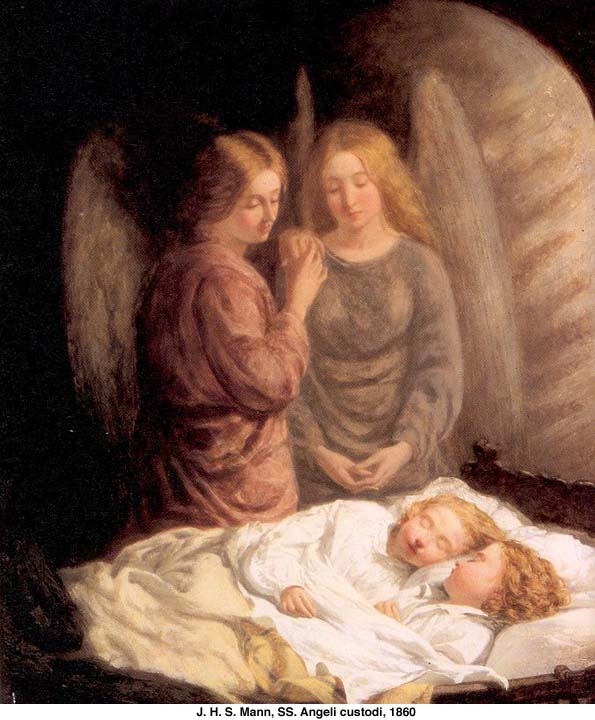
However, the Shedu does not simply “replenish” the incompleteness of consciousness caused by loneliness. Arising from the Psychocosm’s striving for fullness of being, it is directed toward the actualization of consciousness, and for this reason, in fact, it is an angel.
And this means that the Daemon not only supports existence but also hinders freedom of development. It sometimes “guards” too zealously, preventing danger but also restricting the flow of Power.
From the foregoing several important practical conclusions follow. First, we have already said that Magic does not recommend relying on any “Keepers,” although it acknowledges their usefulness and, at times — their necessity. Second, “knowledge and conversation with the guardian angel,” understood in the narrow and literal sense, like other forms of seeking vision, only opens the way to an awareness of one’s particular qualities, but does not provide direct power for the realization of those particularities; moreover, excessive reliance on the “angel” limits the freedom of individual development. Third, the joining of Monadic Families limits the manifestations of Shedu, since the resulting system is itself quite effective and complete. This makes Magi freer in their development, of course within the general flow of the family. In fact, members of a single Magical family themselves become Keepers for one another, occupying the voids of the Psychocosm. The merging of energies within the Family also leads to the merging of Daemons, so that a single Keeper of the Family replaces the “group of angels,” and because ideally the energies of its members are mutually self-contained and do not experience a sense of incompleteness, this Keeper no longer has the qualities of an angel — that is, in this system it is assigned the role of adviser and protector, no longer controlling the flow of Power through the Psychocosm.
It’s not clear. Either we are talking about different things or I don’t agree.
As is well known, in the Golden Dawn, and subsequently in Thelema, the Consultation with the Guardian Angel is not a “some useful (in the sense that, although useful, one can get by without it) but sometimes necessary (the key word is “sometimes”, that is, sometimes necessary and sometimes unnecessary) experience”, but an experience that has absolute and fundamental significance. And, from it, the independent path of a Mage begins, and this experience transforms the Seeker into an Adept.
From the perspective of these magical systems, the Consultation with the Holy Guardian Angel signifies the attainment of the Awareness of Tiphereth. Until this level is reached, a person does not possess wholeness or integrity, but represents a certain unordered conglomerate. In fact, they do not know their Path and are not fully themselves. All they can do is have some understanding of their Path. When people talk about Achieving Knowledge and Consultation with the HGA, I understand Knowledge here primarily as the knowledge of one’s true nature and their Path (what you have called Orlёg).
The HGA, thus, in the understanding of the Golden Dawn – Thelema (and directions related to it), is akin to the Jungian Self, the Higher “I”, possibly even Atman. There is also such a definition: “The Thought of God about a given specific person”. However, there is a viewpoint on the HGA as an Intermediary between One and One (or One and God, as it pleases more). If the Microcosm is akin to the Macrocosm, one can say that the HGA is the God of the Microcosm (that is why Crowley writes that Consultation with the HGA is almost the same as a union with God, but not quite; if we remove “almost”, it would resemble how if a drop thought it was the ocean).
Regardless, the Consultation with the HGA is given absolute, not relative importance.
And even if we say that the HGA is a mediator between One and One, etc., still, what other way will lead you to find yourself?
An alternative is a certain inductive process of trials and errors, at best.
So, either we are talking about different things, or I’m probably, for the first time, acting here as your opponent.
We are not talking entirely about different things, though not about the same thing either. Materia and the Golden Dawn, unfortunately, did not bring the concept of HGA to a logical conclusion, and Crowley, as usual, did not find it necessary to clearly explain his opinion, which is why there was a misunderstanding that many magicians from both traditions have worked to eradicate. Indeed, in the full and pure sense of “knowledge and consultation,” taken as necessity in these systems, denotes achieving the wholeness and hierarchy of the Psychocosmos. In this sense, this achievement signifies acceptance into the order and is absolutely necessary for further development. But the real situation is such that before reaching this very achievement on the path to the wholeness of the Psychocosmos, the Guardian Angel is encountered, understood in a narrower and described sense within this post. That is, when the consciousness seeks the highest counsel and protection, it does not always clearly realize that it should seek the highest part of itself, its ideal archetype – which is not quite aptly termed as HGA. It seems that the founding fathers of the GD did not clearly separate the Ideal part of consciousness (Yechida, Individual Logos) and the Guardian (Šed). Subjectively, both forces are perceived as transcendent to ordinary consciousness. Instead of seeking reliance on the higher energies of the Psychocosmos itself, consciousness finds this support in the essentially external energies of the Guardian. This post addresses that. Relying on the Šed, although it provides relative safety and wisdom, does not facilitate development in several cases for two reasons – due to the nature of the Guardian itself and because of the false confidence in the stability of the external support.
What does ‘external energies of the Keeper’ mean? The Keeper itself is an internal function of the stream of consciousness, right? Or does it have a dual nature and can act as ‘an astral entity’, being a projection of consciousness itself that has a connection with the subtle body of the person?
Yes, the Keeper is a manifestation of the consciousness’s striving for self-preservation. This manifestation has its own signs and activities. Only when manifestations of the being arise from this function, and not from the nature of consciousness itself, can we talk about ‘external energies of the keeper’. Similar to how other functions of consciousness can also have their manifestations—for example, when a person acts as a bearer of a certain profession, and does not do what they would like to, but rather what their functionality requires.
Good day, Enmerkar. Tell me, how can something that inherently replenishes the incompleteness of a person’s consciousness obstruct development? Or do you assert that reliance on the Guardian Angel does not increase a person’s consciousness?
Just like a big antivirus, with a ton of filters and blocks for everything and anything…
The magical family – is it several beings of one incarnation united by one flow, or is it the flow of my incarnations in the spectrum?
Could you clarify if there is a difference between the concept of Magical family and Monadic?