Forms of the Magus
As we have said repeatedly, not only the personality but also the human form of the Magus is as much a product of description as the world in which he lives.
This understanding carries a number of important practical consequences — from “transformations” into animals, other people, or even “inanimate” objects, to the so‑called “acceptance of divine forms.”
The key idea behind such transmutations is that the human form assumed by the vehicle of the mind has certain characteristics only because, in a given incarnation, the mind is most familiar with the way humans describe things adopted by humans. Namely, by describing itself in a particular manner, the mind creates a set of conditions for the realization of specific possibilities, which is the task of that incarnation.
At the same time, the development of the Magus’s mind goes beyond merely carrying out the tasks of the current incarnation and therefore may require changing the form in which his awareness manifests. However, for this it is necessary to form an alternative self‑description, or, as mentioned, to assume the form of an animal one must know how the animal is described.
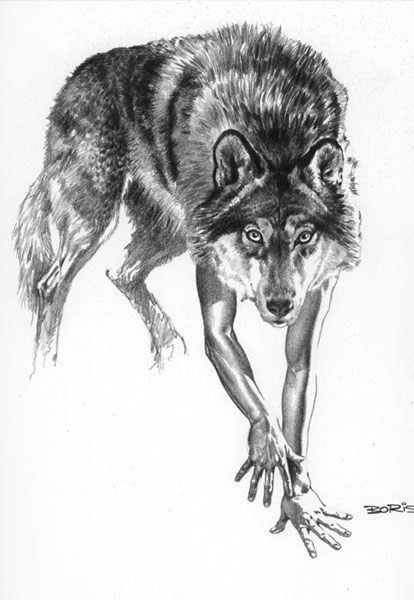
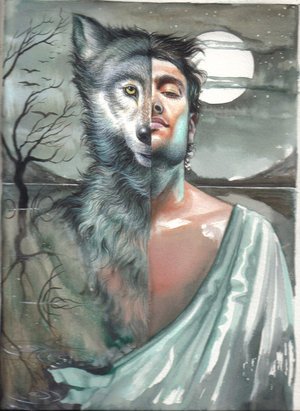
However, such a complete change of form also entails a change in how the mind functions — that is, a transformation into an animal means not merely a change of outward appearance, but a change in one’s very nature. Contrary to the common belief that a Magus who adopts the shape of an animal is the same Magus merely “wearing a mask,” such a transmutation alters the mind as well, and a Magus turned into an animal is not a person who looks like an animal, but a being that thinks like an animal and feels like an animal.
It is clear that such a change of nature is fraught with a number of difficulties and dangers; in particular, it requires considerable strength, and there is always the danger of becoming “stuck” in the animal state.
Therefore, often instead of transmuting into another form, Magi create an illusion of such transmutation, and they may do this either consciously or out of a mistaken belief.
Unlike a “real” change of form, which requires knowledge of an alternative description, this kind of change requires only knowledge of how people describe the creature in question; in other words, in this case the person does not become an animal, but creates the illusion of such a transformation in others.
This can occur in two ways:
first – projection, when the mind projects the corresponding “temporary” form by the mechanism of dreaming, while the body itself remains motionless;
second – when the Magus perceives himself as human, but creates in those around him the impression of another form. This is a kind of suggesting his image to others.
Neither of these methods has anything to do with expanding awareness; they are merely games that lead to an increase in the Magus’s delusions of grandeur.
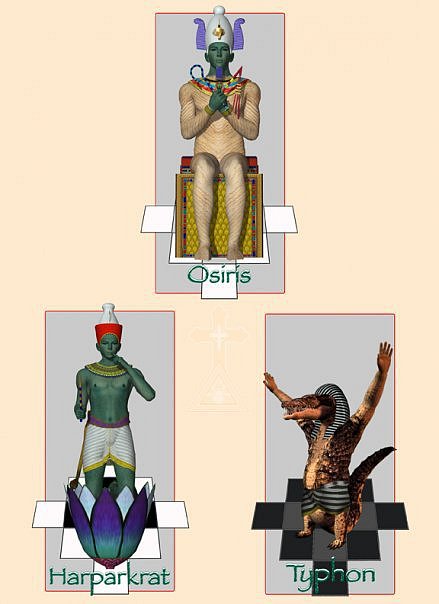
Another widespread method of changing the form of the mind is the «acceptance of divine forms», which entered the common practice of Western Magic thanks to the “Golden Dawn” and was further developed in Crowley’s teachings. The idea behind this change is that if a Magus cannot do something as a human, he assumes the form of a particular deity and performs it as a god. By assuming the form of the corresponding God or the «Divine Image», the Magus binds his mind to the summoned powers, and the magical operation is carried out not only by the Magus’s own will but also by the might and authority of the deity with whom the Magus identifies. If one does not “shed” all assumed “divine forms” in a timely manner, there is a considerable risk of developing a psychological disorder or developing delusions of grandeur.
In any case, a change in the mind’s form aimed at expanding the Magus’s awareness must be strictly controlled and halted, because prolonged change can make the mind transition, which means disrupting the tasks of the incarnation, and thus problems such as becoming stuck on one’s development path.
Thank you so much for describing this topic ))) It’s interesting ))) But why is transformation into animals merely ‘games that lead to an increase in the mage’s megalomania’? Doesn’t it provide any additional experience or power?
It seems to me this is something on the level of witchcraft “illusion” and “transformation”, the power here is used for “domestic” needs and there is no talk of awareness.
A complete change of form can be effective in healing from a range of illnesses that animals, unlike humans, cannot suffer from. At the same time, the described method imposes serious limitations. For transformation, only those forms that possess developed consciousness can be chosen. They must be capable of fully reproducing self-perception and world perception from a human perspective. Otherwise, for successful reverse transformation, a direct path may not be fully accessible. The Goetia in the context of this article reveals a new aspect. Studying the description of the world and oneself from the perspective of THESE beings allows one to fully identify them (and their components) in their current perception. And then there is a choice that did not exist before. Mythology presents even greater prospects.