
Falls into Darkness
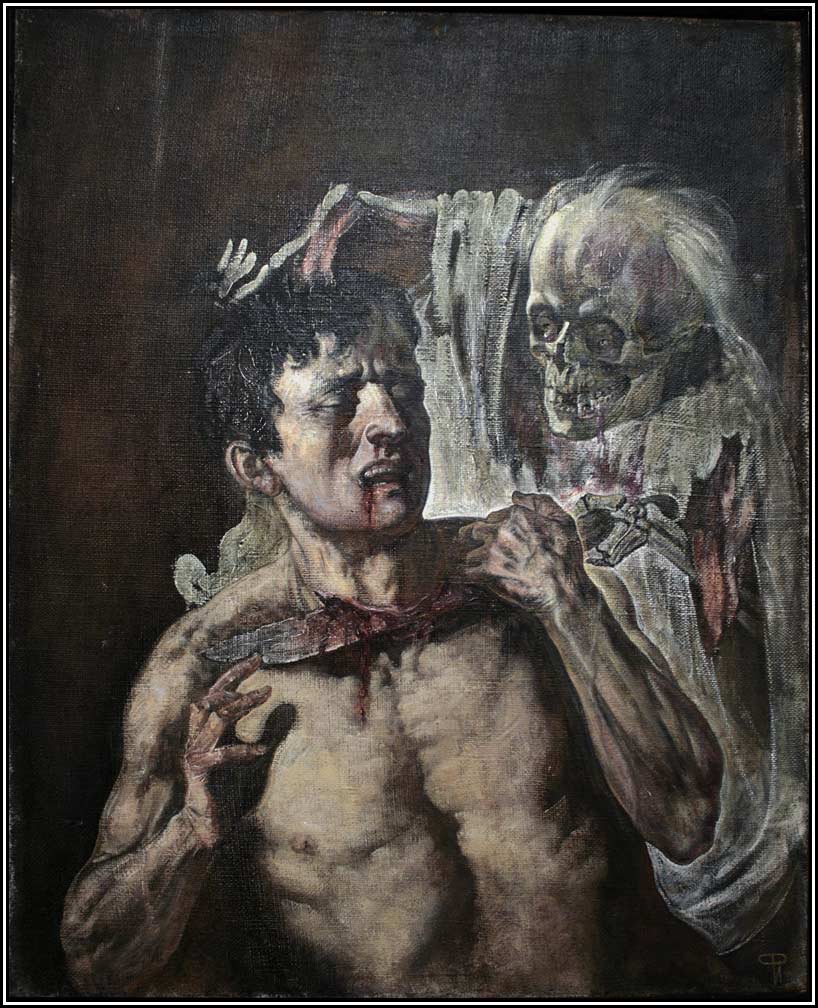
We have already discussed that the Way of the Magus is not a steady ascent and continual perfecting; it is a succession of battles, victories, but also — inevitably — a series of defeats.
Moreover, the higher a Magus rises in his victories, the farther he must fall.
It may seem that only yesterday the Magus was basking in light and power, his prospects rosy and victory close. But then — one false step, one unnoticed lapse — and the hard but still joyful ascent gives way to a dizzying fall into darkness.
And if yesterday the world was full of life, and the gods and spirits spoke easily with the Magus, the next moment he is surrounded by gloom, emptiness and ominous silence.
Such a state of “abandonment by the gods“, or, more precisely, “loss of power”, is familiar to all seekers of power, regardless of their particular Way.
It often seems that yesterday’s friends have betrayed him, and yesterday’s helpers have abandoned him, and one longs to plunge headlong into the intoxicating abyss of despair, beyond which lies only nonexistence.
Nevertheless, despite all the gloom and horror of such falls, despite the unimaginable pain of losses and sacrifices that accompany them, they are a necessary element of development, the very crucible in which all that is superfluous, temporary and counterfeit is burned away, and only that which is truly worthy remains.
Unlike the religious Way, the Way of Magic does not rely on divine mercy. For Magi, life is a harsh reality in which only those who make every effort to survive will do so.
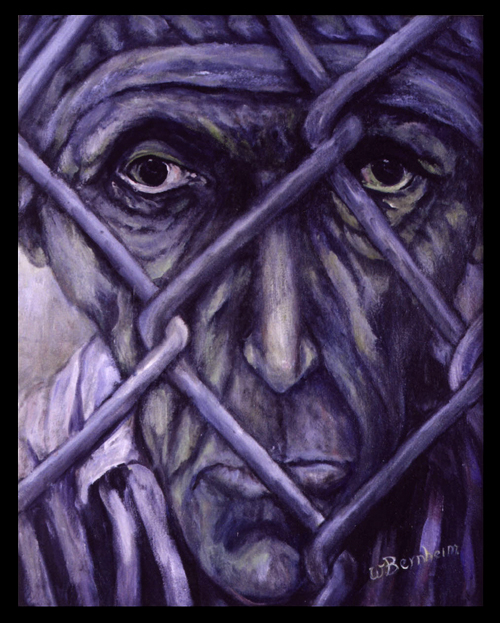
And anyone who sets foot on the Way of Magic must understand well that now he will have to pay for all his mistakes himself — all buffers in the form of egregore and other protective systems are stripped away, and the Magus is left one-on-one with the brutal reality of a world at war.
Of course, everyone would prefer to avoid problems, falls and betrayal. But that is precisely why the Way of the Magus is the Way of the Warrior: it allows no second of relaxation, not a minute of carelessness.
The Magus must understand that any development, any broadening of his horizons is accompanied by a mental shift from one relatively stable state to another, and between these stable — and therefore subjectively comfortable — states there lies a region not accessible to the ordering action of the mind. Traditionally such states are called “abysses” or “veils“. And when the mind experiences such a “transition period” it undergoes a state of uncertainty and chaos, subjectively perceived as severe suffering. Any transition, any Initiation is always, in a sense, a “fall into darkness”, since a mind bereft of inner stability falls into the sway of chaotic forces.
If a Magus has decided to go against a cosmos founded on universal consumption, he must be prepared for that cosmos not to welcome him with cheers.
If he has decided to stop being a victim, he must understand that a disobedient domestic animal is put down by good farmers, and therefore those who benefited from him will do everything either to regain power over him or to wipe him from the face of the earth, so as to prevent the spread of the contagion.
In fact, Magi are a disease of the cosmos. After all, without them everything is fine and harmonious — everyone preys on one another with complacency, everyone is satisfied and unconcerned. Suffering arises when something goes awry — when the little cutlet suddenly jumps off the plate and claims independent existence.
To lessen the disheartening effect of the falls, it is very important for the Magus to stop nurturing illusions of the world’s “friendliness.” He hoped for help — but it was not given, and to the pain of the fall is added the pain of “betrayal.” But there was no betrayal: no one owed him help.
Only those who walk the same way as he does, only those who fight alongside him in the same battles — can and should support him.
It is hard to accept, but perhaps that is how it is… Only if the ‘norm’ for the universe is that we are merely food and should not resist it, then where did we get the ability to realize this state of affairs and desire to disrupt it – to desire to survive? If we are part of the universe, why did it allow such a damaging capability to manifest in us? Or did it come from Someone who gives us (for free? why?) still a chance to have a chance?
Perhaps, the norm for the universe is the existence of hunters and prey… in the animal world everything is simple: there is no good and evil – either you eat or you are eaten… but for the human world everything is very cunningly devised, as we are free to choose who to be.
Oh, how truthfully familiar…
Good Day. The article raised many questions, and while I was describing them, I received answers. One question remains that is similar to Maxim’s. How is it that the force for a mage remains open in such a scenario?
The fact that the world is as it is, is not initially embedded in it, though it is a natural feature of its development. This idea is expressed in the traditional concept of the ‘fall’ of the world. Therefore, it is quite natural that the world not only shackles in the chains of consumption but also gives a chance to break free from those chains.
You once wrote that even gods are born as humans in our world to exit the gilgul. Does this mean that the world of humans possesses some special properties that allow for ‘easier’ liberation?
Absolutely correct, and this property – balance between the world polarities, is achieved in the position of the human world (but I have written about this already).