Battle of Tailtiu
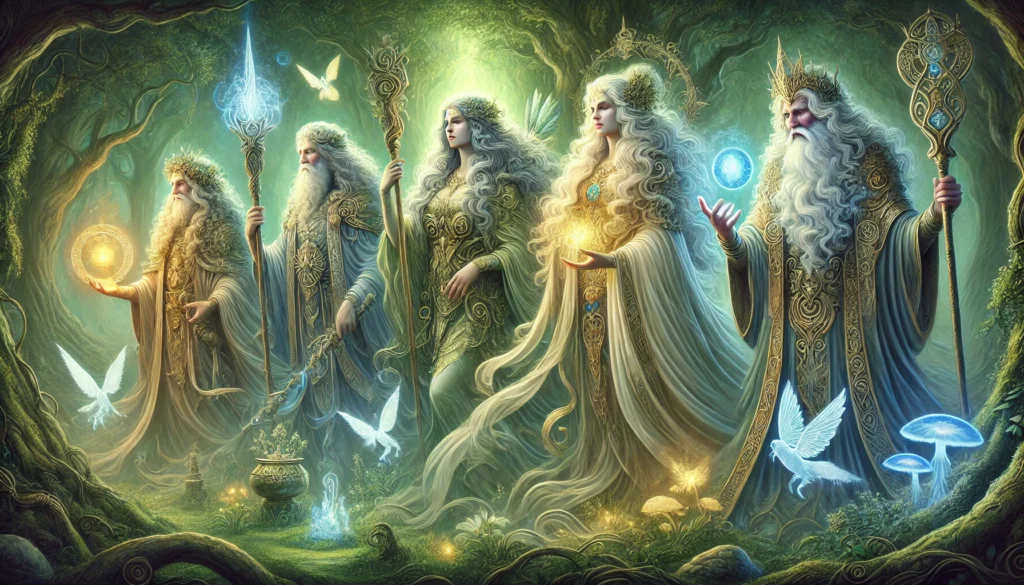
As we have already discussed, the metahistory of Earth includes, among other things, two important dramas that affected the course of development of human consciousness as a whole – the division of the planet into Tellus (Geb) and Jörd, and the Exodus of the fairies into the Interworld.
Let’s discuss in more detail the story of the second tragedy. These events are described in detail in the medieval epic, in particular, in the Irish “Book of Invasions” (Lebor Gabála Érenn).
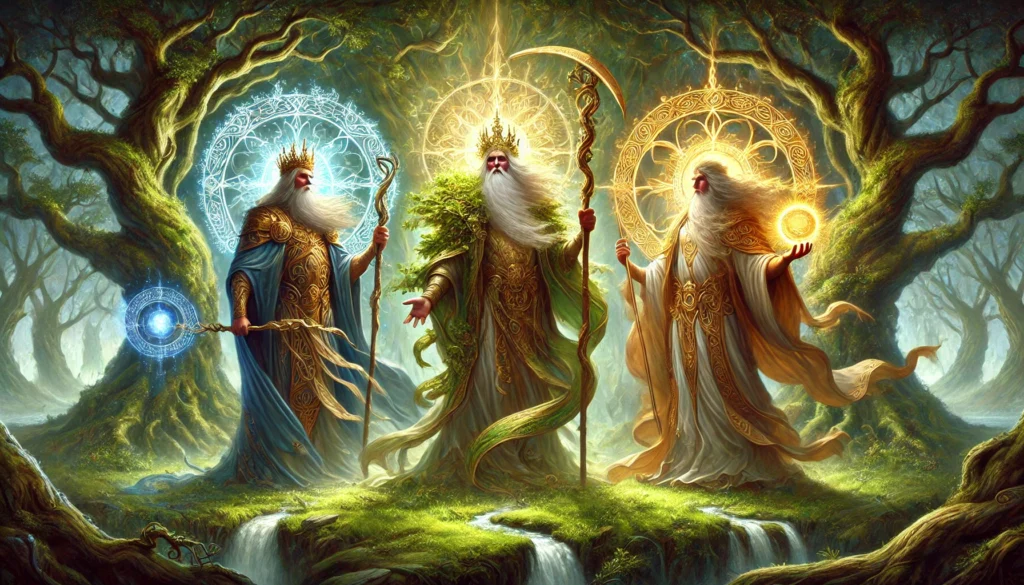
Before the spread of humans across the world of Earth (An Domhan), three great kings of the higher fairies ruled – Tuatha Dé Danann, who received from the gods power over three most important forces:
Mac Cuill (Mac Cuill) — “Son of the forest (Son of the Hazel)”, whose name is associated with the hazel tree, which in Celtic tradition was a sacred tree personifying wisdom, knowledge, and inspiration. Mac Cuill expressed the power of nature, the connection with forests and the highest wisdom that comes from them. Thus, Mac Cuill represented spiritual and magical wisdom.
Mac Cecht (Mac Cecht) — “Son of the plough” — embodied material life and labor. His name is associated with agriculture, work on the land, and cultivation. Mac Cecht represented a force linked to earthly fertility, productive labor, and the earth’s power. He embodied the creation and maintenance of life through work on the land.
Mac Gréine (Mac Gréine) — “Son of the sun” — governed the cosmic order and the rhythms of life. His name is associated with the day-star as the source of life, energy, and warmth. Thus, Mac Gréine personified the light and power of the heavens, the influence of the sun on life on earth, and order in time.
These kings were the sons of Cermait Milbeo (Cermait Milbeo), one of the gods of the Tuatha Dé Danann, who, in turn, was the son of the great god Dagda. Thus, they came from a divine line that ruled Earth with the help of magic, wisdom, and power. Although each of the kings was associated with a certain force, together they ruled as a triune unity, personifying three fundamental aspects of life and nature. This unity embodied the harmony between earth, sky, and forest, which was disrupted by the arrival of a new order.
At the height of Fimbulvetr, the Great Glaciation, and another change of Ages (about 40 thousand years ago), humans of the genus Homo began to acquire their modern appearance and character and, first of all, began to fight among themselves. Three main types – the so-called Neanderthal, Cro-Magnon, and Denisovan human – fought and actively interbred with each other until a single species Homo sapiens remained. As a result, 12–15 thousand years ago, highly aggressive, hypersexual population appeared, which began its broad and destructive expansion across the planet.
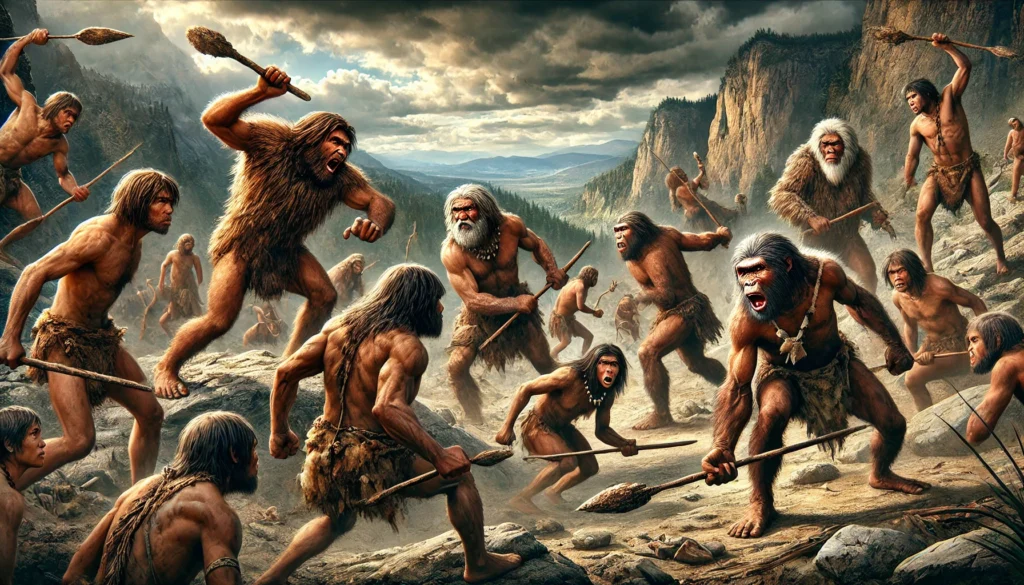
From the moment humans appeared and until the completion of their formation as a single species standing at the top of the biological food chain, humans and fairies coexisted relatively peacefully: the Immortal People from above (and, as later events showed, carelessly) watched the conflicts between their younger neighbors, who honed their combat and expansionist skills.
And inevitably the moment came when the growing humanity no longer coexisted with the fairies, but began to pressure the Magical People, at first competing only for habitats and their resources.
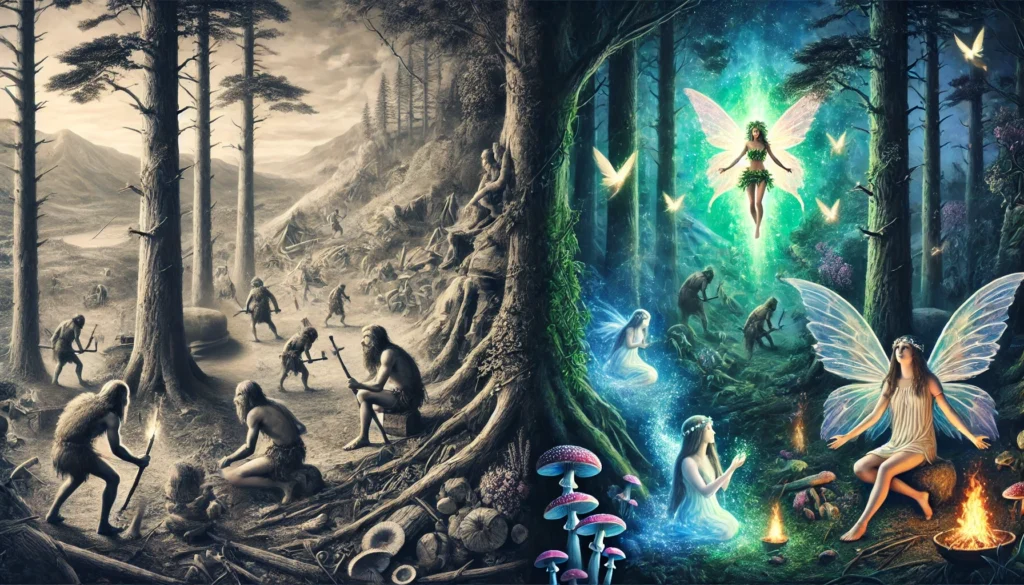
The myth describes these events as an attempt by one of the human leaders – Ith – to “divide” Earth between humans (the so-called Milesians) and the fairies led by the Tuatha Dé Danann. Ith, as a representative of the Milesians, serves as an image of human rationality, curiosity, and expansion. His arrival in the lands of the fairies seemingly aims at “study” or “establishing contact” with the ancient rulers, which can be interpreted as humanity’s first step toward studying and conquering the forces of nature. He offers the fairies to “divide the territories” and live in harmony, which expresses the first attempts of humans to “come to an agreement” with nature and establish new rules of interaction. However, the Tuatha Dé Danann see in Ith a threat not only to their power but also to the established natural order, and they kill Ith. The death of Ith shows the impossibility of establishing a balance between humanity in its new form and nature.
This event reflects the moment when harmonious relations between humans and nature become impossible, and conflict begins. Such a death can be interpreted as the first sacrifice in the struggle for resources, lands, and power, and is known as the “Bronze Age Collapse”, which destroyed many civilizations around the 12th century BCE.
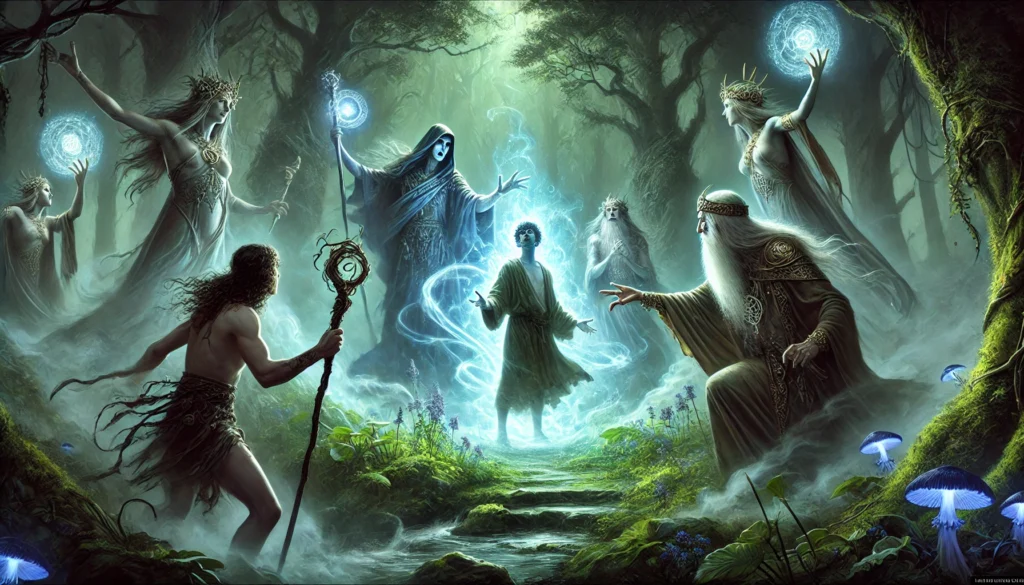
The story of the “murder of Ith” also reflects the human drive for expansion that developed within him, the exploration of new lands and the taking possession of their riches, and also sets a precedent, justifies and “sanctifies” further human aggression against natural orders. Now humans are no longer just invaders; they are avenging the murder of their leader, which in their eyes justifies the subsequent violence. The huge chain of conflicts that swept across the earth at that time reflects these changes of mind.
After the unsuccessful attempts at settlement – the “murder of Ith” – growing humanity enters the Iron Age and an era of conflicts begins, where humans strive to prevail over nature, to control its resources, and to subordinate its laws to their reason and needs.
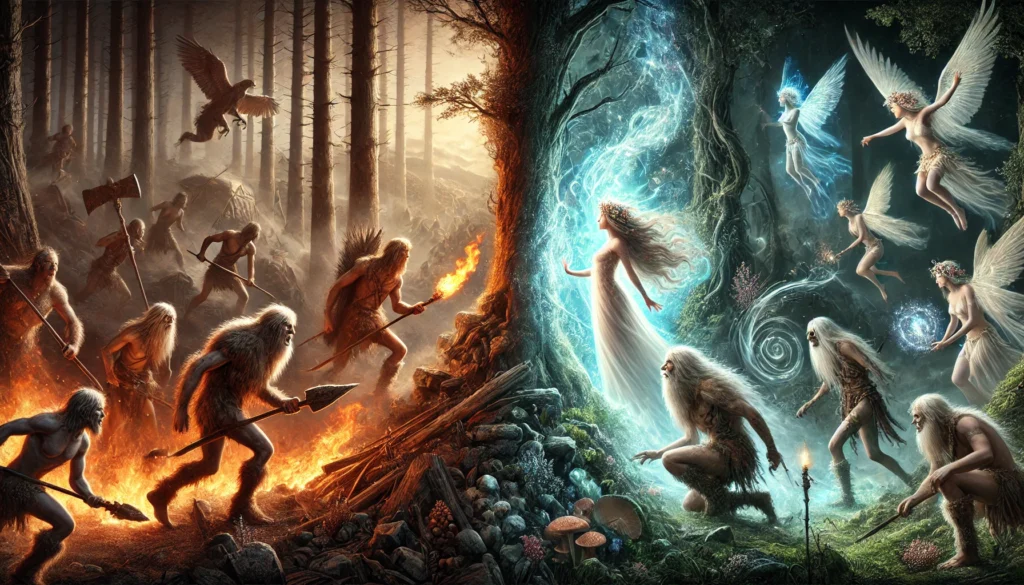
Until humans united in their onslaught against nature and the forces defending it, the fairy (together with the elementals and semi-divine entities) coped without much difficulty with the expansionist impulses of the growing humanity. However, humans were too greedy and aggressive to simply live in harmony with the world. They discovered and began to widely use iron, gaining a huge advantage in this confrontation, and went on the assault against nature, cutting down forests, draining swamps, and building dams on rivers. This is reflected in the next story of the Myth.
After the death of Ith, his relatives, led by the sons of Míl — Amergin, Éber, and Érimón, swore to avenge the murder. They gathered a large army and set off to conquer the lands of the fairies.
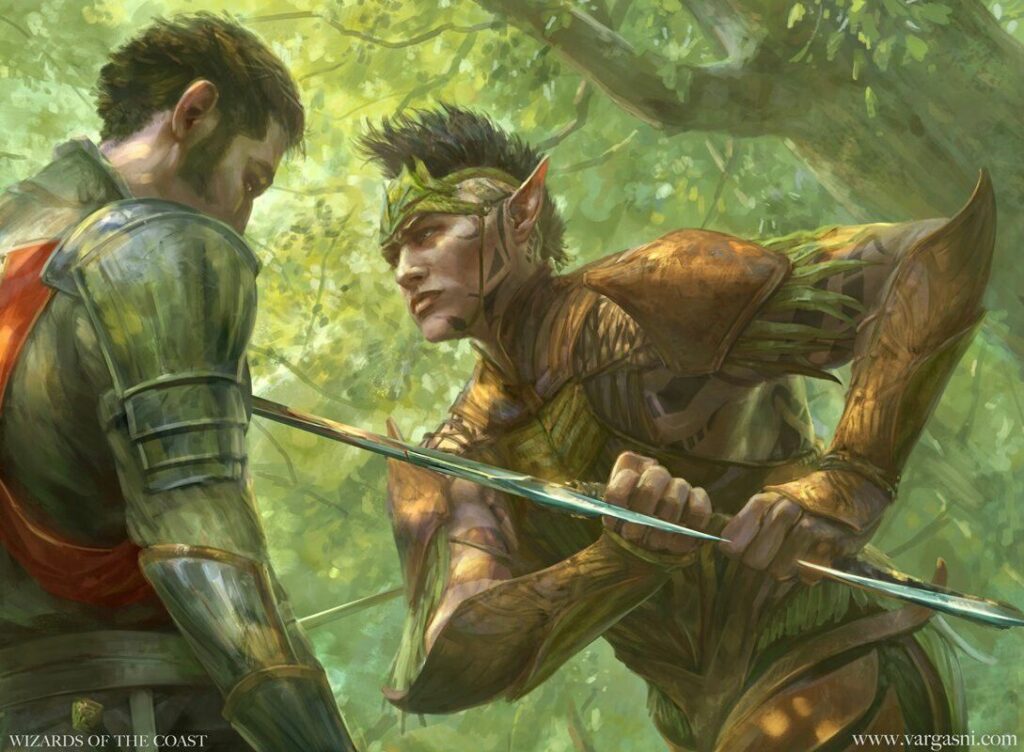
Nor are the names of the leaders of this army accidental — the Eight sons of Míl — Éber Finn, Éber Donn, Érimón, Ór, Érannán, Amergin, Colptha, and Ír. Éber Finn (Éber Finn): Éber means “beauty” or “light”, and Finn — “fair”, “white”, or “pure”; this is the embodiment of reason, the “Apollonian” principle of humans, which is contrasted with the elemental and “Dionysian” nature of the fairies. Éber Donn (Éber Donn): Donn means “dark” or “brown”; represents a connection with the underworld and death. He becomes the first ruler of the “human” world of the dead. Érimón (Érimón) — “king” or “chieftain”; personifies power, leadership, and governance. He became the first High King of humans. Ór (Ór) — “gold” — is associated with material wealth, well-being, and prosperity. Érannán (Érennán) — from Éire, meaning “land”, emphasizes humans’ right to possess the material world. Amergin (Amhairghin) — “birth of song” or “born of song” — was a poet and druid, representing magical and spiritual knowledge. Colptha (Colptha) — the name is associated with the word “column” or “pillar”, represents foundation, stability, and support. Ír (Ír) — means “He who travels” and embodies the spirit of exploration, the discovery of new lands, and the spread of human influence. The names of the eight sons of Míl reflect the full spectrum of aspects necessary for creating a new society on Earth. They combine spiritual (Amergin, Érannán), political (Érimón, Éber Donn), natural (Éber Finn, Ór), economic (Colptha), and cosmological (Ír, as a symbol of movement and time) aspects of human nature.
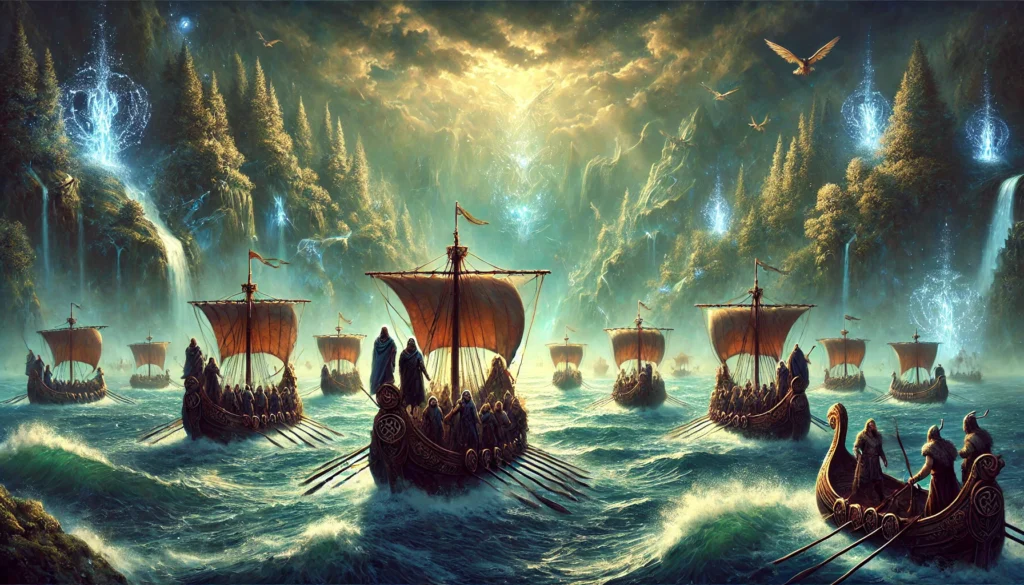
The Tuatha Dé Danann, unwilling to let the Milesians into their possessions, used magic. They created an illusion, hiding Earth with fog to throw the enemies off course. However, the Milesian poet and druid Amergin, possessing a magical gift, was able to dispel the fog. This part of the story shows that gradually humans learned to control the world not only by physical but also by magical means, striking the fairy “with their own weapon.”
The decisive battle is the so-called “Battle of Tailtiu”, where the divine forces of the Tuatha Dé Danann clashed with the physical and strategic power of the Milesians. Here the power of Amergin manifests with particular activity, whose spells and poetic art helped break the magical resistance of the Tuatha Dé Danann.
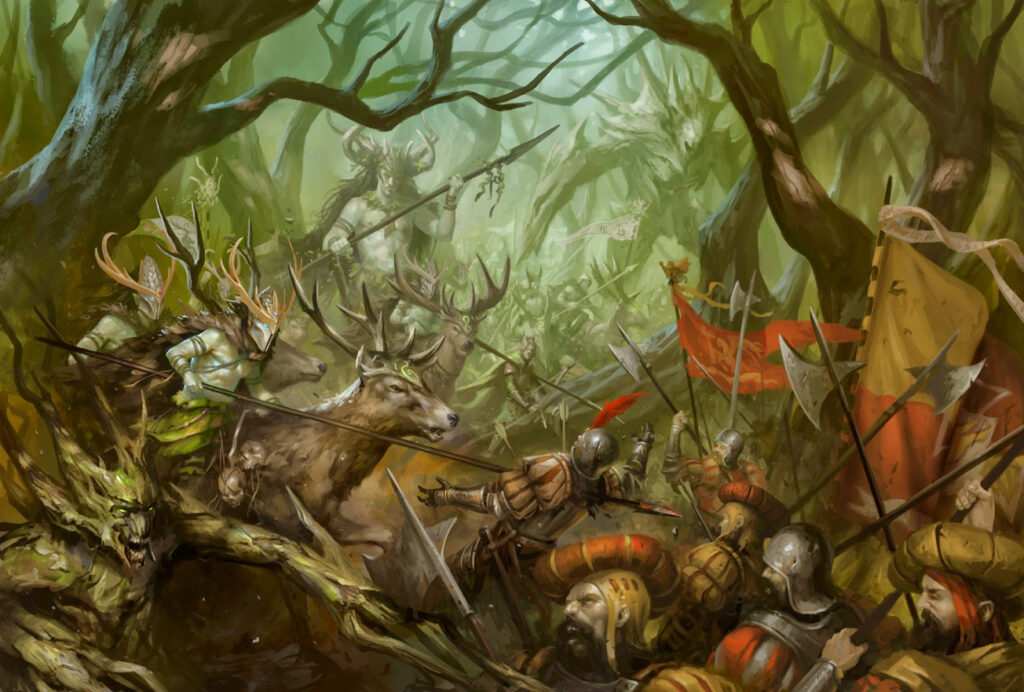
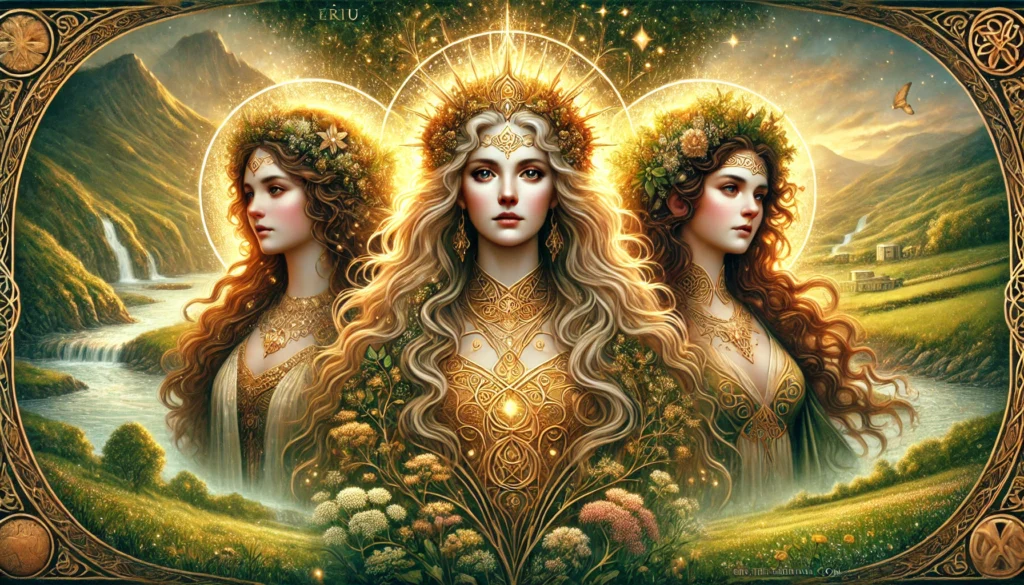
Let us recall that Tailtiu is the goddess of Earth, the foster mother of the Sun god — Lugh, and, accordingly, the Battle is, above all, about how relations will be organized with Earth — whether harmonious life will continue (as it was during the reign of the fairy Kings), or whether a consumerist and oppressive attitude of the Milesians (humans of the genus Homo) will prevail. To emphasize this nature of the battle, the Myth describes the first clash of humans not with the armies of the fairies, but with their three Queens — Ériu, Banba, and Fódla, whose names are different epithets of Earth: Ériu is linked with the Proto-Indo-European root piHwer- or īwer-, meaning “land” or “dwelling”; Banba is linked to the ancient word ban– or bán, meaning “bright” or “white”, and can also indicate the “female aspect”, as in the meaning of “wife” or “woman”; Fódla comes from the word fód, meaning “soil” or “earth”. This name points to the physical foundation, the very matter of the land. Thus, Ériu personifies the spirit of Earth itself, its heart and essence. She is the principal of the three sisters and represents the central, fertile, life-giving force. Banba embodies the bright, exalted aspect of Earth, its connection with the heavens and the spiritual sphere. She is also associated with antiquity and primordial nature. Fódla represents the flesh of Earth, its stable foundation that sustains life. She embodies the connection with roots, with soil and fertility necessary for survival.
Their three husbands — the three kings Mac Cuill, Mac Cecht, and Mac Gréine — offered the Milesians a truce for three days. The condition was that the Milesians would remain on their ships, anchored at a distance of nine waves from the shore. The Milesians agreed, but the Tuatha Dé Danann took advantage of this by raising a magical storm to drive them away. Amergin, who possessed a great gift of words, was able to calm the raging sea with the help of his verses. After this, the Milesians landed on the shore and won a victory over the Tuatha Dé Danann in the battle at Tailtiu. This was one of the decisive battles where the divine forces of the Tuatha Dé Danann clashed with the physical and strategic power of the Milesians. In other words, the fairies tried to prevent the invasion of humans into their territory; however, lacking combat skills and shunning cruelty and aggression, they were pushed ever farther away from the territories seized and developed by humans.
Accordingly, the Myth reminds that harmony between humanity and nature is possible only as long as humanity does not try to seize its resources and order by force.

Thus, the “Battle of Tailtiu” symbolizes the entire period of humanity’s wide expansion in ancient times, when the first states were born, and the world lost its magical uncertainty and became ever more known, described, fixed. After the arrival of the Milesians and the defeat of the Tuatha Dé Danann, the three kings were killed, and thus the forces of Earth passed under human control. Their death marks the end of the rule of the Tuatha Dé Danann in the physical world, after which the fairies departed into the interspace, becoming the rulers of its regions.
When later Amergin (that is, the personification of human wisdom) was asked to divide the land fairly between his people and the Tuatha Dé Danann, he showed cunning: he gave the aboveground part to the Milesians, and the underground part — to the Tuatha Dé Danann. Thus, the Tuatha Dé Danann withdrew into the world of the underground hills of the Sídhe. Under the leadership of Manannán mac Lir they departed into the Interworld — Tír na nÓg — a magical country of eternal youth, also known as the “Flower Plain” or the “Plain of Honey.”
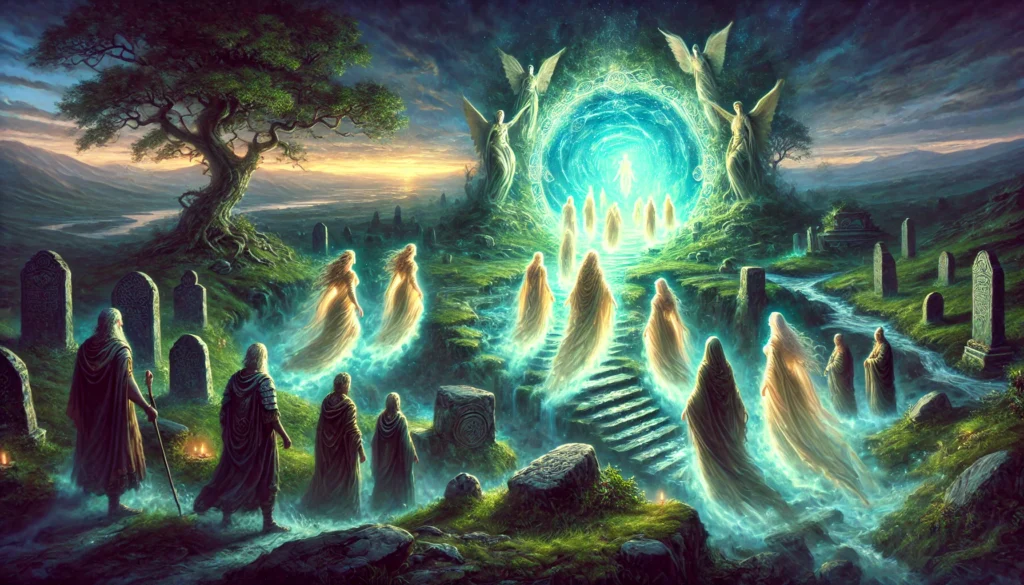
We have already said that this Exodus began approximately in the 4th century BCE and lasted until approximately the 11th century, taking about one and a half thousand years.
According to the Myth, Earth — Tailtiu — died of exhaustion when humans began cutting down forests in order to sow their fields and arrange pastures. Before her death, she asked that annual festivals be held in her honor, celebrating the fruits of the earth and of labor. The Sun god — Lugh, honoring her memory, established Áenach Tailteann — funeral games and a harvest festival, which today is known as Lughnasadh.
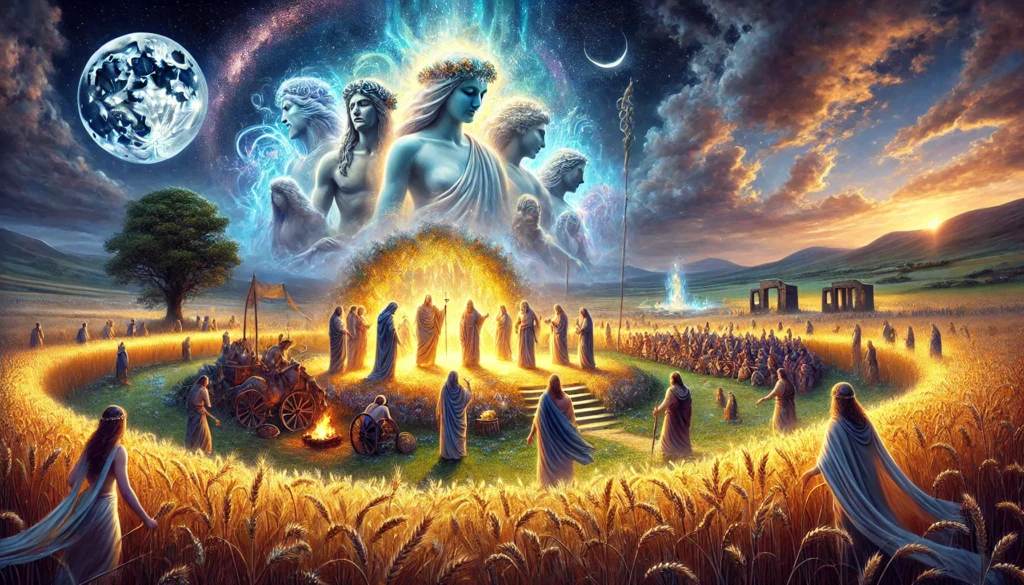
This death of the “primordial earth” reflects one of the most significant transitions in human history: from harmonious relationships with nature, characteristic of the ages of hunting and gathering, to intensive agriculture and the transformation of the natural environment. This transition is associated not only with a change in ways of survival, but also with a deep transformation of their worldview and cultural values. Forests, once considered the abodes of the gods, began to be perceived as an obstacle to agriculture, and the earth itself turns from the Sacred Mother into a resource that must be controlled and used.
In the modern world, where ecological crises have become indisputable, awareness of the value of the “primordial earth” and the restoration of harmony with nature should become the key to a sustainable future. The myth of the death of Tailtiu should not be forgotten — it should inspire revival and a careful attitude toward what still remains. And the Magical People tirelessly remind that humans must see in nature not merely a resource, but an ally. Relations with nature are cooperation, not exploitation, but cooperation. And respect for the Magical People should be understood above all as the restoration of a spiritual connection with nature, which includes not only care for material wealth, but also the revival of the perception of nature as a living world full of wonders and Magic.
“fairy… shunning baseness and aggression”
How does this correlate with:
“He offers the fairies to ‘divide territories’ and live in harmony… However, the Tuatha de Danann see Ita not only as a threat to their power, but to the natural order established, and kill Ita.”
Or:
“the three kings Mac Cuill, Mac Keth, and Mac Greine – proposed a truce to the Milesians for three days. The condition was that the Milesians remained on their ships, anchoring nine waves from shore. The Milesians agreed, but the Tuatha de Danann took advantage of this, causing a magical storm.”
In my opinion, it is obvious from the myth that the fairies were aggressive, deceitful, and vile towards humans. They killed Ita, who did not show aggression, lied about the truce they proposed, and sneaked attacked the people who fulfilled the conditions of the truce.
Yes, yes, history knows many examples of how people love to fulfill agreements: Native Americans, who agreed to the conditions of the conquistadors, were almost completely destroyed. People invaded the lands of the fairies, where the Magical people had lived for millions of years, and offered to ‘divide’ foreign resources, and the fairies strangely turned out to be against it. But people still ousted them and destroyed everything nature had created over millions of years. And although the fairies sometimes behaved arrogantly, they always took care of the world, never disrupting its balance or sowing destruction.
I meant the interpretation of the myth; it clearly suggests that the fairies initially gave reason to seek revenge for the murder and then to punish for the violation of the agreement – perhaps that is what gave humans the strength to win? Moreover, in the myth, humans conquered the land fairly, in battle, outsmarting magical fairies even in magic.
“The Magical people had lived for millions of years”
Maybe those were millions of years of stagnation, and when the challenge posed by humans appeared, instead of showing wisdom and strength by integrating humans into their order and harmony, the fairies exhibited arrogance and weakness, and it was humans deciding where there was now a place for fairies.
Recently, a good movie ‘Killers of the Flower Moon’ came out, it is very reminiscent of it.
In Game of Thrones, there is a moment when the children of the forest create the first White Walker from a man. That is, a kind of ‘balancing’ response, cursing humanity. Is there something similar present in the human being?
Hello!
It seems that you are biased.
On the basis of the conquistadors’ actions, you generalized and concluded that ‘all men are goats’, meaning that these people are bad.
People first offered and then, after the murder of their leader, invaded, not the other way around.
Perhaps he said: ‘To avoid conflicts in the future, let’s immediately define what belongs to whom.’
I agree with two comments by NickNick. Thank you.
Absolutely right, I am biased. I know that, for the most part, fairies look upon humans with disgust, and spirits of nature and elemental beings share a similar disdain. Yet, there is no hatred or aggression toward humans, just a deep, and in my opinion, completely justified antipathy. Human consciousness is hopelessly sick; it is poisoned by consumerism, greed, and malice. In the thousand years since the fairies’ exodus, humans have hopelessly spoiled the Earth, chopped down (and continue to chop down) the majority of forests, exterminated (and continue to exterminate) hundreds of animal species, polluted (and continue to pollute) the waters and air. And there is no sign of the slightest desire to fix the situation or change their way of acting. If the fairies had won then, the planet would surely be much better off. As for humans, our prospects are quite dark – we either destroy ourselves or we become utterly demonized and become an even greater evil than we are now. The chances for humanity’s ‘recovery’ are negligibly small. So if the fairies were wrong in anything, it was simply in agreeing to negotiate with humans at all.
Glaciers, volcanoes, meteorites… have exterminated far more animals, burned far more forests, and polluted the air far worse than all of humanity throughout its history. There are vast territories on Earth covered with volcanic ash dozens of meters thick, impact craters hundreds of kilometers in diameter, and periods when complex life on Earth was nearly completely wiped out, all due to natural reasons. Perhaps the task of humans is precisely to tame volcanoes, manage the climate, protect the Earth from meteorites, and the current ‘excesses’ are the problems of growth?
‘For the most part, fairies look upon humans with disgust.’
And meanwhile, people are defending dissertations on OSA and are inching closer to incorporating that area of the Between-Worlds, where fairies currently reside, into their scientific worldview. It is interesting how long it will be until political leaders realize that they can achieve ersatz immortality like that of the pharaohs and start an expansion into these, still ‘fairy-tale’, realms at a new technical level?
Do you think they haven’t started?)
Why would they reveal the truth, only to lose power?
Representatives from other civilizations are present at UN meetings in particular.
This world is feared, and its inhabitants are denied access to most worlds.
Yes, I was just teasing the author a bit, he seems to sympathize a lot with the fairies. In my humble opinion, the game is much more complex – as far as I understand, fairies started to INVITE people to the Eternal City in the early 90s, at that time the foundations were laid for what might soon become a digital concentration camp, the idea being to lock people into, let’s say, ‘secondary’ virtual worlds, and if in ‘The Matrix’ this was orchestrated by ‘evil AIs’, our ‘immortality’ will be sold for big money, which is quite amusing.
By the time people came to negotiate with the fairies, they had already shown themselves and the fairies formed an opinion about them as barbaric destroyers, which is why the fairies did not negotiate with humans, as they as magicians had a keen vision and thus saw the corruption of human nature through and through and, consequently, the harmfulness of human expansion. Thus, the fairies even ‘committed an act of treachery’ by killing Ita since they decided that by committing a small evil they would prevent a greater evil. The fairies also had the right to such ‘treachery’ towards humans since humans, by their behavior (which the fairies had long observed), deserved such an attitude. Additionally, by virtue of being older and wiser inhabitants of the planet, they practically had the right to punish humans and act at their discretion since caste matters here. According to spiritual laws, the question of hierarchy is important, and humans were the lowest chain of evolution compared to fairies. If fairies had four casts as magicians and humans were barbaric beings destroying living beings (the spirits of sacred groves are living beings, just like the animals, which the insatiable and wild humanity continues to exterminate for fun during hunts, by the way, this is how humans also treat their women – so much violence have human women endured from human men that no martyr of hell has suffered as much!), they were from the lower casts, and thus, from the perspective of spiritual laws, their rationality cannot be called into question! Therefore, according to spiritual laws, if a lower caste attacked a higher caste, then the higher caste has the right to demand compensation fortyfold! Hence the state in which humans currently find themselves, they have deserved it, as Enmerkar writes: ‘humans… have become something foreign and largely demonic, which caused a confrontation with the previously benevolent forces… The result of this was the ‘alliance’ of the Archons with the Alvs (and the Fomorians), aimed at completely turning Midgard into a ‘farm’ for feeding Duat, depriving it of the last prospects for development’. But since magicians, esotericists, etc. are not taken seriously, therefore, this blog can be perceived as intellectual food for thought or personal musings of the author, thus scientific data confirming that a war is indeed being waged against humanity and specifically against human males has recently been conducted, the largest act of sabotage in history has been committed against them. It turns out that in the 20th century, testosterone levels in men fell by almost 70%! Also, the percentage of viable sperm in the ejaculate of young men has significantly dropped, i.e., modern men are becoming essentially infertile. Right before our eyes, men are turning into another biological species as without testosterone there is a gradual transition from male to female. Most scientists cannot find reasons for this phenomenon, but some experts suggest that the cause for the decline in libido in Western men is the herbicide Atrazine, used in Europe and the USA since the early 20th century. https://zdesvamnetut100-livejournal-com.turbopages.org/zdesvamnetut100.livejournal.com/s/612841.html https://www.nbcnews.com/id/wbna45522468
Therefore, someone is firstly intentionally spreading it, and secondly, this same someone is concealing the decline of testosterone levels in men as very few studies on this problem can be found on the internet. Here is a blogger’s selection of research from around the world https://www.youtube.com/watch?v=RHgyr4HpRRs&t=90s Therefore, this is an intentional sabotage since the consequences of reducing testosterone and effectively chemically castrating men are notable – it is the increase in the West of men wishing to change gender and become women, as well as an increase in men of non-traditional orientation (if magicians like Crowley experimented with this due to heightened sexuality, modern Western men are forced to move towards feminization as they are chemically castrated). But instead of searching for the reasons behind such behavior of Western men, the propaganda screams that it is their free choice, but if they were castrated by Atrazine, then they had no choice, and someone has been intentionally castrating men for a century. Based on this article by Enmerkar, one might venture to suggest that it was done by fairies, not the globalist Jews (who are accused of all troubles, since Jews could have poisoned themselves with Atrazine, thus it wouldn’t be reasonable for them to use Atrazine against goyim). But undoubtedly, it was someone who hates people and specifically fights against human males. Therefore, what happened when humans defeated the fairies and the latter were forced to retreat from Midgard to the Inter-realm reminds me of a story about a certain cat – when he, as a kitten, grew up to a breeding age, he began to mark the owner’s table in the kitchen, and no persuasion, negotiations, or even punitive measures in the form of punishments had any effect on the cat; he continued stubbornly ‘waving his balls’ in front of the owners and disrupted the hierarchy, proving that he is the main one in the apartment and will urinate wherever he wants. Ultimately, the cat’s fate was sealed, the owners made a conclusion about him and ceased fighting with him; in the last days before the operation, he freely urinated on the table, and then they cut off his balls, and he grew so fat that he couldn’t even jump onto the stool anymore. The same goes for humans; they won the battle in the direct confrontation, as it could not have been otherwise since ‘animals’ are physically stronger and more aggressive, but since magicians are of the fourth caste and thus the higher caste precisely because they surpass the lower castes in intellect, fairies thus began to battle humans on their level – that is, in ways humans could not even guess – which is evidenced by the example of chemical castration of men, which has been secretly ongoing for a century and has led to the creation of a new species of men in the West; therefore, when Arab and African migrants were brought to the West, white men found themselves incapable of resisting them and are today surrendering their civilization to these occupiers – for they should not have ‘waved their balls’ in front of the upper casts – they were cut off just like the cat. And the story of chemical castration is just one of the many petty tricks played on humans by the higher castes; I know a ton of similar traps that have been implemented to subdue people, as well as in his blog Enmerkar discusses in detail how they exploit humans for energy and what tricks stronger beings use against humans.
After COVID, many people have memory problems. Is it not linked to some transition into a slightly different world?
Initially, the sanction for COVID was given to the forces of order to restrain uncontrolled and parasitic consumption of natural resources. However, since Order is disrupted in virtually every country, the Intelligent virus has spread widely. The more distorted the matrix of being is and the more deviations from the original there are, the more destructive the virus becomes. Added to this is the task of teaching people to value life.
Each infected person is a carrier.
Recurrence and activation of the virus occur with a negative attitude towards the surrounding world.
Can the war between fairies and humans be interpreted as establishing a broad form/strategy of human consciousness and the beginning of the ‘forgetting’ by the majority of people of previous life experiences (loss of depth)?
Of course, that’s exactly how it is. In theory, humans and fairies could continue to coexist, learning about the world from each other’s perspectives. But back then, people had already given up the prospects of broad thinking; they sought certainty and unequivocality in their world, thus destroying everything that ‘blurred’ the borders of their reality. The conflict between humans and fairies is more than just competition for territories or resources; it is a conflict of worldviews, attitudes toward the world. Even the Geba humanity, which treats its environment much more carefully, could not establish a durable alliance with fairies, and even from there, the Magical people were compelled to depart (though not as massively as from Erd). People, in their very nature, chose to oppose the world; they perceived their ‘expulsion from Eden’ not as a challenge or as a way to find a new harmony but rather deepened their alienation and opposition.
But what is human nature? Does it not reflect the cosmos in its entirety, together with possible distortions?
You write as if humans had some choice to act differently. Meanwhile, people have been cattle for feeding the interval all along. It is fundamentally a deterministic process. There is choice only for an absolute minority capable of even slightly grasping their position. And humans are victims and hostages of the world order, their place in the world, their ‘own’ predation and consumerism, the necessity to survive in this aggressive environment, which is the necessity within certainty.
Hostages? Well, it’s a matter of perspective. If consciousness is the force collapsing the wave function, then free will exists. Therefore, there can’t be ‘hostages’. Secondly, the interval with archons and demons is simply the second ‘pole’ of the universe, due to which energy flow exists at all, and hence the entire universe. In short, the world is not a prison, and people are not dolls. Although such a message is possible…