
Heinrich Cornelius Agrippa and his “Occult Philosophy”
“Go your own way and draw your sword”
It is unlikely that there is a practicing Magus who does not know this work, which inspired Goethe and J. Dee, hailed by some as a “textbook of Magic” and by others as merely an “exercise of the imagination.”
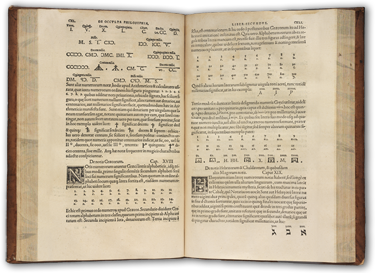
The treatise “On Occult Philosophy” (De Occulta Philosophia), which became the sum of all magical and occult knowledge of its time, was written by the young philosopher and Magus Heinrich Cornelius Agrippa von Nettesheim in 1510, but was published only in 1533, several years after the appearance of Agrippa’s book “On the Vanity of the Sciences” (“De vanitate scientiaram”, 1530) — a tract that declared the vanity of all the sciences, including the occult.
Agrippa was born on 14 September 1486 in Cologne. He received his education at the University of Cologne. Some biographers assert that Agrippa came from a noble family, but the prevailing view is that he himself chose the aristocratic name von Nettesheim, taking it in honor of a founder of Cologne.
While still a boy, Agrippa became secretary to the Emperor of Germany and Italy, Maximilian I. When he was twelve, Maximilian sent the boy to study at the University of Paris. There Agrippa joined the Rosicrucian order.
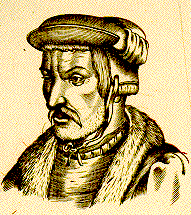
Agrippa von Nettesheim’s reputation as a Magus was established in his youth. It was said that in England, at the request of a court poet, he showed in a magic mirror the image of the poet’s dead wife (this legend inspired “The Song of the Last Minstrel” by V. Skop). It was claimed that he possessed the secret of transmuting base metals into gold, and coins he used to pay at taverns turned into horse dung after he left. Agrippa was also credited with the ability to be in several places at once;
there is said to have been an occasion when he delivered public lectures at the same hour in two different cities. At one time Agrippa served in the army. For personal bravery he was knighted and received the rank of captain. Yet, according to many, he aided his troops’ victories by sorcery.
After finishing university at nineteen, Agrippa set out to travel across Europe, lecturing on occultism and Magic, studying rare manuscripts and books, meeting practicing Magi, and receiving ever deeper degrees of initiation in the mystical Rosicrucian order. The young Agrippa had a sound knowledge of Kabbalah, especially Gematria — its most mathematical part. His exposition of kabbalistic secrets at the university in Douai made him popular: he gained many admirers and received the degree of Doctor of Theology.
Agrippa was also a jurist (holding the doctorate of both laws, civil and canon), a physician, a writer (his literary output, besides large and small treatises, “experiments,” “discourses,” and studies on the most unexpected topics, includes pamphlets and poetic works), a theologian, an engineer, a historiographer, a soldier, a diplomat, an alchemist. He possessed excellent oratorical skills, was a skilled draftsman, and knew several languages (he personally translated one of his treatises from Latin into French).

One of the most admirable episodes in Agrippa’s biography is his rescue, in 1519, of an old French woman who had been condemned by the Inquisition as a “witch.” It is noteworthy that this formidable opponent of scholasticism succeeded in defending the poor woman only by resorting to ingenious scholastic arguments and stratagems.
In 1523 Agrippa became a physician in Freiburg. His high reputation and the recommendations of the Bishop of Bayeux enabled him the following year to go to France, where he became physician to the mother of Francis I. Later his patron became Charles V, who made him his historiographer.
After several clashes with the Church, the famous Magus withdrew and moved to London. By that time he had conceived a plan for an extensive work — the “Occult Philosophy.” He was only twenty-four when he completed this famous treatise. However, for reasons known to himself alone, he published it only four years before his death.
Of all the stories about Agrippa’s extraordinary abilities, after careful analysis, the most credible are his own accounts of contacts with the dead and with spirits. They suggest that he was more a gifted medium than a conventional Magus. One of the best-known testimonies recounts the instance when Agrippa, in the presence of a group of respected men, summoned Marcus Tullius Cicero himself in order to hear one of his famous speeches. Cicero, obedient to potent spells, appeared, delivered his speech, and disappeared, leaving the audience in tears of overwhelming emotion.
Around 1530 he published the treatise “On the Vanity of the Sciences and Arts,” in which he took a stand against all the sciences and against occultism, arguing that knowledge only reveals to a person how little he really knows. The book enraged the king, who imprisoned Agrippa for a year on charges of heresy. After his release, Agrippa’s “On Occult Philosophy” was printed, which seemed to contradict everything he had written in “On the Vanity of the Sciences and Arts.” So stark a contrast between the two books seriously damaged Agrippa’s reputation.
Because Agrippa, until the end of his life, had doubtless been most interested in the occult sciences, some think that the decision to publish a book on the impotence of the sciences before issuing their compendium in the treatise “On the Occult Philosophy” was a means of self-defense. Magi and astrologers often employed this device so that, if criticized by theologians, they could point to their own “rebuttals” of heterodox views. Generally, they were condemning only the perverse use of certain knowledge, not the proper use of it itself.
Agrippa went to Cologne, where he was pursued by the local inquisitor. Ultimately he was expelled not only from Cologne but forbidden to enter Germany at all. Agrippa returned to France, but his rude remarks about his former patroness, the queen mother, again resulted in his imprisonment. After his release Agrippa went to Grenoble, where he died in 1535.
Agrippa’s death gave rise to a new legend. According to it, sensing his end, Agrippa summoned to his bedside his shaggy dog Monsieur, and with stiffening fingers removed from his favorite a collar covered with kabbalistic signs and said: “Begone, accursed one! From you come all my misfortunes!” The dog is said to have tucked its tail, dashed from the house, run to the river, and drowned.
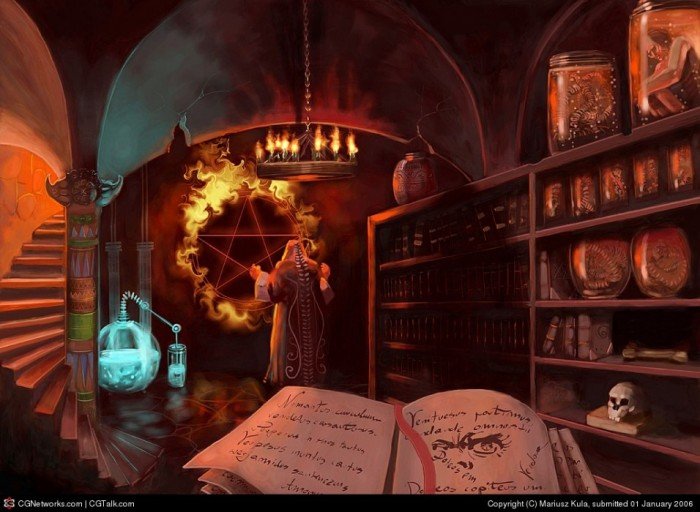
However, the most famous of the legends connected with Agrippa tells of one unfortunate youth who was killed in Agrippa’s study. Agrippa, then living in Louvain, Belgium, had rented a room to this young man. Once, when Agrippa was out of town, the youth asked the Magus’s wife for the keys to her husband’s study, saying he needed to read some books there. At first Agrippa’s wife refused, but the youth begged so persistently that she finally relented and gave him the keys. In the study the youth found a book of magical incantations lying on Agrippa’s table and began to read it aloud. Suddenly there was a knock at the door and a Demon appeared, who demanded to know why he had been summoned. The young man was so frightened that he could not answer; the Demon seized him by the throat and strangled him.
Returning home, Agrippa found the corpse in his study to his horror. Had he sought the authorities or removed the body from the house, he might have been accused of murder. So he summoned the Demon and compelled it to restore the body to life. The Demon brought the youth back, and Agrippa immediately sent him out to walk through the market square. There the youth suddenly died again, this time apparently of natural causes. But signs of decomposition were found on his body, and Agrippa was accused of murder. Once more he was forced to flee.
Let us now briefly consider the content of the work that immortalized Agrippa. Agrippa’s composition consists of four books. The first book is devoted to natural Magic, or the Magic of the elemental world; the second to celestial Magic; the third (and the fourth treated as distinct) to ritual Magic.
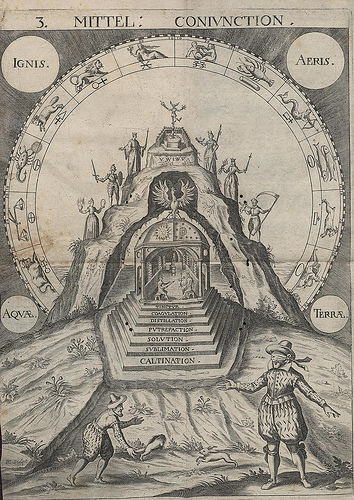
In the first two chapters of the first book Agrippa maintains that the universe consists of three worlds: the world of elements, the heavenly world, and the world grasped by the intellect. Each of these worlds receives currents from the world above it. The worlds are interrelated and influence one another. Thus the virtue (virtus) of the Creator descends through angels of the intelligible world to the stars of the heavenly world, and from them to the elements and to all objects composed of elements in the lower world: animals, plants, metals, stones, and so on. Magi suppose that we can travel this same path in reverse and bring down the forces of the higher world to us by manipulating the forces of the lower world. They attempt to investigate the properties of the elemental world through medicine and natural philosophy, the properties of the heavenly world through astrology and mathematics, and to gain an idea of the intelligible world by studying the sacred rites of various religions. Moreover, every object, substance, and chemical process — everything in the three worlds of the Universe — has both manifest and hidden properties. To understand the latter and learn to use them is to become a Magus. In principle, nothing is impossible. Having learned the secrets of the cosmos, a Magus can change the course of lightning, summon rain, walk on the sea, move mountains, and so forth.
The closing chapters of the first book discuss the power of words and names, the properties of proper names, and how to compose an incantation using all the names and attributes of a star or deity. The final chapter is devoted to the correspondences between the letters of the Hebrew alphabet and the zodiacal signs, the planets and the elements — a correspondence that imparts to the Hebrew language great magical power. Other alphabets also possess such correspondences, but their magical potential is considerably lower.
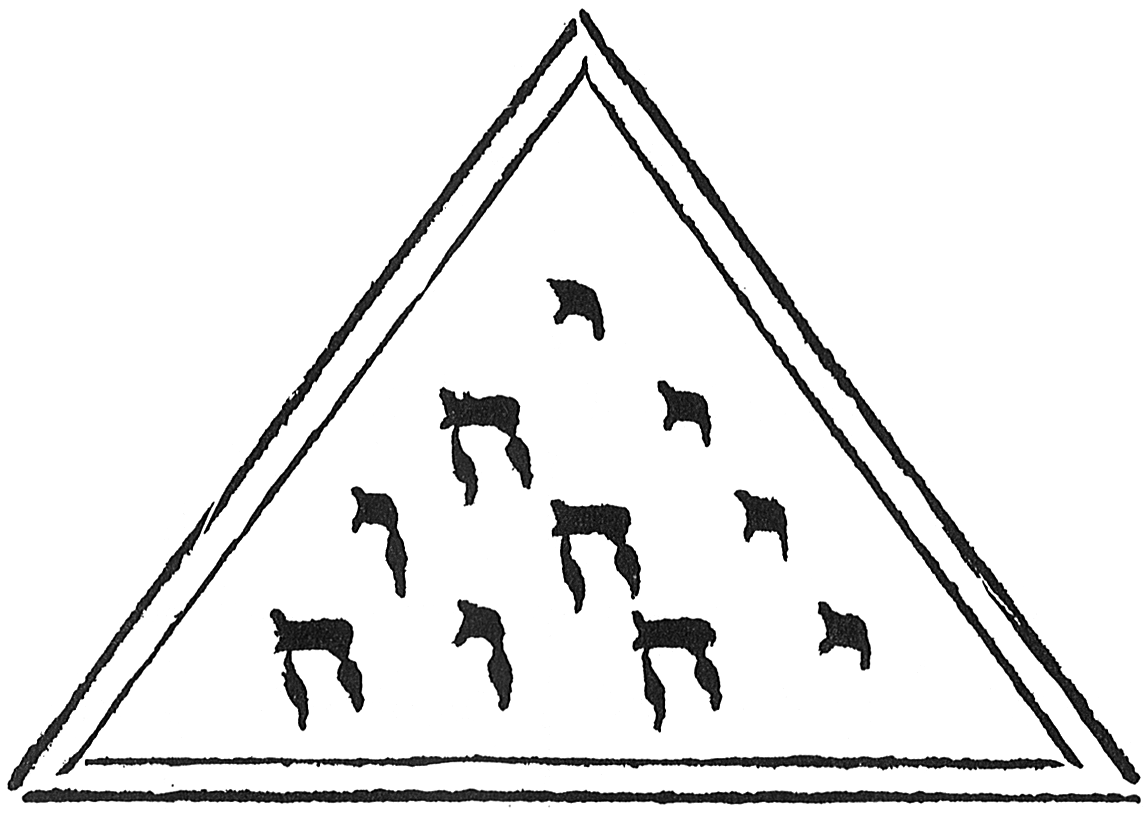
The second book is devoted to Gematria, the mathematical foundation of Magic. Mathematics plays an enormous role in Magic, for all that is performed by natural forces is subject to the laws of number, weight, and measure. By means of mathematics alone, without recourse to natural forces, one can produce effects analogous to those produced by natural means, make moving and speaking statues and figures.
The letters of the Hebrew alphabet have numerical values that play a leading role in the magic of numbers. Agrippa then provides magic squares, which are numbers arranged in a square (either as numbers themselves or as their Hebrew letter equivalents), corresponding to planetary numbers and possessing the power to draw down upon the earth the influences of the planets to which they relate.
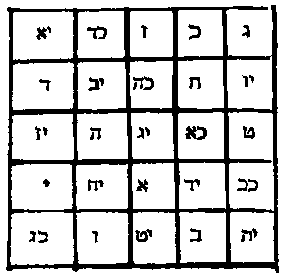
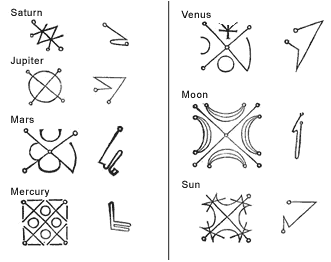
A lengthy discourse on the role of numbers in celestial Magic is followed by an even more expansive discussion of images in celestial Magic, accompanied by long lists of such images: images of planets, images of the zodiacal signs — Agrippa even ventured to print images of the thirty-six genii of the decans. Agrippa supplies lists of planetary names and planetary attributes and properties to be used when invoking them.
“anyone who wishes to perform wonders in this lower world must come into contact with the Sun. A Magus striving for perfection must attract the currents of the Sun to him by every possible means — praying to it not only with the lips but with a devout posture”
He also explains here the basic principles of making talismans bearing planetary images.
The third book (from which the fourth is distinguished) begins with a detailed treatment of the Names of the Most High and their significance. He holds that Power issues from the divine names — through angels who act as conductors.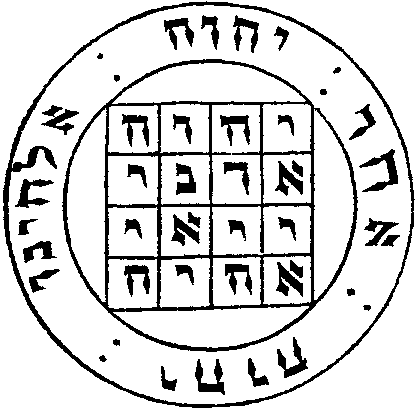
Among the traditional Names Agrippa mentions the famous charm Abracadabra and its use in healing. He also provides several amulets for cures.
Agrippa then reflects on the pagan gods, considering them manifestations of natural Powers emanating from the Most High.
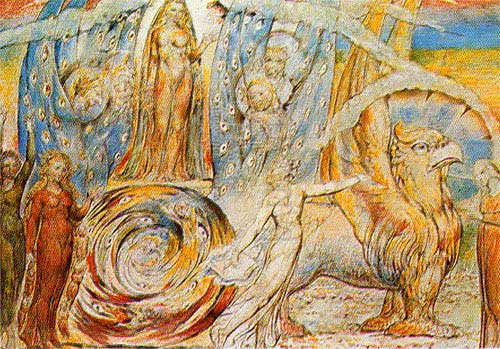
The next (15th) chapter of the Third Book speaks of ministering spirits, stating that there are three orders of intelligible beings, or demons. (1) The supercelestial, who deal only with the Deity. (2) The celestial — demons related to the zodiacal signs, decans, planets, and other stars. All of them have names and symbols — the former are used in incantations, the latter are depicted. (3) Demons of the lower world — such as demons of fire, air, earth, and water.
Angels too are divided into three groups: seraphim, cherubim, thrones in the supercelestial world; dominions, virtues, powers in the heavenly; principalities, archangels, angels in the earthly world. Hebrew angelic orders correspond to those listed above. From Scripture the Kabbalah derives many other angelic names — for example, the names of seventy-two angels who bear the Name of God. Agrippa’s kabbalistic magic is quite traditional — he speaks of angelic Orders and the Names of the Most High that move them.
He also speaks here of “evil spirits,” their fall and their varieties.
“There are several theological schools which distribute the evil spirits into nine degrees, in opposition to the nine angelic orders.”
He further notes that
“the nature of spirits is not bodiless, yet the bodies of angels and the bodies of devils are not alike. The bodies of some are immaterial, but those of devils are in part material, like shadows, and objects of punishment, which suffer from blows, and can be burned in fire, into visible ashes”
For Agrippa, Magic is inseparable from religious practice. In the last chapters he speaks at length of religious rites and ceremonies, of lavish rituals with music, candles and lamps, bells, altars.
Finally, in the Fourth book Agrippa describes methods for finding the names of genii and of good and evil spirits who govern the subcelestial world.
“Many Magi, men of great learning, wished to compose these tables by means of the Latin alphabet. With the same tables, according to the name of an entire division of spirits or its manifestation, one can find the name of a good or evil spirit in the same way as was set forth above; the name of an entire division of spirits or the kind of its activity is determined by the corresponding luminary.”
These tables are widely used in ceremonial Magic, including as an adjunct for controlling the Spirits of the Copper Pitcher, since Agrippa’s Genii correspond to these spirits.
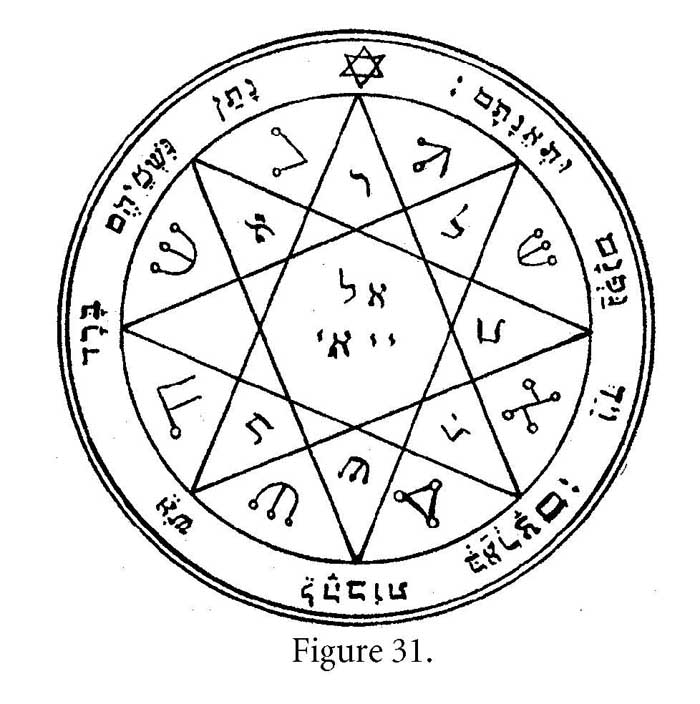
The fourth book also treats necromancy, the summoning of Elementals, the preparation of instruments and items necessary for magical operations, and general principles for composing Pentacles.
Thus, the “Occult Philosophy” truly constitutes a complete compendium of the theoretical foundations of Magic. While not a grimoire in the narrow sense, it is encyclopedic and clarifies methods and avenues for the execution of magical operations.
Agrippa believed that Magic arises from concentrated will and imagination; Magic is the mind’s control over the body; a scorned lover, Agrippa thought, could die of grief. He held that a person can attain this supreme power by investigating the harmony of nature.
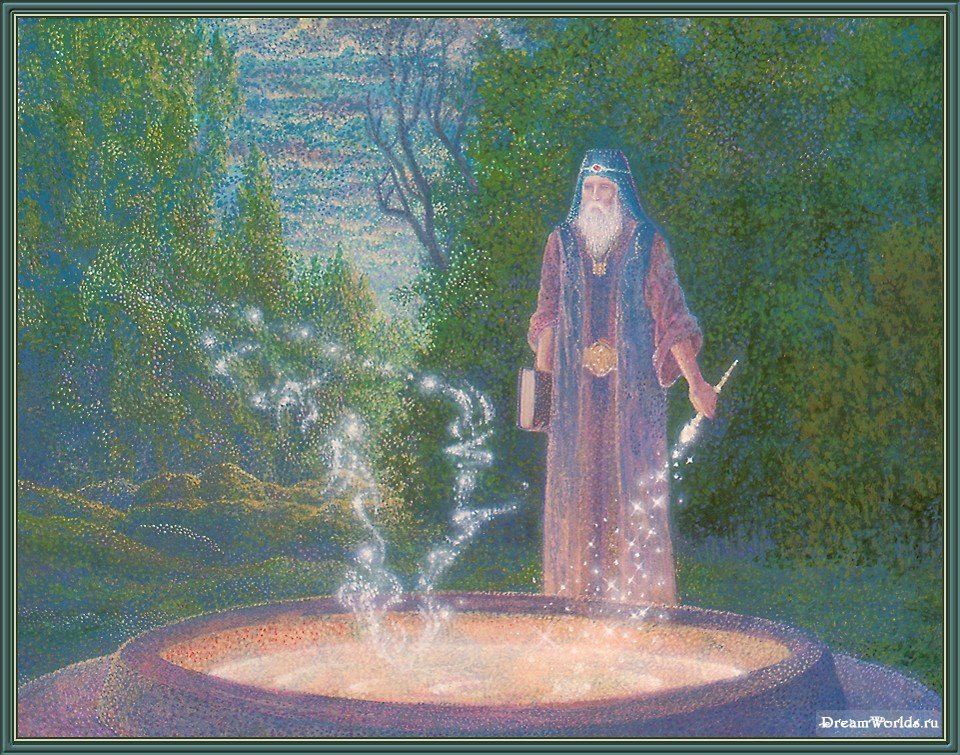
According to Agrippa, the highest rank of the Magus is the magus-priest, performing religious rites and working religious miracles. “The marriage of earth and heaven,” wrought by the Magus with Magic, and the summoning of angels by means of the Kabbalah lead to his apotheosis as a religious Magus; his magical authority in the lower worlds is organically linked to his higher religious authority in the intelligible world. To Agrippa the Magus does not appear as a mere sorcerer, but as a sacramental sage and prophet.
Thank you for the wonderful article. I gleaned a lot of useful information from it.
Today I learned about Agrippa for the first time while reading the book “Secret Arts.” Additionally, I found your article online, learned about his life too. THANK YOU!!!
Very interesting. Thank you very much.