Feda of Ogam – Stages in the Growth of Power
We have already discussed that Magical systems developed by humanity conform to the law of the quaternary: some of them are focused on the affirmation of the principles of existence (for example, the Tarot), others on the contemplation and “catching” of the world’s “flow” (for example — the I Ching), a third on the formation of realization streams (for example, the Futhark — the Runic order), and the fourth on the “inner”, “immanent” activity of natural processes (for example, Ogam).
At the same time, depending on the peculiarities of a given Magus’s individual Way and on the stage he is at, any of the mentioned systems may be more or less congenial to him.
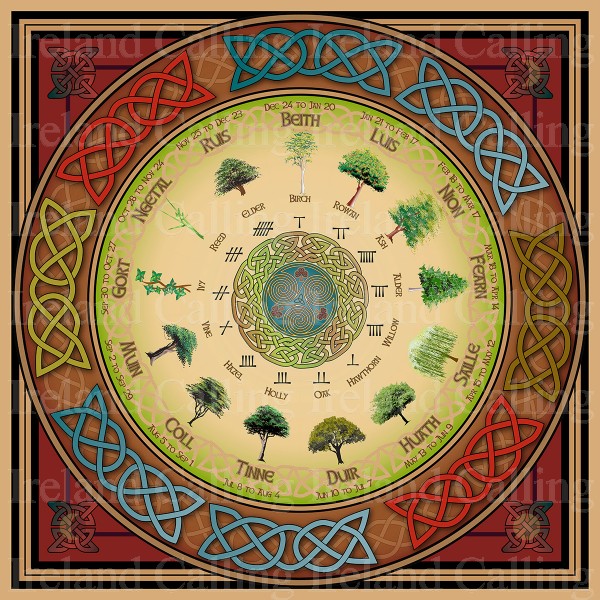
When a traveller turns his attention to the “nurturing” of Power, to the inner nature of its flows, an understanding of the “arboreal” spirit of Ogam can be of great assistance. We have already discussed that this system essentially describes the character of expansion and diffusion of any flow of power, much like the way a forest spreads or the famous “Battle of the Trees.”
Like Runic systems, Ogam was, apparently, first and foremost a system for realization, which later acquired a divinatory use. For example, even in the late Middle Ages, historians attest that divination by Ogam was a recognized means of determining the truth in legal proceedings when it was difficult to establish by other means.
However, as a system of realization — unlike the Runes, which were intended to direct the flow of Power along one or another vector, or the Tarot, which was intended to create the “skeleton” of realization, its support points — Ogam describes the “internal regularities”, the intrinsic condition of a growing system, and therefore allows one to activate particular “buds” and steer particular “branches” of development toward a preferred direction.
From this point of view it is clear that the first akme reflects the process of “sprouting”, is the accumulation of “potential” energy; the second — “growth upwards”, represents initial drive toward realization; the third — “branching”, is the creation of “secondary” streams derived from the primary; the fourth — “tying knots”, represents establishment and stabilization of flow, giving it “stationarity”. The forfeda correspond, in this scheme, to the “fruits”, is the “secondary” consequences of the given flow.
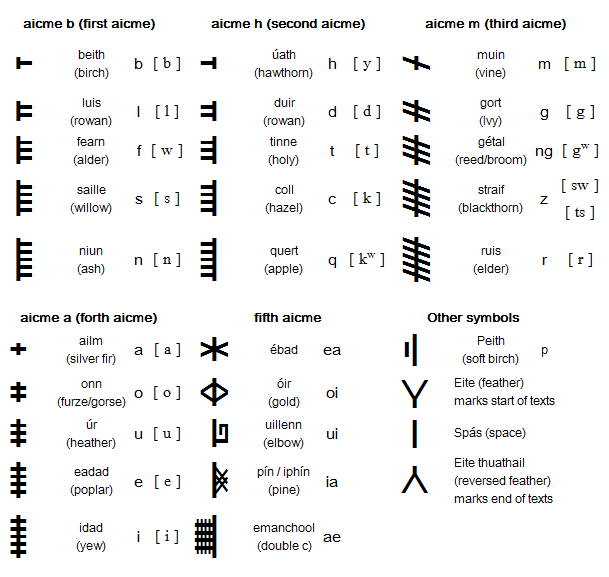
The structure of Ogam is such that each of these stages is fivefold, passing through five degrees of its manifestation. At the first degree the Power is born, “finds” itself; at the second — identifies itself; at the third — reveals its strong, expansive properties; at the fourth — its attractiveness; and finally at the fifth — its capacity for manifestation, for “fruiting”.
In this sense, the “initial” feda are the “progenitors” of each akme, the second are its “heart”, the third its activity, the fourth its receptivity, and the fifth its manifestation.
For example, in the first akme (sprouting) its source is the life of the birch, its essence the breath of the rowan, its activity the firmness of the alder, its passivity the protection of the willow, and its fruit the union of the ash; in the second akme (assertion) the source is the thorns of hawthorn, the heart the firmness of the oak, the activity the needles of holly, its applicability the hazel’s flexibility, and the fruits apples; the third akme (branching) begins in the flexibility of the vine, is affirmed in the creeping ivy, is expressed in the swaying of the reed, is expressed in the spread of blackthorn and bears the berries of the elder; the fourth akme (stabilization) is born in fir cones, is affirmed in the sunlit flowers of the rockrose, is applied in the rustle of aspen leaves and bears fruit in the yew’s cone-berries.
Considering the separate stages according to the nature of plants (or birds, or lakes, etc. — depending on the chosen Ogam), one can not only understand the peculiarities of the “inner”, “immanent” life of a flow of Power, but also discover the “hidden” levers for guiding its currents, which act upon the flow’s own “support points.”
Good day. Am I correct in understanding that there are two types of vector systems (Runes and Ogham) and two vortex systems (Tarot and I Ching)? In this case, one from each is largely directed towards internal structures, while the other is outward.
Thus, Ogham is kind of identification with a growing tree, while Runes are the ability to cut into the wood? And if a person wants to turn the runes inward, it’s like trimming some branches of themselves, while Ogham is the ability to grow or not grow branches ‘on their own’ in the sense of without external (even if directed by oneself) influence.
If so, what is the external influence of Ogham? After all, major systems actually have all the functions. The ability to ‘grow’ the tree of the desired event from the global environment?
The magical action of Runes is based on directing the flow of power coming from the erila. Rune Magic is always the Magic of a specific erila. Ogham Magic is the ‘awakening’ of certain forces contained within the system itself. That is, if the source of realization when using Runes is the will of the erila itself, then when using Ogham, it is the ‘internal’ gravitations of the very system being impacted. Ogham is the Magic of Awakening, the art of ‘awakening’ Forces.
You start understanding the structure of the flow of symbols – a direct path to create your own ones 🙂 The most pleasant – is the research.
Any “way of speaking” is imperfect, however, the Desire for Expression seeks a way.
How does the Alphabet form? – One can imagine a certain god – a highly developed otherworldly being, who grants primitive creatures an instrument of communication. Or descend from the heavens and assume that among humans, someone may also be born with the gift of symbolic formatting of similarly perceived (relatively closed) population objects, processes, and their interrelations.
One can imagine that this is more likely a man with his innate ability for differentiation and discretization or simply put – the ability to extract details from the Whole.
The habitat is that Whole, the field for activity in which the structuring and ordering of its description occurs.
By what means do we initially describe something new, hitherto unknown, that has arbitrarily intruded into the perceptual field of consciousness? – By means of a collective sensory response to the incoming signal. Smells, sounds, visual images, sensations of the body and sensations through the body of surfaces and textures plus (mostly unconsciously) arising emotions – biochemical processes of the organism resulting in a reaction to stimuli.
Something bodily, semi-conscious – semi-unconscious, somewhere on the border between the external and the internal. That collective reflection – reaction, which we usually seek confirmation and similarity in the perception and reactions of our kin.
It is not hard to imagine that people who have lived for years, for example, somewhere in nature, close to a forest, engaging in similar joint activities year after year, frequently interacting with the same objects, processes, their qualities, and interrelations develop similar tuned feelings and perceptions of specific details of the unified environment.
Forest dwellers think in seeds, sprouts, branches, leaves, scents of flowers, rustling of wind in the treetops – those energy clusters of feelings that repeat periodically and make a finite primary set, a similarly identifiable list (alphabet) of states not yet separated from their own body, but already being a property of the society existing in a certain environment.
Some regular experiences subsequently get separated by consciousness from the body in the form of collectively recognized conditional designations – symbols, static “photographs” of slices of dynamic processes, which help to reproduce in the inner space of a person that feeling experienced at the moment of direct physical involvement in the action.
That is, these static “photographs” – conditional designations – symbols – letters and their combinations perform the role of triggers endowed with the power to initiate the process of reproducing in the body direct participation in the activity.
In this context, the alphabet and language as a “way of speaking” are justified and necessary for developing a joint strategy of interactions, because the consequences of the behavior of letters-states and qualities are predictable. The grain thrown into favorable soil will inevitably sprout, establish roots, send out branches and leaves, bloom and bear fruit.
Relatively stable regular rituals of the objective environment are copied and reproduced in the consciousness and activity of the perceiving subject.
The alphabet is formed based on the synchronicities of perceptions and interpretations of primary signals from the external world (energy field), with which the inner space of the person, perceiving with the organs of senses or – from another point of view – the surface and content of the vessel – energy cocoon – enters into tangential contact.
People synchronize through empathic tuning of mirror neurons unaware of the difference between themselves and others.
Energetically, one can tune not only with a person but also with beings of other worlds, animals, trees, and even stones, if one initially allows at least the potential for their semblance of consciousness, self-awareness (and mirror neurons in this context are merely a “way of speaking”)
In light of the above, any attempt to teach psychoenergetic practice through words is inflexible and its consequences are uncertain and unpredictable, especially when there is no direct energetic contact between teacher and student, when there is no empathic tuning of their physical systems, because it is impossible to reproduce an experience of a process in which one has never physically participated.
When it comes to a process or inner state that a person has never experienced, there is no guarantee that reproduction will be an exact copy rather than a self-imposed imitation.
Words can teach a person to think, to form certain patterns, constructions from fundamental bricks-descriptions, provided that preliminary group concordance of the meanings of specific words and concepts has taken place.
However, it is well-known that there is a vast chasm between reflecting on wisdom and applying wisdom in practice.
The Alphabet, of course, is necessary to know and its basis as well. That is, to understand how it was created. This is useful for development. But it seems to me that to magicians, it is more important to learn to read images. Honestly, it surprises me when I watch a movie like “Arrival”, where people try to understand other forms of consciousness using sounds and words.
But any magician in half-astral can communicate with the beings inhabiting it, no matter who it is, a Godzilla from the dark side of the sphere, an elf, a humanoid from a techno-world, or a little dragon. And it is very short-sighted for anyone to say that training in astral vision is not important. It is paramount, as it allows not only to communicate with other species, to create one’s own worlds, but primarily introduces the magician to new energies, allows to learn to dialogue with forces, to understand the same language of images when communicating and much more.