Paganism and Neopaganism
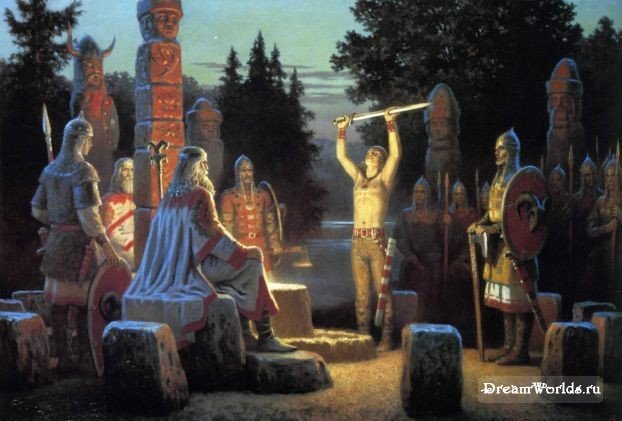
It is perfectly clear that today in Europe there are almost no entirely original systems of pagan religion and Magic remaining. Fifteen centuries of Christian dominance, with its burnings at the stake and the Inquisition, have all but destroyed the sacred groves of traditional religions.
Nevertheless, the memory of freedom in pagan sensibilities is still quite alive in the collective memory of the peoples of Europe.
And dense undergrowth has grown where the sacred groves stood: new currents arise that carry the same proud, free spirit.
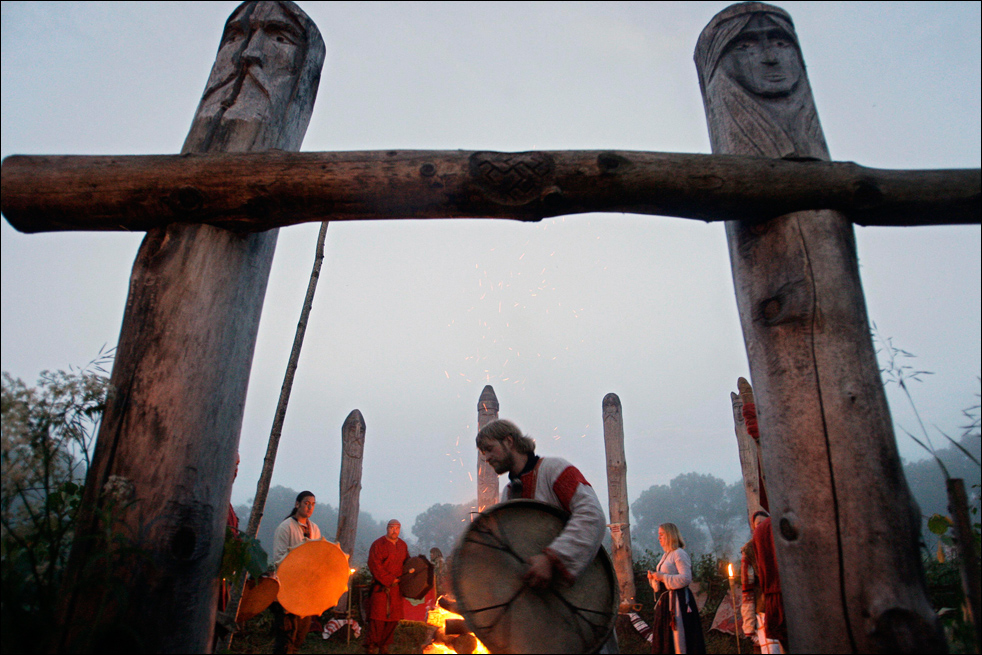
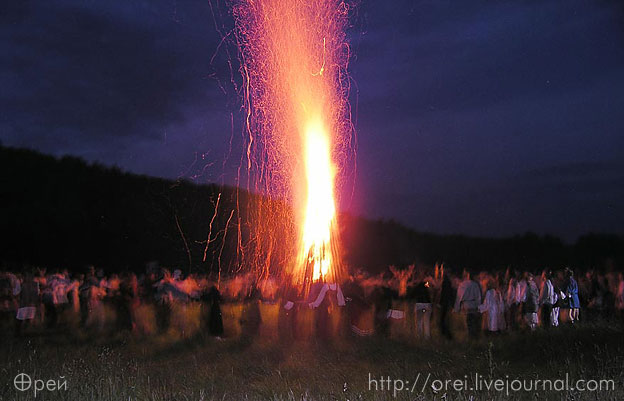
At the same time, all schools and currents calling themselves “pagan” fall into four groups: 1) lineages attempting to recreate ancient religions in their entirety — both form and content; 2) movements seeking primarily to revive the spirit of ancient worldviews; 3) groups attempting to create new systems on the basis of ancient beliefs; and 4) movements that arise in opposition to monotheism and use paganism merely as a cover for extremist views.
Although the spirit of paganism itself rejects reliance on books or authorities, movements of the first group urgently need such support to prove their authenticity; therefore, they revere the books accepted as genuine testimony to ancient views. In the pursuit of the “primordiality” of views and forms, excessive attention is very often paid to external attributes, while the spirit and meaning are either lost or distorted. Scoffing at “neopagans,” these movements fall into the trap of dependence on “primary sources” and lose flexibility and freedom of thought, becoming as much a prison of the spirit as other totalitarian organizations.
We will not discuss the fourth group; extremism is dangerous in any form for adherents and for others, and we will speak of the second and third groups of pagans.
These groups may or may not have traditional roots, which, of course, significantly affects their effectiveness and, what is even more important, whether they degenerate into profanation.
From a magical perspective, the primary criterion is effectiveness, and it is evident that for different Wayfarers both traditional and new systems may be effective.
At the same time, the likelihood of finding an effective myth or model in traditional systems is considerably higher simply because they developed over a long time and are the fruit of the labors of many generations of seekers.
You are most likely to find power along that Way which, without neglecting form, does not place excessive emphasis on it, instead placing primary emphasis on the spirit of freedom and pluralism characteristic of paganism.
However, one must not dismiss the possibility of creating new effective ways that employ various traditional or newly invented approaches to mental development. The main problem in such cases lies in the widespread neglect of systematic methods and safety.
For the Magus, the choice of worldview is a personal decision. He is not obliged to follow commonly accepted or traditional views if they do not harmonize with his own way. Arguments like “this is how our ancestors believed” or “this is what authorities think” carry no weight for the Magus. For him, the highest authority is his own Orlög, his way, and his harmony.
Everything is said beautifully and understandably =)
Only thing left is to say thank you))
Attempts to revive paganism, relying on the authority of charismatic individuals or ancient books of unknown origin, are very shaky, as there is a danger of distorting the original understanding of ideas and imposing someone else’s will.
___
But what is the original understanding of ideas? Where did this understanding originally arise if there were no books?
___
In nature, everything is harmoniously arranged. One cycle replaces another, maintaining relative balance. However, man, producing goods for civilization, disrupts the natural balance, to his own detriment.
But if you look a little deeper, then a person still lives according to the laws of the Family, in some sources referred to as the main pagan god.
Survival, hierarchy, continuation of the family – these are the three pillars upon which the family stands. Nowadays, psychologists call these basic qualities of the system, but no matter what you call it, since time immemorial, the main instinctive desire of man has been to survive. It is easier to survive in a group than alone. Any group is maintained by hierarchy. The strongest or wisest, or one who is able to lead the group thanks to inherent qualities stands at the head of the group. If the strategies and tactics are effective, and the group survives, the need arises to copy the group in the new generation through reproduction or election of successors.
Nothing has changed. The laws of the Family influence a person from within. The realization of these laws is a deep-rooted necessity, regardless of whether the group is a human family or a magical one.