
Paganism: Life without Revelation
Religions that emerged in the era of developed statehood always based their authority on a divine source enshrined in Holy Scripture or Scriptures. To account for the origin of that source, they introduced a special category of people — mediators between man and deity — prophets, who were later replaced in this office by the clergy: prophets recorded revelations, priests interpreted them.
Such reliance on a transcendent authority gave these religions stability, and written revelation — popular appeal. Indeed, someone who wanted to know the will of a deity did not have to seek contact with that deity; it was enough to consult the text and read what it said on the matter.
It is obvious that such support in the form of the recorded words of God — revelation — is necessary precisely for the universality of a religion, so that those who feel no otherworldly presence either within their soul or around them could nevertheless fulfill the social functions of religion — supporting the clergy, restraining socially disruptive manifestations, and so on.
Pagans, as we have already said, had a different view of the relations between the “lower” and the “higher” worlds. Paganism is a mythological worldview, not a religion. It aims to foster a particular mindset with the goal of a person’s self-improvement and ascend to the level of a ruling deity. Contrary to popular belief, the pagans never placed humans and gods on the same level, and never considered gods equal to humans. Yet the pagan understood that the source of humanity is rooted in the divine, and that the divine, though distant from the human, is nevertheless accessible to them — and sought direct contact with the gods — either by ritual or legal means, through sacrifice, or mystically, in personal experience.

At the same time, paganism did not have “God-inspired” texts that would provide support for weak minds; it was generally not designed for the “poor in spirit.” Holy Scripture, offering the “one truth,” presupposes that this truth is inaccessible to ordinary people; its primary premise is the idea of the inadequacy of human nature, which must be guided since by itself it cannot discern truth from falsehood. Such an attitude cultivates spiritual frailty and timidity in belief and action. Although, of course, this is precisely what a “universal” religion — suitable for all — must be.
The very idea of a revelation common to all was alien to paganism, which emphasized the individuality of the relationship between a person and a deity. As the ancient Greek philosopher Thales said, “everything is full of gods,” and one can and must live in harmony with them. An all-absorbing love for this world, with its bright and dark sides, is what has always distinguished pagans. Instead of bookish revelation pagans relied on experience — experience of communion with nature and experience of communion with the gods.
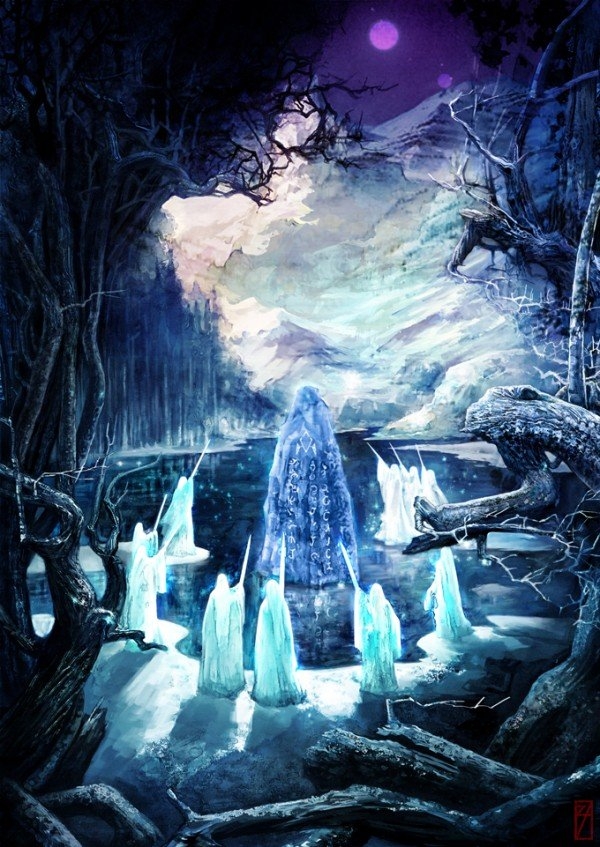
A vivid example of acquiring such experience was the tradition of the mysteries, widespread throughout the ancient Mediterranean world and aimed at bringing a person into direct contact with divine forces. Initiatory rituals of other peoples were directed toward the same end.
Paganism says that, being merely a grain of the cosmos, a person contains the whole cosmos within themselves. Being part of the whole, a person remains an individual, and therein lies their freedom. Such unity with the world does not reduce one to the level of a mere cog in a mechanism; on the contrary, it makes one a bearer of the universe. Only the one who is a slave to Another’s Choice is a slave — that is the claim of monotheistic, single-ideology systems. Pagan thought teaches people to choose — and to take responsibility oneself.
Pagan priests never claimed that “truth” was more accessible to them than to ordinary people; their status was determined simply by their knowledge of what was “pleasing” and what was “not pleasing” to a given deity, and this knowledge facilitated contact with the deity, but did not replace the personal relationship between a person and a god. The absence of dogmatism inherent in paganism was precisely the consequence of this kind of collective religious practice: in fact, everyone believed in their own way, and no one imagined that their faith was “more correct” than their neighbor’s.
In this sense paganism is quite tolerant of monotheistic religions — it readily accepts those ways of approaching the divine that are convenient for some. But at the same time, monotheism, claiming a monopoly on truth, is often extremely intolerant of paganism, quite predictably seeing in it the destroyer of its “flock and shepherds” ideology.
It is precisely the breadth of outlook and great tolerance that bring the pagan worldview closer to magic.

The accents are well placed. I completely agree with the author’s point of view. Paganism is not a religion but rather religiosity. Similar thoughts are argued, for example, by Hans Günther in his works. Or, for instance, Veleslav (if closer to modern times).
The foundation of all modern religions is ancient Vedicism, including its Slavic form, Völkhvizm. It arose, in fact, with human society. Völkhvizm is the sum of spiritual practices and knowledge leading to world understanding. Slavic Völkhvizm prevailed in Europe for several millennia (possibly tens of millennia) and gave rise to the Slavic community itself. Its center is in Volhynia (VOLHONIE), as maps and research work suggest. Völkhvizm became the father of all local manifestations of paganism, although it itself was not and could not be a religion by nature (it rejected the dogmatization of phenomena and material forms that are constantly being restructured in their spiritual-energetic basis, as in the restructuring of the entire universe)…