
Water — The Principle of Fluidity
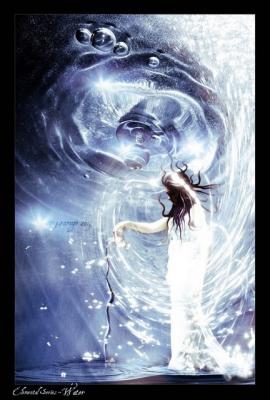
The element Water corresponds to the passive, feminine principle of fluidity and adaptability, and to the Descending movement of Power.
Water therefore has a purifying power, and Ritual washing is obligatory in sacred rites. Possessing the quality of depth, the Element of Water is necessary for trance work as well as for dream work and similar practices.
In addition, the element of water relates to the Flow of Life itself and to other attributes of the Great Mother in her virginal aspect.
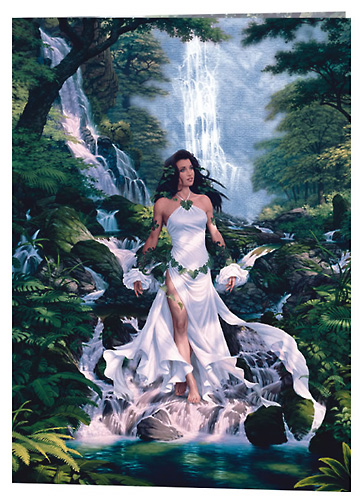
Water is connected with the emotions and with intuition. It is associated with the West and with autumn. The Descending properties of Water are used to return unwanted manifestations to the unmanifest. Because it is easily applied, Water grants insight and clairvoyance, from which much of Magic — witchcraft (that is, “works with the cup” (literal)) — arose, aimed both at divinatory ends and at manipulating feelings.
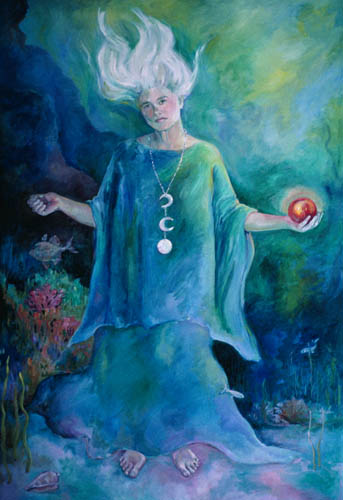
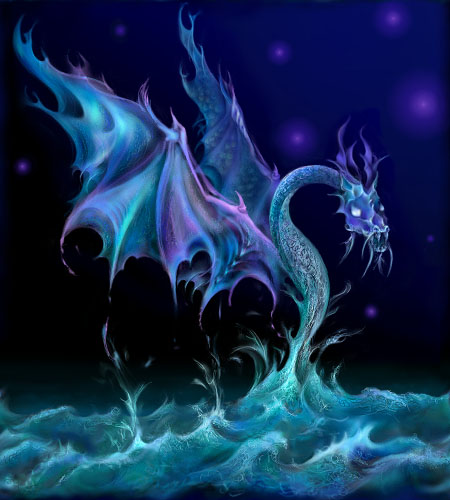
The Slavs regarded Water as belonging to Mother Lada and recognized Danu (goddess of rivers and streams) and Ilma (god of the seas) as water deities. Ilma is served by the Sea Serpent, which, like the Norse Jormungandr, is a necessary condition for the existence of the cosmos.
The Celts assigned the element of Water to the city of Murias, where King Neks and the druid Semias ruled. From Murias comes the sacred Cauldron of Dagda, a source of life, health, and longevity.
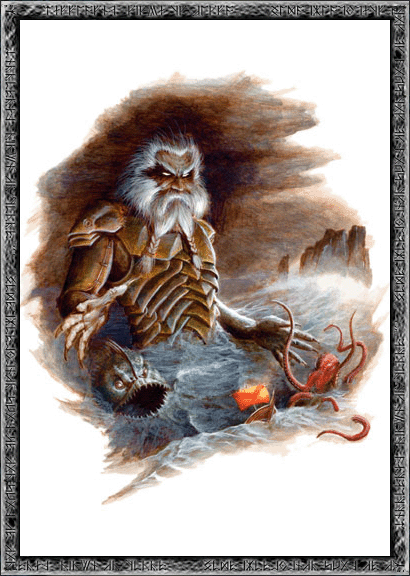
Among the Scandinavians, the waters were presided over by the “sea giant” Aegir and his wife Ran. Aegir was one of the few Jotuns who favoured the Aesir; the gods often gathered at his feasts. It was at one such feast that the famous “Quarrel of Loki” took place.
Western European magic calls the water elementals Undines (from Latin unda — “wave”). Since Water is feminine, Undines are beautiful maidens, sometimes with fish tails, who emerge from the water and comb their hair. They rise from the water, shrouded in mist, and cannot survive long away from it. It is said that undines live in coral caves or among reeds on the banks of rivers or lakes, beneath lily leaves and in little houses of moss near waterfalls.
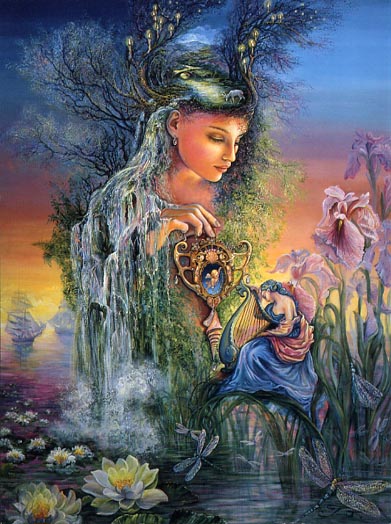
Unfortunately, undines are often confused with rusalki (mermaids); the latter are elementals, often the souls of drowned women.
According to legend, a person who obtains the fern-flower will be able to look upon undines without succumbing to their charm and may even secure their help with fieldwork, for undines can govern the weather, sending rain.
In magic, the Element of Water is invoked to impart depth and a penetrating quality to an object or person. Negative manifestations of Water correspond to lies and deceit.
Undines enliven the fluids of plants, animals, and humans and are present wherever there is water. Thus, the Element of Water, which constitutes the fluid, mutable part of anything, forms its deep essence.
Enmerkar, you talk about the relationship of the water element with the West. But what if we consider the Scandinavian structure of existence, it seems that water should be compared with the North, with Niflheim? Here arises the question of whether Ice can be associated with water as a primary element?
You answered your question yourself. Firstly, indeed, sometimes Water is associated with the North, and Earth with the West. Secondly, water can hardly be attributed to Niflheim – the Realm of Ice and Mist, since there is no fluidity there, although it is rooted there. Thirdly, Scandinavian mythology is not fourfold but twofold: Niflheim belongs to passive elements, while Muspellheim belongs to active ones.
So, in the context of Scandinavian mythology, the association of the four elements with the four cardinal directions is completely incorrect? In general, I want to understand whether such comparisons carry any specific benefit, or if this is done exclusively as an auxiliary element for better understanding of the myth?
Not ‘completely incorrect,’ but not entirely correct. Such comparisons have value for building rituals since a ritual is a model of cosmogony (or anthropogony), but their maximum usefulness occurs only when they are supported by the Myth on which the ritual is built.
Enmerkar, thank you. You helped me understand a bit. Although, one question still remains unclear. Does it mean we have the right to compare North or West with both earth and water, depending on the myth we use to build the ritual? P.S. If it is not too much trouble for you, could you share your opinion on rituals and views of elements specifically in the Scandinavian magical tradition? Its duality confuses me somewhat, and the overall picture somehow does not come together.
No, we must conduct this comparison based on the mythological picture we operate within. Associating Water with the North means opposing it to Fire, and to the West – to Air, and depending on which of these binaries we choose, the picture becomes different. The duality of Scandinavian myth simply reflects the understanding of a potential quaternary: Fire as common activity contains within it Flame (Light), that is, ‘activity in activity,’ and Heat (Warmth), meaning the method of this activity’s influence on the outside, ‘passivity in activity.’ Similarly, Ice contains within it Hardness (Resistance to external influences), ‘activity in passivity,’ and Water (Fluidity), ‘passivity in passivity.’
Wow… Everything is quite simple, it turns out. =)
Thank you very much. Now everything makes sense.