Jotuns — the Eldest of the Ancients
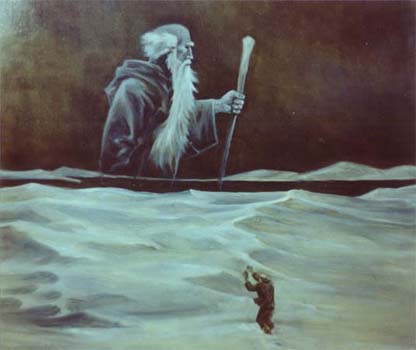
However, alongside the formative forces — the Aesir — the cosmos also includes the Eldest manifested beings, the progenitors of the gods and of Being — Jotuns.
Usually Jotuns draw little attention from scholars; often there is confusion about their origins and tribes.
At the same time, Eddic texts provide a clear picture of three stages of development, or rather of the decline of the generative forces:
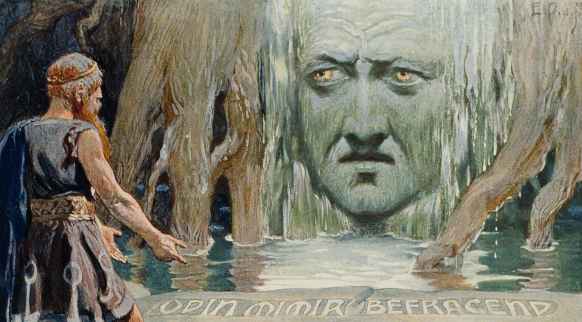
1) the Jotuns proper, the Wisest and Most Ancient beings, who emerged from the World-Stream Elivagar and, in fact, represent its agency. The very name “Jotuns” derives from ‘to be’, and thus the Eldest embody the principle of existence. Jotuns are indifferent to the Aesir and humans, yet they possess great wisdom which they may share under certain conditions with humans and gods — for example, Bölthorn, who gave Odin the mead after His sacrifice and the gaining of the Runes, or Mimir, the keeper of the Source of Wisdom, who allowed Odin to drink from that source in exchange for an eye. Note that both these examples point to the flowing nature of the Jotuns: Bölthorn is, effectively, the basis of the “Mead of Poetry”, a current of inspiration, while Mimir is the embodiment, the outward manifestation of the Flow of Wisdom. In this sense one can equate the terms “Jotunheim” and “Elivagar”, since they, from different perspectives, describe the same reality — the world-flow of probabilities.
2) Hoarfrost Giants, or Hrimthursar, also Ancient beings, but born of Ymir, the Primordial Being, the World-Man, one of the Elder Jotuns.
Hrimthursar view gods and humans as disruptors of the original order and are therefore hostile toward them. Such are, for example, Suttungr, the keeper of the Mead of Poetry who refused to give it to Odin, Hrungnir, who raced with Odin, Thjazi, father of Skadi, and others. Hrimthursar are a younger tribe compared to the Jotuns, inferior to them in wisdom, yet still possessing both great wisdom and strength.
It was the first and most ancient Hrimthursar, settling in Utgard, the Interworld, who gave rise to local rulers — the Guardians of Potentiality, known as the “Archons” of the Interspace. At the same time, the Archons themselves often identify with the Progenitors, seeing themselves as the cosmos’ oldest forces.
In this sense the Hrimthursar constitute the “external” manifestation of those creative forces of the Awakening Cosmos, whose “internal” nature is constituted by the Jotuns.
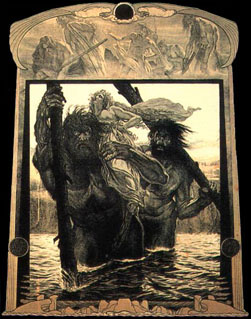
3) Giants, or Thurses (one of whose groups was known to the Celts as the Fomorians — outdwellers), who are the third, even younger generation, and, as usually happens, less wise, since wisdom fades with distance from the origin. The name “Thurses” derives from the word “turá“ — “strong, mighty, wealthy“, and indicates that they are an expression of primordial energy just as the Jotuns embody the principle of being. Examples include the nameless builder of Asgard’s walls, Hymir, who nearly caught the World Serpent, and so on. Thurses inhabit Jotunheim as well as the Primordial Realms — Muspelheim and Niflheim — since they enact primordial powers. Accordingly, Thurses can be “Icy” (often confused with the Hrimthursar) and Fiery. However, it is important to remember that whereas Hrimthursar have a nature of “rime“, integrating both ice and fire forces, Ice giants live mainly in Nifl, “halting” all movement.
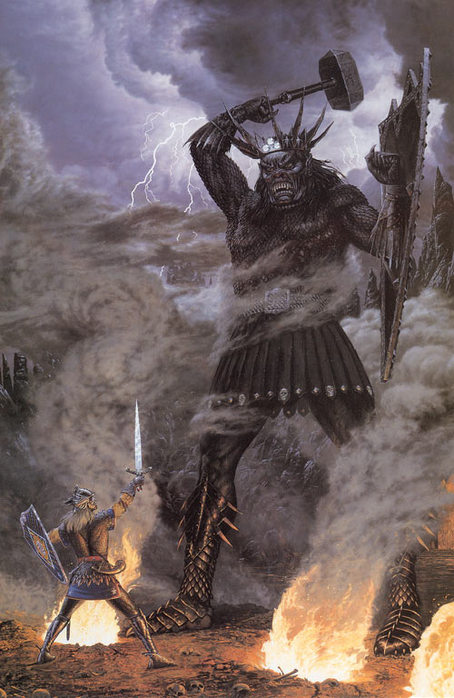
When they degenerate, Thurses become trolls — very strong but primitive, aggressive beings, which merge with the fairies, forming yet another source of their origin.
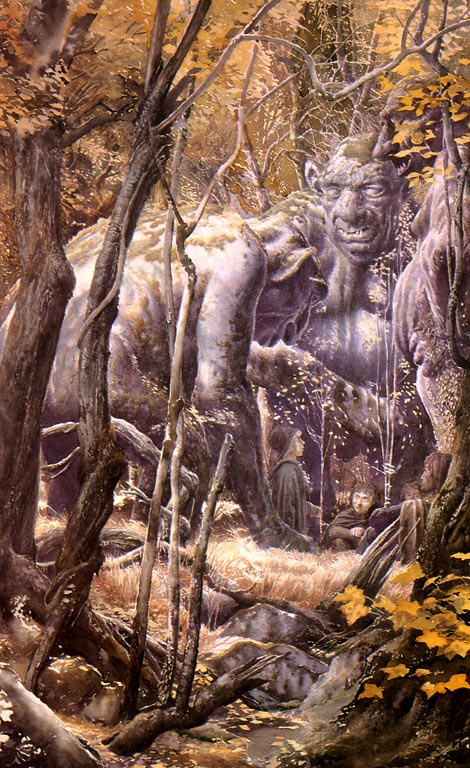
Thus, alongside the majestic progenitor Jotuns, Jotunheim, the world of primordial birth, is also populated by other, less impressive inhabitants. Yet the common characteristic of all denizens of Jotunheim is a colossal, though crude, chthonic elemental power by nature.
Thank you for the unity of thought!
Thank you for the information, what do you think of R. Calder’s book? He wrote about the Jotuns; I read it on translator Anna Blaze’s site.