
Seiðr — Games with Souls
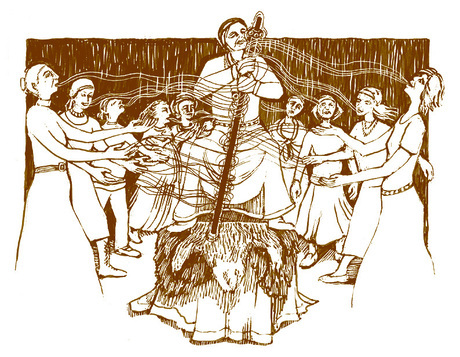
“One man possessed the mightiest of all arts. It is called seiðr. By it he could learn men’s fates and future events, and also bring death to men, deprive them of their souls or luck, and take a man’s wit or strength and give it to others.” (Saga of the Ynglings)
As mentioned, originally seiðr was an art of the Vanir, and Freyja brought it to Asgard. The sagas mention three basic traits that characterize seiðr: 1) a high seat, or platform, on which the practitioner sits; 2) the use of special songs to induce trance or to secure assistance from spirits; 3) an association with sexual “indecency” (ergi).
Because of these traits seiðr is often likened to shamanism or even called northern shamanism. This, however, seems not entirely correct and potentially dangerous, because it encourages importing into seiðr other shamanic features, making the recovery of seiðr itself more difficult. The northern literature contains other typical shamanic elements, for example taking an animal form to gain information or to fight — but these are in no way connected with seiðr. In the northern tradition, the name of the Tree — “Yggdrasil” — is rendered as “Odin’s steed.” Yet the journey along Yggdrasil is likewise in no way connected with seiðr.
Snorri Sturluson distinguishes Odin’s skills of this kind from his knowledge of seiðr. The author of “Egil’s Saga” calls Gunnhild hamhleypa (the “skin-shedder”) when she turns into a swallow to distract Egil from composing a drápa, but not as part of seiðr practice, as he had described earlier in the saga. The word “seiðr” is never used in connection with shapeshifting or out-of-body journeys, let alone journeys to the Lower or Upper World. There is likewise no observed connection of seiðr with healing, the return of the soul, or guiding the dead. Except for a few late sagas about heroes, we find no special mention that the practices of seiðr included cursing or healing.
There are no traumatic initiations typical of shamanism. There is no mention of unusual physical feats by practitioners of seiðr like those of shamans, who during trance fear neither fire nor cold nor sharp objects.
Modern scholars often consider shapeshifting an integral part of seiðr. Such combat magic was actively used by berserkers and similar warrior-shamans. Upon entering a trance, the warrior became inhumanly strong and agile, utterly insensitive to pain, like a raging animal. Nigel Pennick suggested that most seiðr practices were based on totemic magic; this may have led to the belief that a warrior transformed into a bear, wolf, or boar.
At the same time, although the practice of leaving the body in animal form — by men, gods, and jötnar — and the donning of plumage by dísir occur frequently in the northern tradition, they are in no way connected with seiðr. Sometimes even shapeshifting occurs involuntarily, as in the case of Egil’s grandfather, who was compelled to prowl as a wolf after sunset. They do not seek knowledge in other worlds, do not return souls, and do not guide the dead. They were not even considered a threat to ordinary people.
The active effect of seiðr consists solely of acting upon the souls of other people, upon parts of souls, or upon people’s minds. It can cause psychological discomfort or even death, but it cannot change the weather, extinguish fire, raise or lay the dead to rest, protect a warrior in battle, or perform other abilities common to galdor magic.
The most brutal description of seiðr’s effects is found in the “Ynglinga Saga,” where the seiðkona Huld pursues Vanlandi, sending him nightmares and driving him mad; then, by means of spells, she breaks his legs and twists his neck. Seiðmaðr Þorgrim acted similarly (“Gísla saga Súrssonar”), Queen Gunnhild (“Egils Saga”); likewise, Tordis forces Gunnarr to pay wergild for a slain brother (“Gunnars Saga Keldugnupsfifls”).
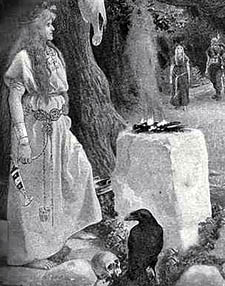
In traditional sources the use of seiðr is almost always associated with something ominous; a few exceptions occur when seiðr is connected only with prophecy. The word is used only to describe magical actions at a specific moment, when, in order to affect external forces, a particular spell must be sung. There is a distinct difference between magicians of seiðr and diviners who receive knowledge from within, and between kings and leaders who use an innate ability to channel the will and wisdom of their ancestors. The prophetic aspect of seiðr includes the summoning of spirits, who are bound by special spells. These spirits then reveal their knowledge of the future to the völva. This is also confirmed by saga accounts; for example, in the “Saga of Oddr the Shot,” there is an episode in which a special spell was required for seiðr, and a woman who knew it was found only with great difficulty. “Many spirits came now. They liked to hear the song, whereas before they wished to hide from us and did not obey us. Now much has become clear to me that was previously hidden both from me and from others.” In the sagas of Oddr the Shot and of Hrólf the Gerding witches are explicitly called seiðkonur. At the same time, in the Scandinavian sagas the word “seiðr” is sometimes used both to describe a specific sacred act and to designate the particular place where the rite was performed.
Galdra spells are usually described by words meaning “to sing” (gala syngja); in the case of seiðr, the verbs are invariably those meaning “to speak, to utter” (kveda). The spell itself is called speech (kvaedi), or wisdom (frdi). A galdr spell carries magic in itself and is performed by the primary creator of magic; a seiðr spell is pronounced by the practitioner only when there is no other option. A seiðr spell was even performed by a Christian woman, which means it did not always require special magical skills or a particular state of mind.
There is another attestation of seiðr use — when Þurid Sundafyllir, during a famine in northern Norway, called fish into the nets (“Landnámabók”); however, here seiðr techniques may have been confused with the everyday shamanic practices of the Finns, described in the “History of Norway” (since Hålogaland, the saga’s setting, borders the territory inhabited at that time by Finno-Ugric tribes).
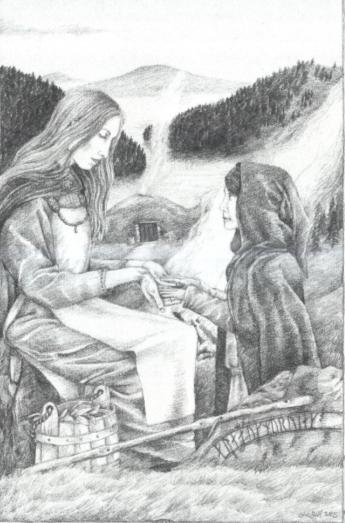
Very little is known about the roles of women in the Nordic Tradition, and it is easy to err when attempting to reconstruct them. The best known are the völvas and the seiðkonur. The distinction between a völva and a seiðkona is hard to establish, since both engaged in prophecy and magic. It is thought that seiðkonur practiced a darker seiðr and were more feared than völvas, who were more honored members of the social community, since, from the community’s point of view, they were sorceresses acting for its benefit and for healing.
Thus one may assert that seiðr is one of the methods of entering the transcendent unconscious, into the Womb of the Great Mother, with the aim of finding there ways to resolve various tasks — predictive, sometimes aggressive, but in any case manipulations of soul and mind — either of the practitioner, someone else, or of another person.
Therefore seiðr and its trance techniques are, in fact, much closer to the techniques of lucid dreaming than to shamanic ways, and may, in practice, be considered a form of waking-dreaming.
In the internet regarding “connection to sexual indecency”—there are only vague assumptions. What do you think it consists of?
Well, why not— vague 🙂 It is believed that during seiðr, spirits take possession of the seiðmaðr (seiðkona). This can be understood on different levels, including sexual. Only in the case of seiðkona, she uses the spirits for her own goals, attracting them, while in the case of seiðmaðr, there is a danger that the spirits will use him. Overall, like all ecstatic paths, seiðr extracts the essence from the sphere of conscious control, and since sexuality is the most powerful of the unconscious forces, it manifests during this process.
Can one affect only people with seiðr, or anything that has consciousness? And if Odin could “divert luck”, does that mean that with the help of seiðr one can also attract Hamingja? And also: is it true that seiðr, by its nature, makes it impossible for völvas (seiðkonas) to see their own future and affect themselves?
1) With seiðr, it seems possible to manipulate various aspects of the human being, including, of course, their Hamingja. Historically, it seems (probably under the pressure of Christianity), that seiðkonas were not very kind and gentle, hence they often took luck rather than giving it (however, modern “grannies” also tend to cause curses more often than help).
2) A völva, in its very meaning, acts as a conduit of information for society (tribe). She dissolves in the Immanent flow, and therefore her own future loses all meaning. As for influencing oneself — that is always difficult.
Why is seiðr and the body of dreaming an unfounded mix? What else besides the body of dreaming is there in a person while dreaming-in-wakefulness and in ordinary sleep?
The task of Seiðr was not to move in the space of trance visions; it has always had a more precise aim and therefore does not necessarily imply a trance state.
From some passages of this post, one can conclude that Seit is something like a method of conjuration. It’s irrelevant whether to conjure Spirits or the Souls of people. It turns out that Goetia is, from the point of view of the Scandinavians, a Women’s Work? 🙂
Sait is far from Goetia. Quite the opposite, since in Goetia, Spirits are summoned, meaning active Will is applied to them, while in Sait rituals, forces are attracted, meaning an attractive principle is applied.
as always – so thoroughly presented! thank you