
The Wisdom of Intelligence and the Wisdom of the Heart
“The bright beams of Truth do not always give off warmth. Blessed are those who did not pay for the good of knowledge with their heart!”
(Schiller)

As we have said more than once before, a Magus’s comprehension of the processes occurring in the psyche and macrocosm occurs at the level of two psychic principles — Intelligence and Feeling — which stand in a binary relation to one another.
Each of these principles has possibilities and limits; therefore, harmonious awareness is possible only through their proper combination.
Yet this very “proper” combination often presents the greatest problem, since a tilt toward either one or the other side threatens the loss of harmony and, with it, a drop in effectiveness.

In any binary pair, it is important to understand where the center of gravity lies. At first glance, one might assume this center rests in the active (masculine, expansive) element, but in practice that is not always the case. On the contrary, more often the initial impetus comes from the attractive principle, and the expansive follows it; the roles of the poles thereby become ambiguous — the attractive proves active, and the expansive passive.
The same can occur in the cognitive process.

For many centuries, the people of the Land of Erd learned to perceive the world first and foremost from the standpoint of intelligence — after all, it is much safer.
But Magi do not seek the absolutely safest state; their aim is the most effective path.
Whether the initial support is found in intelligence or feeling determines the character of subsequent activity.
We have already mentioned that a Magus sees harmony in multiplicity. In other words, he uses intelligence to differentiate the world and Feeling to sense its essential unity.
But which is more effective — to seek multiplicity first and then unite it, or to feel unity first and then discern its manifold harmony? Clearly, in time these two recognitions must be inseparable; yet in the very mechanism of the mind, it is more convenient for a Magus to begin with feeling, shaped by intelligence. In other words, it is more effective to place the mind’s center of gravity in Feeling, while not forgetting to balance it with intelligence.
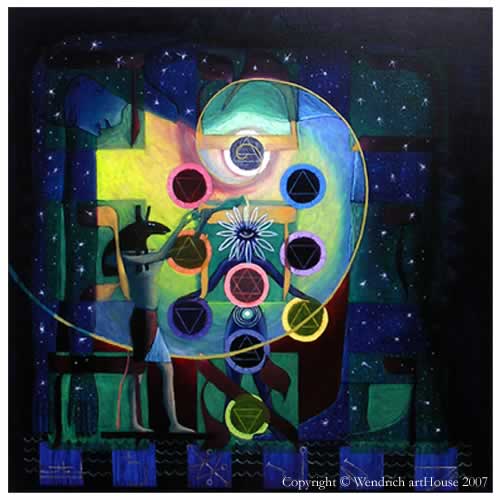
The reason this approach is more effective is rather trivial — because for centuries people relied mainly on intelligence, parasites of the mind also learned to manipulate it, and it is in the realm of intelligence that most destructors take root, draining the psycho-cosmos (the exceptions were hysterics and mystics, who lived in the realm of Feeling, but its disorder also made them vulnerable and easy prey for parasites).
Therefore, for a Magus, the advice to “listen above all to your heart” is very important, for the head is more easily led astray, more readily deceived.
However, this advice has another side — upon honest and attentive consideration, it usually becomes clear even from the standpoint of intelligence that the heart’s counsel is more accurate and more effective than pure logic.

As they say, “the transition of the mind to the first step is in the realm of contemplation; the transition to the next several steps is in the realm of thinking.” The smaller a person’s mental step is, the less advanced they are; the stronger the influence of the principle of logic, the fewer and shorter the periods of instantaneous contemplation and direct insight, and the more conceptual constructions are necessary to move the mind to the next level.
Thus, all that is perceived by the senses must be translated into concepts, illuminated by it and revealed in detail. Yet every discursive cognition must also draw on the power of intuition and be shaped by it.
The more developed a person’s mind, the greater their capacity to know by intuition; moreover, development, in a certain sense, consists above all in transforming one’s mode of knowing, increasingly making use of intuition.

So it turns out that using predictive systems is training intuition until one refuses to use them?