Part and Whole
The Law of Analogies, adopted by the Magical myth as one of the primal principles of the cosmos, has many important manifestations within that myth.
One of those projections is the placement of part and whole on a single axis of analogy.
This arrangement is important, above all, for groups of willful beings, each of which represents a complex system — for example, this is precisely how the famous Microcosm–Macrocosm Analogy is formed.
In the pagan worldview there is another important consequence: each of the gods of the pagan Pantheon contains all the other gods, in an aspect characteristic of it.
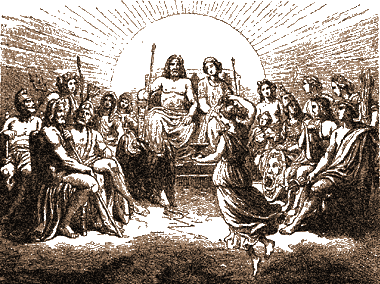
The last idea lies at the heart of paganism: by worshiping any one of the Pantheon’s gods, the pagan worships all the Radiant Lords, but in the aspect that is personally closer and more comprehensible to them. The pagan does not need to seek contact with gods they do not understand; paganism has no compulsory, universal cult — each reaches the World Fullness (the Pleroma) by their own way.
In principle there is nothing extraordinary in this idea, yet it often goes unnoticed. For instance, everyone knows that human genomes are virtually identical — different genes are expressed in different people.
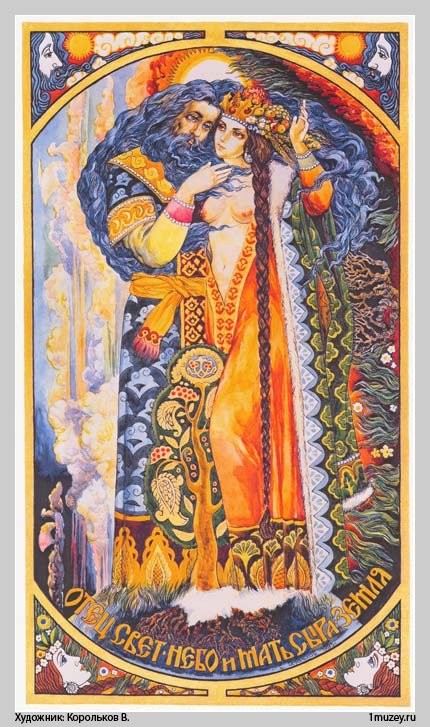
The same is true of the other Waves of Life — each god contains the “imprints” of all the other gods just as a person contains the entire body of knowledge of human information.
For example, consider the ancient Polyan pantheon:
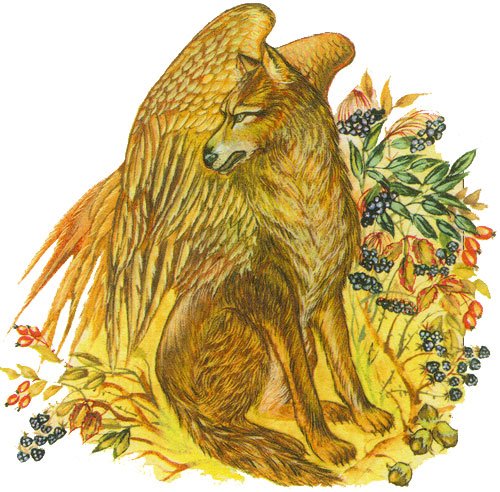
Semargl, the God of the Open Gates, naturally contains the principle of Veles as his binary counterpart;
By asserting the principle of the Joining of Worlds and bringing forth the principle of fire, Semargl expresses Svarog’s principle, the lawgiver;
Entering battle with the Black Serpent, Semargl acquires traits of Perun, who guards the world against chaos;
By guarding the Tree of All Seeds, Semargl is also father of life, bringing it from non-being into being — that is, he carries within him the power expressed in Dazhbog;
By marrying Night and adopting her mystery, Semargl shares Mokosh’s generative powers of the Earth-Mother Mokosh;
The movement of fire, produced by Semargl’s power, naturally also includes the movement of air, granted by Stribog;
The searing power of Fire, combining with the serpent-slaying aspect, manifests Khors’ forces in Semargl;
Finally, Semargl even bears the imprint of Mother Lada, since the passage through the Open Gates is, in a sense, a birth.
Thus, despite the apparent differentiation of the pagan worldview, it turns out that such a multiplicity is even closer to a synthetic unity than many monotheistic worldviews. At the same time, such unity within multiplicity better fosters the development of individuality, the search for oneself and one’s own way.
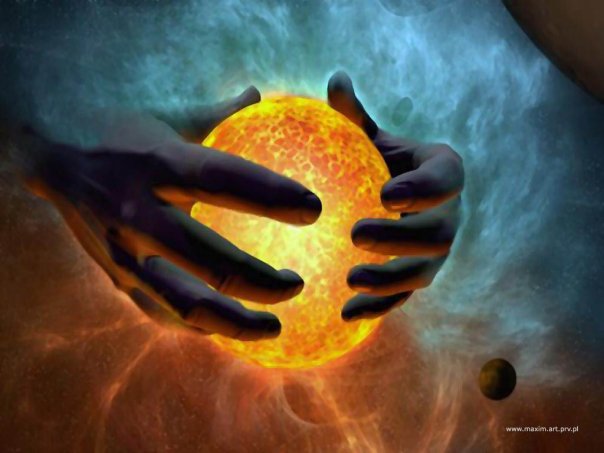
Did you count the principles of seven gods with the seven-headed Semargl? Is that accidental or not?
The Seven Powers of Semargl are not the powers of the Seven gods; they are the universal Powers of the Universe, the Septener (see the article on Septener). At the same time, if one considers the Ennead in its section, then the Power of Veles and Semargl merge into one, just as the Power of Svarog and Lada do, and then the Ennead becomes the Septener.