
Magic and Sex
There is probably no other question that has provoked such heated debate and elicited so many polarized responses as the question of how sexual energies interact with Magic and “spirituality.” Some staunchly defend the necessity of celibacy, or at least abstinence, for Magi; others insist on the necessity of using sexual energies in Magic.
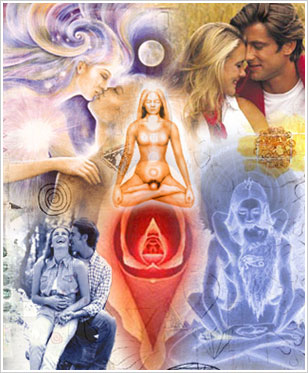
Thelemic and Wiccan Magic are steeped in sexual practice; other traditions are more cautious.
The most ancient forms of sexual magic were related to fertility rites and bore little resemblance to modern ideas on the subject.
Sexual orgies in temples, temple prostitution, and the “fertilization” of fields and gardens on Walpurgis Night are well known. These rites (rites rather than rituals) served as a practical means of stimulating the generative forces in nature and, as such, were closely associated with the Mother Goddess. Among many peoples, sexual freedom was sanctioned during the harvest festival.
One characteristic feature of the seiðr was the active use of sexual magic (both direct and indirect, the latter implying entrance into trance through certain sexual practices). Naturally, in Christianity, which condemned sex, this appeared filthy and shameful; hence one of the epithets of seiðr was “ergi,” “filthy.”
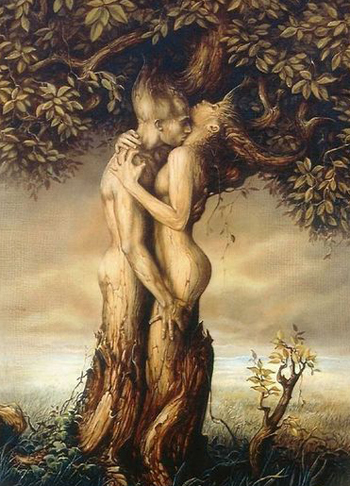
Modern Wicca regards sex as part of nature and believes it should be accepted as it is. Bringing pleasure, lifting our minds from everyday concerns, and continuing our lineage, sex in Wiccan Magic is considered sacred. Wiccans hold that it is God who fills us with amorous passion, prompting us to care for the future of our species.
The history of modern Western sexual magic has its roots at the beginning of the 12th century — more precisely in 1118, when the knight-monastic Order of the Templars was founded to protect pilgrims to the Holy Land and to support the Second Crusade. In 1312 the Order suffered a devastating blow from both ecclesiastical and secular authorities, united by jealousy of the Order’s authority and power and envy of the vast treasures accumulated by the Templars. Several members of the Order were executed, and its Grand Master, Jacques de Molay, was burned at the stake. Like all those at various times accused of heresy, witchcraft, and sorcery, the Templars were accused of numerous and incredible crimes and blasphemies. The practice that we call sexual magic was mentioned as a terrible sacrilege.
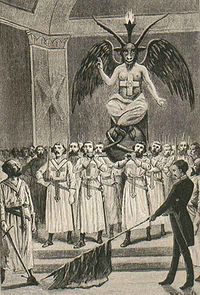
It is believed that the Templars learned sexual magic in the Middle East from followers of Sufism, who in turn drew on the knowledge of Tantric adepts. The theory and practice of the Templars were inherited by some medieval European alchemists, who encoded forbidden information in their works. Later, Aleister Crowley (1875–1947), who studied sexual magic in India and Africa, conducted a series of experiments in traditional Western sexual magic and developed a number of new magical techniques. “My sexual life was very intense… Love was a challenge… It was degradation, a curse,” Crowley wrote in his Confessions.
A diligent pupil of Pan, singer of the Abyss, he staged unimaginable mysteries using altered states of mind. In 1910 he devised a series of rituals he called the Eleusinian mysteries, mixed with mescaline and sexual elements.
The publicity given to those orgies sparked persecutions against Crowley.
Another magician, Paschal Beverly Randolph, at twenty-five was initiated into the Hermetic Brotherhood of Luxor and in 1868 founded his own Eulisian Brotherhood. Randolph wrote a book titled Sexual Magic, whose central ideas were the recognition of spiritual bisexuality as a normal phenomenon and the concept of orgasm as a joining of the magical and the sacred. Randolph significantly influenced the revival of the Templar Order under the name Ordo Templi Orientis (or OTO). Crowley later joined this Order and, by 1922, had succeeded in becoming its indisputable authority. If in our time any information from the sphere of ceremonial Magic is somehow associated with the Golden Dawn, then practically everything that concerns the achievements of sexual magic is attributed to Aleister Crowley and the OTO.
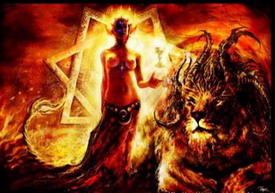
Crowley’s attitude toward sex is shown in the following excerpt from “Synopsis on Six Articles on Drugs,” which he wrote in 1923: “Every person must attain absolute mastery over the control of their passions… A preliminary condition of success is to get a clear view of the subject and to clarify every detail by precise and intimate analysis. The first step, evidently, is to conquer the fear and fascination which, at the slightest mention of this topic, are aroused in ordinary men and women… Therefore it is essential for people to be able to master the subject intellectually in its entirety. When they are able to consider any given sexual idea without emotion, they are on the right road to freedom. It is the same simple principle as teaching a medical student to observe operations and to perform autopsies without tears, weakness, fainting, and the like. The surgeon must look upon his patient as the connoisseur looks upon a painting or the lawyer upon the case before him. So long as he is excited, he will not be able to look straight; he will be confused and utterly incapable of giving judgment or performing the necessary action. This may sound coarse, yet most people cannot even understand such an explanation, because the slightest mention of sex throws them into a blind convulsion of lust and they erupt into priapism or camouflage themselves in shocking indignation.”
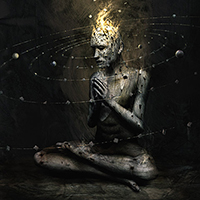
It is customary to distinguish three possible attitudes of a Magus toward sex: 1) he refrains from sexual activity and thus preserves his energy for Magic; 2) he has sex with a partner whose energy is harmonious with his own, which allows them not merely to expend energy but to exchange it. In this case, the Magus does not diminish his energy reserves; on the contrary, it increases, for the combined energy of the partners has different qualities and proves more desirable to each of them than their individual energies. 3) he has sex while shielding his own energy and drains energy from his partner.
Nevertheless, it is well known that traditional Western magical traditions are rather cautious about sexual magic. Many of these currents choose either the first option or its modifications (for example, druids are known to have been forbidden from heterosexual intercourse). The third option, in which the Magus practices vampiric sex, is also practically absent in traditional currents since it is believed (even aside from the moral question) that assimilating another’s energy may require more force than will be gained in the end.
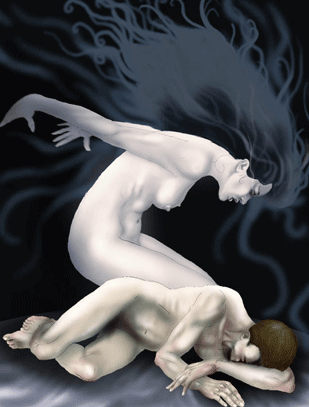
Another celebrated method of demonic sexual magic is the demons acting as incubi and succubi. St. Thomas considers this doctrine, elaborated earlier by St. Augustine, to be “sufficiently grounded and justified,” with the self-evident caveat that by such sexual magic children can at best be conceived by artificial means. The same view is held by St. Albert the Great, St. Bonaventure, Duns Scotus, Suarez, Pope Benedict XIV, St. Alphonsus Liguori and, in modern times, Cardinal Lépicié. This type of sexual magic was taken seriously enough that Bavarian legislation of 1751 punished cases of “carnal union with the Devil” by “burning alive.”
In every ritual of sexual magic, the roles among participants are distributed as follows: the man is the Magus (a projection of the God of the Sky, the Creator, the Forefather), and the woman is the Medium, or conduit of the Magus’s Will (the Earth Goddess, giving birth to what the God of the Sky has conceived). This is conditioned not only by “tradition,” which essentially belongs to the realm of the psyche, but also by personal energy patterns, which vary in part according to sex. Even if a rite does not require intercourse, the male Magus “leads” the ritual — that is, he utters the principal phrases and performs the necessary gestures; the woman — the Medium — projects his Will onto a particular object or a particular person.
And finally, the most difficult point. Most often the term “sexual magic” has little to do with magic. It refers either to an attempt to cover up banal lust and debauchery or to a naive misunderstanding when one confuses energy exchange with magic.
Attempts to combine “the pleasant with the useful,” that is sex to extract power, or to use Magic to facilitate sexual contacts (seductions, love spells) or to obtain satisfaction of one’s fantasies under the guise of magic are, of course, as old as the world.

It seems to me that no one can describe sex better than Crowley. In my opinion, the existence and relationship of the Goddess-Mother and God-Father can be considered magical, but to link sex with magic on a magical-human level seems somewhat duplicitous 🙂
“For example, it is known that Druids were banned from heterosexual sexual contacts”
I have a question: how is this known? After all, the Druids were practically destroyed during the conquest of their territories by Christians, and all information about Druids and their mysteries was moderately distorted by Christian historians and mystics: the struggle of egrets.
It seems to me that everyone has their own way. Some magicians simply cannot do without sex, which fills them with energy and pushes them forward. And someone refuses sex under the influence of delusions born of societal moral frameworks, simply shutting themselves off from this process, not even imagining it except in purely theoretical terms.
I still don’t understand anything – “Templars, cardinals, mother goddess, Crowley”… What to do with sex!!! Should we engage in it or not? Is it better to have one partner for life or is there nothing wrong if there are many? Does the number of partners matter for a magician or not? Heterosexual or homosexual, group or some perverse connections – does it even matter, direct or indirect, negative or positive impact on personality, soul, strength, or something else? What does the author think?
What do you think?
You are asking important questions, dear Student. Except for the last one. Essentially, what does it matter what Templars, cardinals, Crowley, or Enmerkar think about this? Each person has to decide and live with it themselves. If people asked themselves questions of such level, say, regarding food, I think we would be much healthier. Or even sleep. Not everyone keeps that childlike resolve of the body – I want to sleep – I fall asleep and sleep. Here, sorry, whether to defecate or not – everything is clear, no questions. But with something slightly more complicated, it is not so simple))). To be or not to be? – that is the question…