Kabbalah and Urban Magic
Pagan Magic arose and developed alongside the living forces of nature, deriving its main features from them. In the cities, however, another form of Magic long ago took root — one that first arose in the rocky, clayey, lifeless deserts of Mesopotamia, was reshaped in Egypt, reinterpreted by Jewish sages, and has come down to us as Ceremonial Magic and its theoretical counterpart — Kabbalah.

Much has been written about Kabbalah; we have already discussed certain questions, and here I will only add that this dry, precise, highly formalized, mathematical doctrine fits the conditions of modern cities very closely, as they are likewise ordered and precise.
Some commentators say that God first taught the Kabbalah to chosen angels, who established a school in Paradise. After the Fall, the teaching was entrusted to humanity so that humanity might recover its lost status. From Adam it passed to Noah, then to Abraham, then to the Egyptians, and from them to Moses.
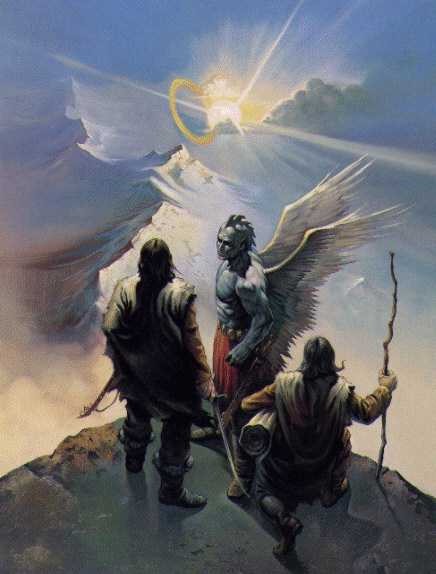
An angel is said to have taught Moses Kabbalah during his forty years of wandering in the desert. Moses then concealed this teaching within the first four books of the Pentateuch and initiated Aaron and the seventy elders into its secrets. According to tradition, the teaching was handed down in a chain of priestly succession (among whom were David and Solomon) until the destruction of the Second Temple, after which it was first committed to writing.
It is held that nothing now called Jewish Kabbalah was written down before the Christian era. The first to record these traditional teachings is thought to have been Nehunya ben HaKanah, around 70 CE. Rabbi Ishmael ben Elisha wrote around 121 CE. Another Talmudist, the presumed author of the Zohar, Rabbi Shimon ben Yohai, lived around 150 CE.
However, historical research shows that Kabbalah first became known to the wider world around the seventh century through Greek schools of Neoplatonists and Neopythagoreans. It seems that the main corpus of the chief Kabbalistic work — the Zohar — remained accessible only to secret schools until the thirteenth century CE.
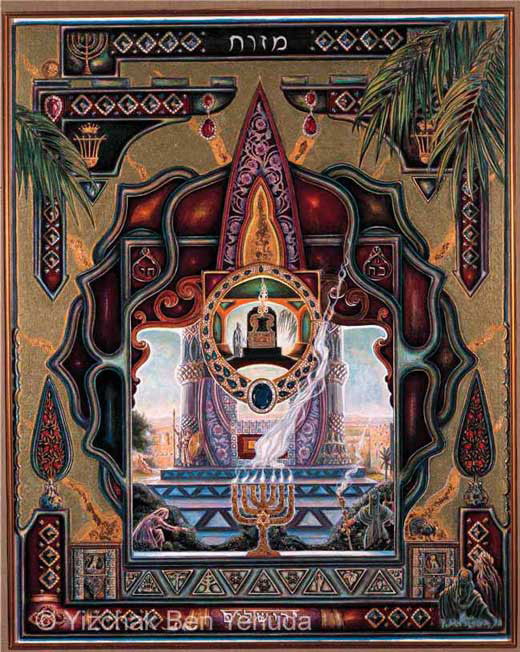
Among the early Kabbalistic texts are a work called “Palaces,” which describes the throne of God and His angelic household, as well as the books “Dimensions of the Deity” and “The Alphabet of Rabbi Akiva.” In these writings, each Hebrew letter is treated as the embodiment of an original spiritual idea.
The Sefer Yetzirah surfaced in the eighth century. It is an entire philosophical system set out in thirty-three short sections, each based on one of the twelve zodiacal signs, on one of the ten planets, and on one of the ten numbers. “Sefer Yetzirah” means “Book of Creation.” It is believed to have been dictated by the patriarch Abraham himself.
The study of Kabbalah aims at experiencing the spiritual worlds in their fullness while still in this life — to grasp the entire cosmos, to attain perceptions beyond birth and death, to step into timelessness, to reach a condition in which one can exist simultaneously in all worlds, fully united with the Higher Power, fully comprehending the Creator.

This is the purpose of human existence in this world and of the cosmos as a whole. It is revealed gradually to one who studies the Kabbalah.
Attitudes toward kabbalists have changed in recent years: whereas once their books were burned and they were persecuted, today many people — including those far removed from Kabbalah, artists and singers — wish to adopt the label “kabbalist.”
However, despite all this, Kabbalah was and remains an urban teaching, oriented toward people living apart from the forces of nature and drawing inspiration from the higher transcendental worlds. It is therefore understandable that it does not convey the living dynamism here, treating processes chiefly as the influx of Light (Or) into individual Vessels (Kelim). That, of course, corresponds to reality, but it is only one mode of describing it.
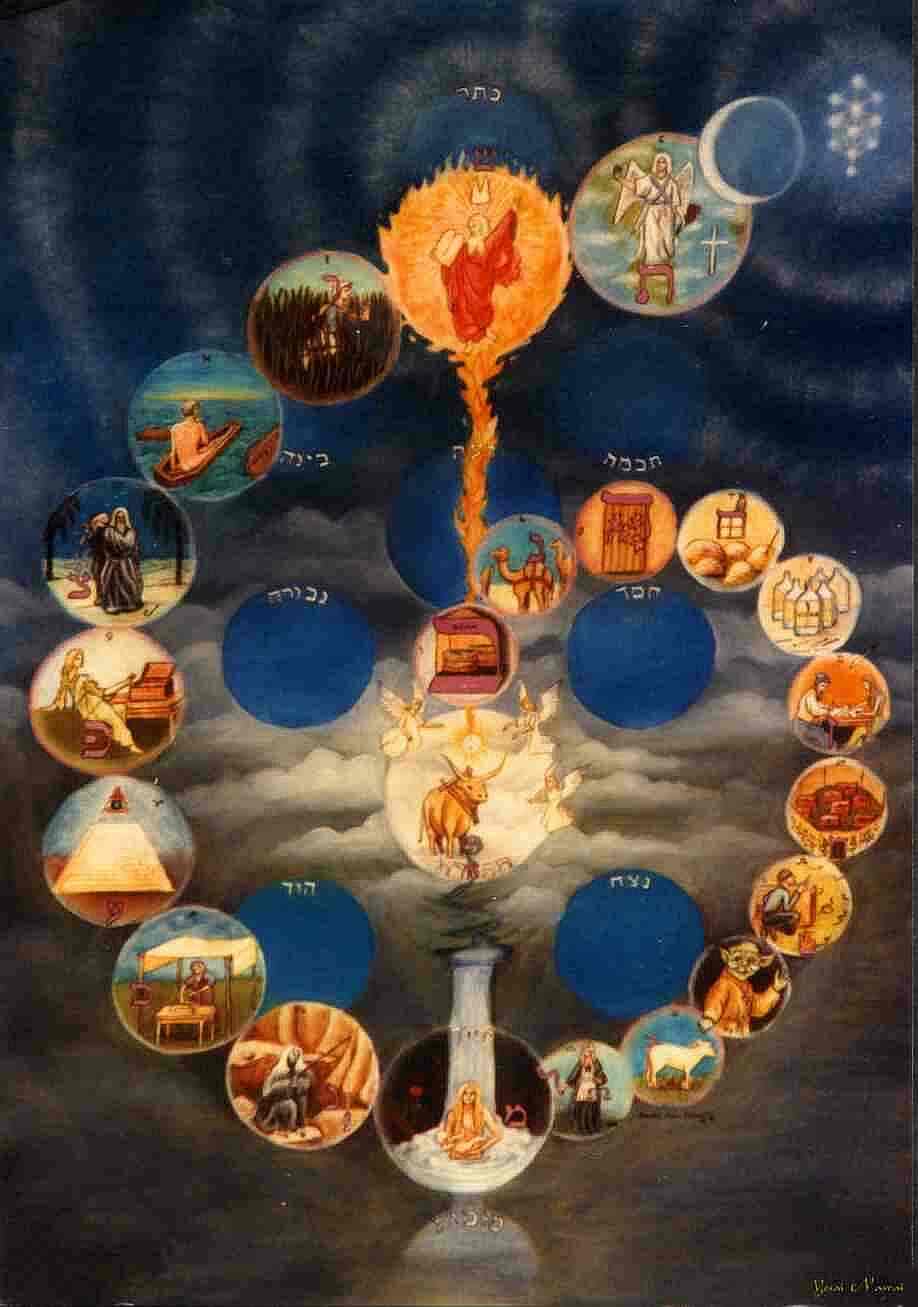
It follows naturally that urban Magic, developed on a kabbalistic-gnostic foundation, differs in that it lacks nature’s influence on the course of processes and rituals. As early as the Middle Ages, such magi sought out castles and towers, moving higher and farther from the forces of the Earth and the spirits of Nature, who can — and sometimes must — interfere with goetic workings. Incidentally, modern magicians often fail to account for this, summoning spirits outside the city or even in the forest, which makes the operation difficult to control and nearly unpredictable.
Thus we observe another division among magical ways: apart from the appeal and summoning strategies discussed above, it becomes clear that the summoning strategy is the urban method of influencing vortices, while the appeal strategy is closer to nature.
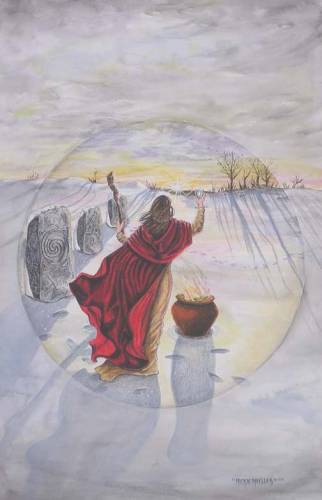
Kabbalah is the “urban teaching”, more relevant for cities. What teaching represents Pagan Natural magic? And is there such?
Druids.
Help me study Kabbalah.
At the center of the magic of Kabbalah lies the concept of names of all that exists. These names, accordingly, must be pronounced in Hebrew, otherwise they will yield no result. The essence of these names in Kabbalah magic is to gain power over living and non-living nature, since everything in it has its own secret names. For example, if a Kabbalist can know the secret name of a particular person, they will gain immense power over that person. The same can be done with the elements or natural phenomena. To know these names, one must first master the true meaning of the ancient Hebrew alphabet. And this is not so simple, since Kabbalah magic cannot be thoroughly studied just through books. Representatives of orthodox Kabbalistic teachings assert that to grasp it, one must be a Jew and have a good teacher who can unveil the secrets of letters and numbers. Here lies the main contradiction between Kabbalah magic and Kabbalah as metaphysical knowledge: prophets and teachers of Kabbalah strictly forbade their students to use Kabbalah for magical purposes; for them, Kabbalah is only a means to know the Almighty and should only be used as theory. Practical use of hidden meanings of Hebrew letters or Kabbalah magic is a very sinful endeavor and no orthodox Kabbalistic teacher has supported it. But this didn’t prevent less principled teachers from introducing Kabbalistic magic into practice.
I agree, one can wait for a Mentor, or one can have the Desire and even, being not a Jew, try to uncover the meaning of letters and numbers.
When I started meditating, I remember an entity emerged from Aleph and asked: “why do you need this, you are not a Jew?” I replied – I want to understand the wisdom of Hebrew. The being turned around and left. They didn’t bother me anymore.
…and you, by the way, have you ever thought about what distinguishes a Jew from a non-Jew?
……..I can confidently say that these differences really exist, which I had the honor to experience firsthand……………………I can even say that Jewish roots bring people closer, attract them to each other
………………………one can recall their books, which start on the last page and texts that are written from right to left (which, in my opinion, indicates the dominance of right-brain perception, I decided so because I myself started reading and writing from right to left and was very surprised why I need to relearn)) ……………………..it is very difficult to suppress or hide Jewish genes in oneself…. they manifest themselves easily… even if a different nationality is indicated in the passport)
………………images, letters arise from perception, one might say that certain energetic streams, passing through the prism of individual perception, crystallize into certain forms (the very letters)………….and hence, people with genetically similar perceptual abilities or rather shades of these abilities will more easily and fully comprehend what similar individuals have tried to express…………