Kli Hitzon
The Power’s ability to induce corresponding flows has many important consequences.
In fact, it is precisely this that underlies the First Rule of Contagious Magic: «if two things once come into interaction, interaction never ceases».
Every object or living being is a point of support for a set of powers, and these Powers affect both the object itself and its surroundings, generating various flows.
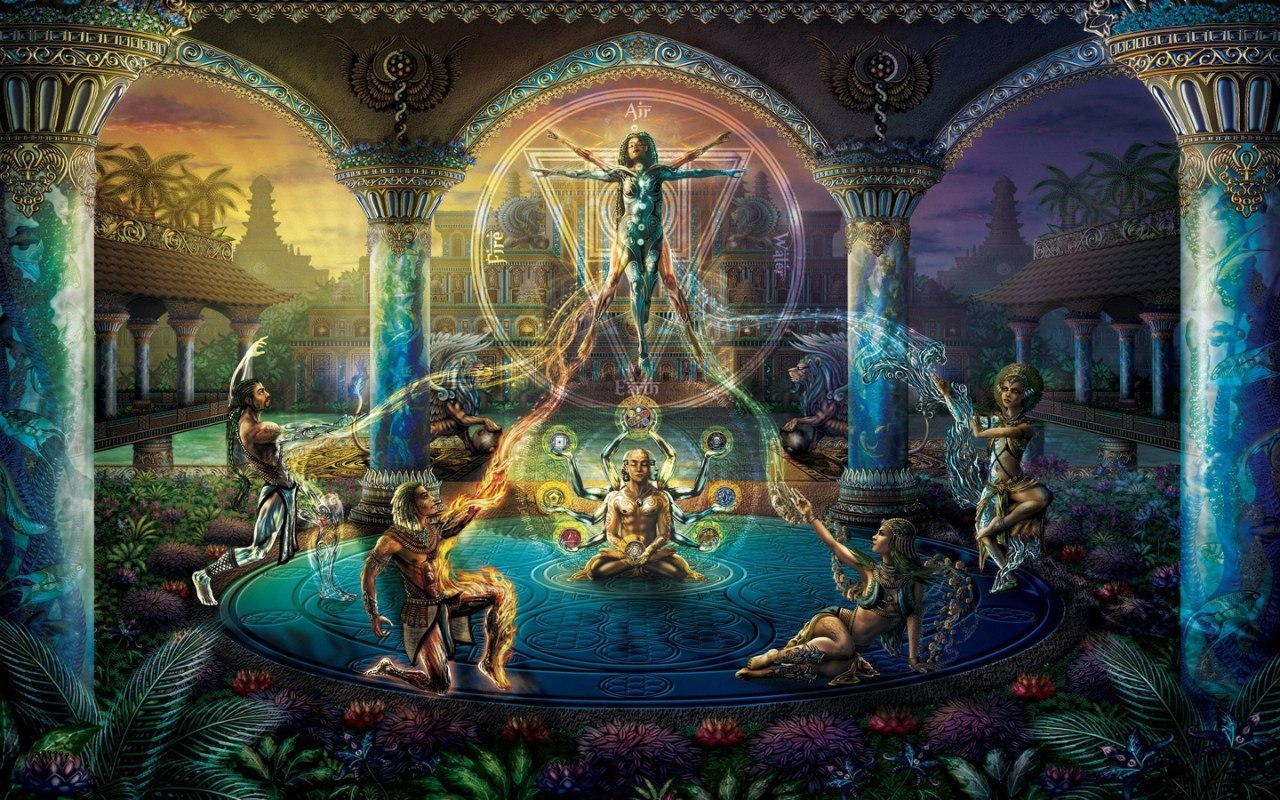
This means that a creature’s environment matters enormously. It is not merely the “background” or the “field” in which its existence unfolds; it actively and diversely influences the being, and this influence must be carefully assessed and equally carefully shaped. Therefore, the collection of objects with which a given mind interacts is called the “Kli Hitzon” — the “External Vessel” of that mind, which signifies its direct participation in the development and realization of the being. In fact, the entire Universe is held in unity by the repeated intersections of these “external vessels,” through which mutual induction of powers occurs.
When it comes to the ritual space, people usually recognize how important its harmony and order are.
However, when it comes to one’s living space, circle of acquaintances, and other modes of interaction — discrimination and attentiveness often lapse.
It is well known that different objects have the capacity to stimulate the mind in different ways: some inspire it, others stifle it. But even those objects that, at first glance, seem to exert no direct influence are not neutral once one interacts with them.
People often associate with those who are easiest to get along with, rather than with those who stimulate their development, and thus lose opportunities. People pay little attention to objects they bring into their homes — and experience various problems. People choose “convenience” instead of love — and sink into helplessness.
A Magus must clearly understand that the «External Vessel» and the Inner Vessel are closely interconnected – «As above, so below»: dirty clothing affects mental clarity, and room disorder is inevitably reflected in the mind, while indiscriminate relationships weaken protection against predators and parasites.

A Magus must evaluate how objects in the “External Vessel” affect the intensity of his being. He must not merely understand the cosmic structuring of space intellectually (both macrocosmically and in the psychosemantic sense); he must watch, feel, study these interrelations and alter them in order to increase his vitality.
And this is not just about the exchange of energy, not just about interactions — it concerns far subtler, and at the same time more fundamental influences and interactions — the formation of the mind. The mind not only creates the surrounding world; it is also created by it. And to ignore or diminish the importance of the “External Vessel” is to risk catastrophic failures in development.
Predators and parasites expend enormous effort precisely to create disharmonious «External Vessels», sometimes persuading that «these are trifles», sometimes claiming it’s easier, sometimes inventing all kinds of justifications. But the fact remains — “a king is made by his retinue”, and a single disharmonious object in a Magus’s room can bring him to ruin.
And so, speaking of that, one problem arises, which probably many of those who embarked on a certain spiritual journey in one paradigm or another face (be it Magic, Yoga, or even traditional religion). There is one factor that did not exist in the Middle Ages, which appeared during the so-called ‘Enlightenment,’ and in our time has become the dominant paradigm. You can say that this is an inseparable property of the collective Klikhitzon.
In the book ‘The Mindfulness Practice,’ Charles Tart presents the Credo of the modern Western world. Here it is:
‘I BELIEVE that the material Universe, governed by immutable physical laws and randomness, is the only and ultimate reality.
I AFFIRM that the Universe has no Creator, objective purpose, meaning, or destiny.
I BELIEVE that all ideas regarding God or gods, enlightened beings, prophets and saints, non-physical beings or forces are sheer prejudice and illusions. Life and consciousness are completely identical to physical processes and arise from the random interaction of blind physical forces. Like all other life, my life and my consciousness have neither objective purpose, nor meaning, nor destiny.
I BELIEVE that all judgments, values, and moral norms – my own or those of others – are subjective and arise exclusively from a biological basis, personal history and randomness. Free will is an illusion. Therefore, all the most rational values by which I can live must be based on the knowledge that what brings me satisfaction is good for me, and what causes suffering is bad. The one who helps me obtain pleasure and avoid suffering is my friend; he who hinders me in this or brings me suffering is my enemy. According to a rational approach, friends and enemies should serve to increase my pleasures and decrease my sufferings.
I AFFIRM that churches are only needed for providing social support, that there are no sins that can be committed and for which one can obtain forgiveness, that there is no punishment for sins and reward for virtue, except for those that I can bestow upon myself, directly or through others. Virtue for me consists in obtaining everything I want without being caught and punished by others.
I BELIEVE that the death of the body is the death of the mind. There is no life after death, and any hope for it is nonsense.’
Thus, among other things, is a property of that external Vessel in which every individual dwells. This is what he was taught since childhood.
If we replace some points of this credo with ideas of social equality, building communism, and a bright future, we obtain the credo that was implanted as the dominant ideology in the minds of those who are now around thirty-five to forty (and older) during their formative years.
During the Perestroika period, it became permissible to believe in something that did not conform to the materialistic worldview. And many people began to consider themselves believers de jure – they started going to church, celebrating Easter and Christmas, MORALLY EVALUATING THE BEHAVIOR OF OTHER PEOPLE in accordance with the morality of the denomination that resurrected on the territory that previously belonged to it (Orthodoxy in Kiev and Moscow, Catholicism and Lutheranism in Tallinn, Islam in Tashkent, Lamaism in Ulan-Ude). But de facto ‘I Believe…’ in their mouths meant ‘I want to believe…’, ‘I am trying to believe…’. This is because their de facto faith was and is what is outlined in the above ‘Credo.’ Thus, there arose an unresolved, irreconcilable, and often unrecognized (and, thus, repressed into the Shadow and belonging to the Shadow) contradiction. And thus a widespread type emerged, the so-called ‘Sunday Morning Christian’ – the one who goes to church every Sunday (so everyone can see), sings the loudest (so everyone can hear), arranges for himself a mini-Christian theater every Sunday, recording all these actions ‘for himself,’ while in the rest of his life he professes the above-mentioned ‘Credo of Rationalism.’ Rather, while formally considering themselves believers, they live and act precisely according to the ‘Credo of Rationalism’ and ‘Healthy Egoism.’ Moreover, when it comes to people who cause them various inconveniences, they judge them according to Christian morals, but when they act themselves, they do exactly as those whom they condemn do. ‘Faith’ for them is a kind of appendage to life that can always be sacrificed for some worldly distractions and things. For example, it’s unlikely that such a person would go to church when a football match is on. Or when he learns about a sale of something at the nearest fashionable clothing store. Or when there’s a ‘today only’ promotion at the nearest supermarket. Or when some Zhanna Friske is shaking her butt at the nearest concert venue. That’s the price of their faith. And this goes on until a liver sarcoma is discovered, and the doctors say, ‘medicine is powerless.’ And then the subject starts a tour of churches and monasteries, resorting to faith as a last hope for healing when doctors can do nothing. But… as a rule, it’s too late to drink Borjomi…
If we’re talking about those who’ve chosen the occult path of knowledge, then such a ‘Credo,’ being an integral part of the surrounding ‘Kli Khitzon,’ undoubtedly influences them and is a significant obstacle to progress. If many occultists remain ‘armchair, chair-bound, bookish occultists’, believing in occult paradigms just as an average person believes in the historically accepted religious dogmas of their homeland. Rather, not believing, but wanting to believe. That’s why they can’t cross that boundary that they are so clearly aware of. An extremely significant contribution to that boundary is precisely that very ‘CREDO,’ which is an inseparable property of the surrounding vessel (and, accordingly, the vessel, Klikhitzon, influences the person). In this regard, for the modern occultist, magical isolation (during which the influence of the collective vessel is minimized) would help to become a Mage like never before, but not everyone can afford such a luxury physically. First of all, money is needed to buy yourself a little house somewhere in the Carpathians, for example.
If in the Middle Ages, presumably, the main obstacle was fear of the ‘supernatural’ force (and there was no doubt about its existence), then now to experience such fear (fear of the force, as such) is already an achievement. Since, to come to this fear, one needs to overcome another stopping fear – the fear that ‘CREDO’ is Truth, that everything, in fact, is exactly like that. Because when a theorist thinks about switching to practice, a certain part of him, that part he may not even be aware of, whispers to him: ‘Well, you know that you won’t succeed.’ And he is afraid to do something because he fears that nothing will come of it, fears disappointment, fears losing that faith which, after all, warms him, which gives meaning to his life. Although, in reality, it simply provides a ground for his indulgence in ‘I WILL …’ (I will become a Mage, a powerful sorcerer, and a great Theurgist who is ‘on a first-name basis with gods and angels,’ and so on.) So, that’s the sad picture.
There is a concept known as the “social contract”—an agreement in society about what exists and what does not, what is acceptable and what is unacceptable. Such a contract imposes certain limitations and reveals certain possibilities. For some, pork is a nutritious protein, while for others it is poison. In some people’s worlds, telepathy is possible; in others, it is not. It turns out that everything is relative. Relative to the agreement.
From this, we can conclude: allowing everything expands possibilities.
Who and what shapes this “social contract”? Parents, schools, spiritual teachers of humanity, religious figures, power structures, information sources, science, and experience. Whom to trust is also prescribed and rewritten in your social contract.