Tetractys: the Unfolding of Power
Among the symbols endowed with realizational power, one of the oldest and most widespread is the Tetractys, which describes the stages of manifestation of power.
The ancient Pythagorean oath is:
“…I swear by the name of the Tetractys, sent down to our souls. In it is the source and root of ever‑flowering Nature…”.
Even this phrase hints at the exceptional importance the ancients attributed to the Tetractys.
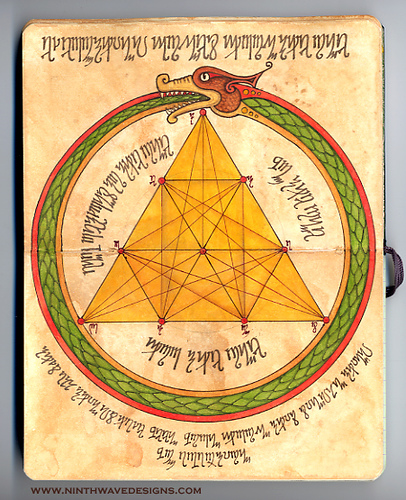
The Egyptians regarded the Tetractys as the supreme symbol of the universal forces and processes at work in the Universe.
The idea of the Tetractys is simple: the neutral One, in order to manifest, becomes a difference in potential — a Dyad — which unfolds into a Triad (the binary begets the androgyne), the Tetrad forms the background for its manifestation. Together these stages constitute the Decad, the sacred unit of Western thought.
The One was conceived as the universal essence, an activity that is the form of all things and the active principle. By participating in the One through ‘imitation,’ everything is made equal to itself, is “One.” The second characteristic of being — the Dyad — is pure inequality, indeterminacy, and opposition — the object of “cognition,” of manifestation. The Dyad — a passive category — arises when the One adds itself to itself, when the One extends beyond itself, generating a moving force. The One and the Dyad are the fundamental characteristics of being and were regarded as the universal modes of existence for things. The third characteristic — the Triad, in which the One attains its reality and its completion — arises from the unity of the one and the many, when the One forms unity with the indeterminate multiplicity of the Dyad; in other words, the Dyad gives birth to the neutral, balanced Triad. This is the first equilibrium of unities. The universe and all things are defined through the Triad, the principle of manifestation. The fourth characteristic — the Tetrad — arises from the doubling of the Dyad’s pure difference, from a passive state, even passive compared to the Triad’s neutrality. In the Tetrad, the object of “sensory perception,” the Triad finds bodily embodiment. The numbers 1 through 4 form the Tetractys, expressing thereby the entire cosmos.
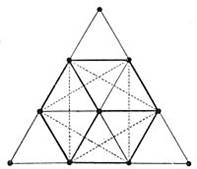
In the Tetractys scheme the One signifies a point, the Dyad, extension, the Triad (triangle), a plane, and the Tetrad volume or space.
Plutarch held that nothing can be named that does not rest on the Tetractys. It is the cause and maker of all things, the knowable God, creator of celestial and sensible good.
The Tetractys is divided by the ten intersecting points of its lines into nine equilateral triangles, which embody the fullness of the world. The tenfold embodies the absolute primordial One as potency and the givenness of being, which, having passed the necessary stages of evolution, acquires being and essence in itself. Pythagoras said that the Decad is the nature of number because all things come to it, and when they come to it they return to the Monad. The Decad was called both heaven and the world because the former includes the latter.
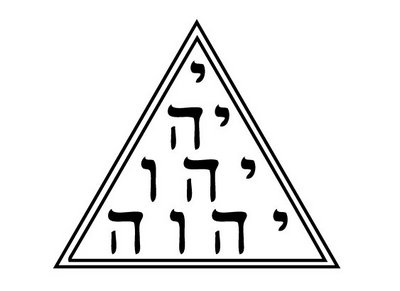
It is this simple idea that underlies the sacred Kabbalistic teaching of the Tetragrammaton and the Tree of Life, numerous incantations (for example, the widely known Abracadabra), the Tarot, and many other ideas — so that the Tetractys can rightly be considered the foundation of European mysticism. The Tetractys is a symbol of the cosmos, perfection, order, and measure. The Pythagoreans identified the Tetractys with harmony itself. The universe, fashioned by number and opposing principles (finitude–infinity), behaves according to reason, in proportion to necessity and measure. The Tetractys is an extremely common symbol; it appears in ancient manuscripts, alchemical treatises, on the facades of buildings and cathedrals historically associated with the Templars and Masons. It underwent many modifications — it was rebuilt, truncated, deprived of its apex (its activity), had rows of points removed or new ones added — and each manipulation of such a universal sign had particular consequences for its potency. Since all the symbols that make up the Tetractys influence its meaning and power, altering any part of it entails various consequences: activity increases from bottom to top; moreover, its right side is active, while the left and the base are relatively passive. Accordingly, a truncated Tetractys signifies a controlled, “domesticated” Power; a Tetractys deprived of one of its points loses its equilibrium and becomes a weight, displacing the flow of power. Thus the Tetractys (or the “Sacred Pyramid”) embodies a vivid expression of the universe’s wholeness, which moves from its unity toward the multiplicity of the material world.
Hello! Enmerkar, you say that ‘the truncated tetractys means managed, “tamed” Power…’. How should this be understood? After all, if we truncate the tetractys, we at least lose the ‘unit’ or ‘Yod’, which is related to the ascilut or to Chokhmah, which, due to the blockage of the source, reduces (or halts) the flow of power, plus decreases its potency since it, in a particular sense, is ‘not legitimized’ at the designated levels. Or is the ‘truncation’ in this sense executed after actualizing the power and is seen as a temporary procedure, so to speak ‘conserving’ the power, and later, to implement the tetractys, its apex is returned?
In this case, the own apex of the Tetractys, the source of its activity, is replaced with an external controlling factor. By depriving the Tetractys of its highest point, one can use its resources, similar to how a bird’s wings are clipped or a horse’s eyes are blindfolded. It is clear that such action, in essence, implies violence against the energy of the Tetractys and is, in its essence, not very noble.
Informative. Thank you.