Mirrors and Magic
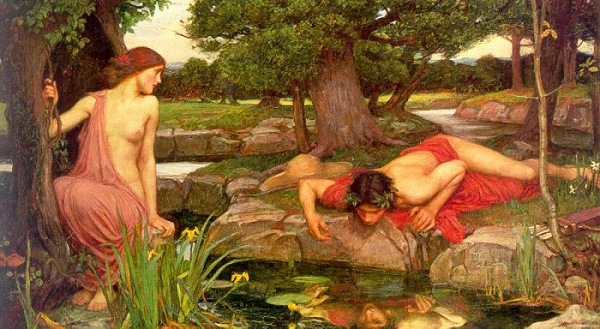
The magical use of mirrors has an ancient and rich history. Myths mention mirrors as an attribute of gods and heroes. The mother of the Scythian gods — Tabiti — and the mother of the Japanese gods — Amaterasu — were depicted holding a mirror; Narcissus, who saw his reflection in a pool, could not tear himself away and turned into a flower; Perseus defeated the Gorgon Medusa with a reflective shield; the Titans forced Dionysus to look into a mirror, after which he sank into a world of illusions and perished. According to Pliny, even the fearsome Basilisk, which burns everything with its gaze, dies when it sees its own reflection.
In Demeter’s temple there was a rock-crystal mirror used to determine whether a sick person could be cured or whether all attempts would be futile. Amaterasu’s mirror was kept in the Ise shrine and was regarded as a Japanese national relic. This mirror is fashioned in the form of an eight-petaled lotus and is handed to the emperor during his enthronement. The Japanese mirror bears the inscription: “I am who I am.”
The Chinese goddess of lightning, Dianmu, is shown with two mirrors in her hands. She brings them together and separates them, producing flashes of lightning and illuminating the sinners whom the thunder god must punish. The goddess also bore the epithet “Mirror of the Thunder God.”
The Romans carried mirrors as amulets. Even now in Romania and Germany brides walk down the aisle with mirrors. Pausanias reported magical mirrors.
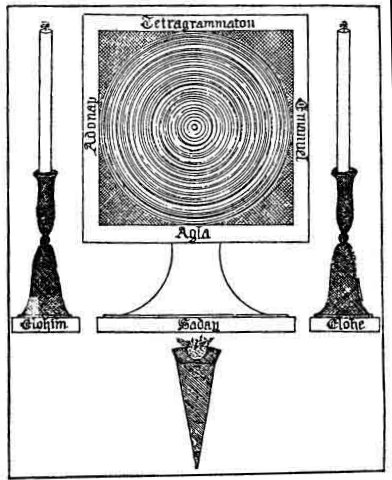
The “Mirror of Solomon” is one of the oldest examples of the divinatory use of mirrors. In magical mirrors one could see not only the present, but the past and the future as well:
“Whoever carries this mirror can read another’s thoughts. When you look into the magic mirror (but no more than once a day and only before sunrise), you can see around your face those people who thought of you most that day. If your face in the mirror appears blurred, as if covered with a film, it means that some sorcery has been done against you.”
Thessalian witches taught Pythagoras how to divine with a magic mirror by pointing it at the Moon. The Romans who could read with mirrors were called “specularii.”
Chinese and Egyptian bronze mirrors served the same purpose, and earlier people used crystals and crystal balls, as well as bowls of water. In Chinese culture mirrors were believed to repel evil, because evil that looks into a mirror and sees its own deformity is seized with terror.
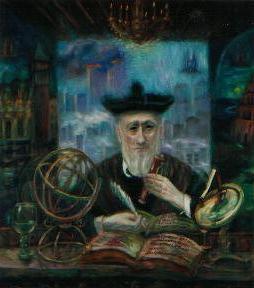
A prominent place among John Dee’s “magical crystals” was a mirror of polished obsidian (volcanic glass) brought by the Spaniards from distant Mexico. Evidently it was a relic the Aztecs used for the same purposes as John Dee — for divination. One curious supporting fact is that the name of the all-seeing, all-knowing Tezcatlipoca — the god of volcanoes and of volcanic glass, obsidian — literally translates as “the smoking mirror.”
At the same time, in Russia until the fifteenth century mirrors were largely unknown, although among the Scythians and the Polovtsi these objects were widely used. Scrying with mirrors was considered one of the most dreadful practices in Russia. It made no difference whether a girl practiced divination alone in the banya or in the living room with friends. For if the suitor who appears in the mirror notices the girl and beckons her, and she does not cross herself in time and say ‘Chur me!’ three times, stack the mirrors, she will die. Slavic traditions prescribe that a woman should not look in a mirror during menstruation, pregnancy, or the postpartum period — that is, at times when a woman is considered “unclean” and when, according to folk belief, “a grave is open before her.” It was held that the reflection in the mirror belongs to the otherworldly, to the “that” world, to the realm of death and unclean powers.
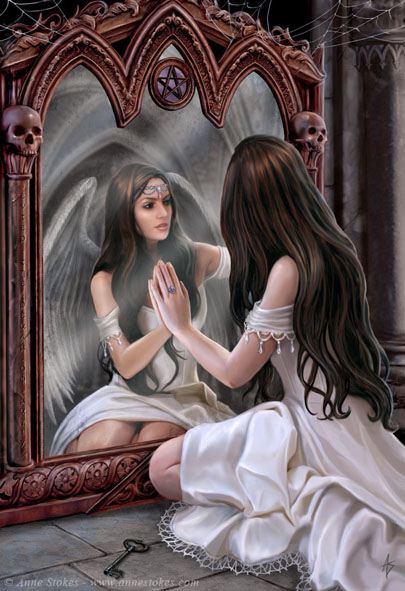
Ivan Vasilievich the Terrible, highly suspicious and obsessed with hunting sorcerers, feared curses and the evil eye so much — which were supposedly easily cast through any mirror — that mirrors for his wife’s household were made only by blind craftsmen.
Fear of mirrors was also common in Europe. In 1321 the maiden Beatrice de Planissol was accused of heresy and sentenced to life imprisonment merely because a mirror had been found among her belongings.
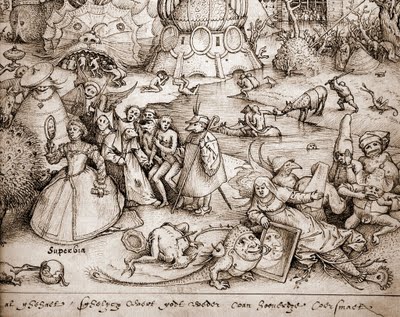
In any case, the ancients agreed that a mirror is a “point of cosmic intersection” that grants access to another world, and it was thought possible that a person might disappear into the depths of a mirror or that a spirit could emerge from it and carry a person into another realm.
Indeed, literature abounds with accounts of deaths involving mirrors, and everyone knows the custom of covering mirrors in the home of the deceased to prevent the living from following them.
What underlies a mirror’s ability to reveal what the eyes cannot see? Opinions diverge. Some believe mirrors ‘can concentrate astral light’; others attribute mirror visions to the subconscious; still others believe that mirrors are windows into “parallel worlds.” Paracelsus believed mirrors linked two worlds: the subtle and the physical.
“The mirror is linked with the water–moon–woman complex. Like water it is a reflecting surface (in which one can see images of the unknown). Because it only reflects the forms of other objects, having none of its own, the mirror resembles the moon, which reflects solar light and is itself devoid of any; its nature is changeable — it is sometimes ‘inhabited’ and sometimes vacant, which points us to lunar and feminine symbolism. In its capacity to reflect the human and the surrounding reality, the mirror corresponds stably with the mind, with thinking as instruments of self-knowledge and of reflecting the universe; the notion of ‘reflection’ (Latin ‘reflectere’) brings thought and mirror together.”
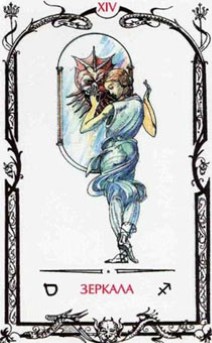
Many predictions and prophecies were made using mirrors. Visionary mirrors were made from a great variety of minerals: nephrite, hematite, obsidian — and in many different shapes. Concave, hemispherical mirrors were considered the most effective. Practically all Magi and alchemists of medieval Europe possessed concave mirrors, and some even had “mirror rooms” and “mirror machines.”
Roger Bacon, then a student at Oxford, owned such mirrors; legend has it that with one of them he could light a candle at a distance, and with another he could observe what was happening at any point on the globe. Heinrich Cornelius Agrippa showed guests in his magic mirror their loved ones, including some long dead.
The Hermetic tradition maintains that mirrors do not reflect an “other world,” but rather reveal what exists in this world yet is invisible to the ordinary eye. Many polished surfaces have the ability to weaken perceptual defenses, revealing what has been pushed beyond the barrier of perception. In other words, what is seen in the mirror exists alongside the viewer but is not perceived by them and therefore cannot interact with them. Once it becomes available to perception, this “beyond” reality can affect the operator — and that effect may be either positive or negative.
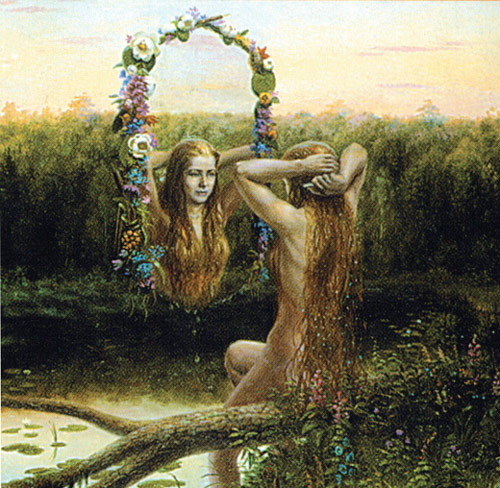
Another important point is the mirror’s ability to reflect the “memory” of objects — the “reshimo,” imprints laid upon objects by various emanations, including those long past. It is well known that “two objects that have once interacted forever retain the trace of that interaction.” The reflection of an object in a mirror is, of course, an example of such interaction. Therefore mirrors retain the imprint of everything and everyone that has been reflected in them, and under certain circumstances these imprints become accessible to perception. Not because a mirror’s imprint differs from others, and not because the mirror preserves these imprints better, but because the mirror draws the viewer’s attention more strongly, and the mirror’s “memories” are the easiest to perceive.
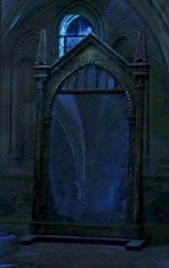
“Take great care that when making a magic mirror you are alone. No one besides the Magus should look into that mirror.”
There is also a purely psychological factor — the brilliance of a mirror hinders concentration on external objects and drives attention inward. This effect is successfully used during hypnotic sessions.
In fact, it is most likely that all the above-mentioned variants occur: some mirror “visions” are projections of the viewer’s inner images, some are reflections of processes occurring in the ether, and some are images of this world “knocked out” by the barrier of perception. At the same time, it is undeniable that using mirrors in magic is not always safe, since the risk of losing control is considerable. The ambivalence of the mirror’s symbolic meaning depends on a person’s attitude and maturity, and on their self-control.

Advice for novice magicians: do not start your path by working with mirrors; unknowingly, you may open certain ‘portals’ and ‘release’ certain entities or simply see them, which is dangerous for your physical and mental health!
In our house, ghosts walked near the old mirror. I’m not familiar with magic, but I am very much with ghosts. Haures, what do you think about this situation?