
Life on the Threshold
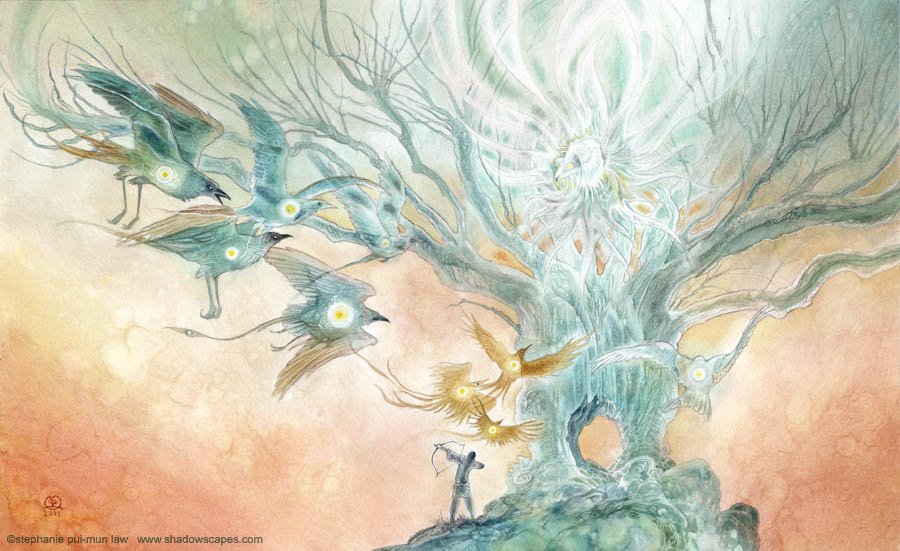
Let us briefly recall what we have already discussed about the functioning of the mind. The Myth we are considering describes the process of awareness as the mind’s Light entering the vessel into the potentials of the vessel — of being — and their actualization.
At the same time, as we have already said, the aggregate of energies available to the mind for perception (that is, for actualization) at a given level is called its Adir, and Adir’s focusing capacity is the Eidolon.
The Myth calls this differentiated focus for actualizing potentials the individual mind, an element of the Great Spirit’s self-knowledge.
For this purpose each separate Monad, as such a conscious unit, forms a temporary structure, a conglomerate of actualized potentials and their associated bonds, which is the incarnate being, a distinct limited vessel.
Thus, the mind of an incarnate being forms a sphere within which energies are being actualized.

It is clear that the more actively the mind works, the more elements and energies it encompasses, and consequently the larger its sphere; and precisely thus the process of the mind’s development is called its expansion.
At the same time, the process of filling the mind with the Light of actual existence occurs gradually, since accepting too much Light risks the “shattering” of the vessel — the sphere of the mind (“shvirat kilim“).
Therefore it is customary to divide the Light of the mind into the “accepted” — that is, which has already been assimilated by the mind, the part of energies — potentials currently assimilated by the mind at the current moment — and the “reflected” — that which cannot yet be perceived by the mind at its present stage of development.
Indeed, the reflecting part of the Light is necessary for the vessel’s distinct existence as a distinct unit, because by accepting all Light and actualizing all potentials, by fully actualizing all available potentials, a being loses its reason to continue existing, and the mind’s sphere collapses.
Now let us attempt to clarify one point of great importance for Magic.
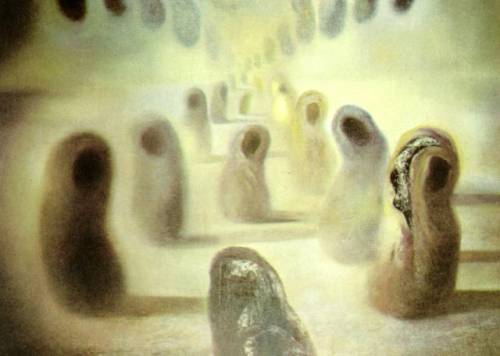
The place of “personality,” the “focus of the mind,” is in fact the screen — that is, the boundary of the vessel of awareness — since it is precisely there that potential energies are transformed into elements of the mind.
Accordingly, the more “concentrated” the mind is on this Threshold, the greater its effectiveness; conversely, if the focus of the mind is shifted inward into or outward beyond its sphere, “clarity” is lost and effectiveness diminishes. A similar situation occurs with the eye’s perception of an image — if the eye’s focal length matches its axial length, the image is sharply focused on the retina and we have clear perception. If the focal distance is smaller (nearsightedness) or larger (farsightedness), a sharp image does not form, and visual effectiveness declines.
It is clear that there are a great many interested parties in limiting the mind’s effectiveness.
Accordingly, the minds of most people do not focus on the Threshold, but are shifted either inward into the sphere (this is characteristic of “astral” travelers, mediums, and undisciplined dreamers), or outward from it — which is typical of most “ordinary” people, preoccupied with daily affairs and political unrest in the Republic of Chad.
Neither in the case of wandering through the “worlds” of the Inner sphere, nor in the case of living in the Reflected light does the mind attain full power.
Therefore for a Magus it is very important to hold the focus of the mind precisely on the Threshold, on energies passing through it in the current moment, and it is precisely thanks to such a focusing on the “here and now” that Magi succeed in developing higher levels of being to which they aspire.
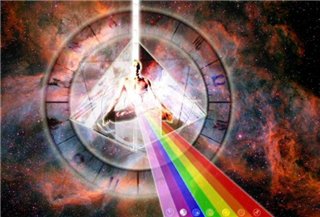
Can the boundary of consciousness be considered the boundary between worlds?
Thank you. An interesting article, and I have several questions.
Could a temporary transfer of consciousness inward or outward be useful? For instance, for identifying distractors or reviewing perspectives.
And what is the difference between ‘undisciplined dreamers’ and ‘disciplined’?
It seems to you that the sphere of consciousness is the same as the ‘brain’ in the usual understanding. That is, everything ‘inside’ is merely ‘fantasies and illusions,’ while outside is the ‘big world of reality.’ In fact, the situation is quite different. The boundary is not just a perceptive field. And the main thing to understand (and even better to see) is that the energies inside the sphere of consciousness and outside of it are the SAME. They are simply touched, ‘processed’ by consciousness inside, and in potential form outside. So when we speak of ‘internal’ and ‘external’ in relation to the sphere of consciousness, we do not refer to the conventional psychological division into ‘inner world’ and ‘outer world’. We are simply referring to Blue and Red Light, potential and actual reality concerning this consciousness. Accordingly, ‘transferring consciousness inside the sphere’ does not imply a better understanding of distractors, and transferring it outside does not help see ‘perspective’ better, but simply focuses on interactions that have already occurred, or on those that have yet to occur. In both cases, the very process of awareness eludes attention, since, in fact, the filling of potentials with the Light of consciousness occurs at the Boundary, at the eidolon. If consciousness focuses within its sphere, it does not immerse itself in the Psychocosmos; rather, it immerses into its own interpretations, and if it focuses outward, it immerses into others’ interpretations, into another reality. Only at the Boundary does it catch the very PROCESS OF INTERPRETATION, when one can still influence the created image and avoid the intrusion of destructive and limiting elements.
Thank you. I really overlooked the difference between the Psychocosmos and the inner sphere of consciousness.
Not again 🙂
The Psychocosmos is also not the ‘inner world’ of psychology. The Psychocosmos is a world from the perspective of consciousness.
Enmerkar, you have opened my eyes again. In the Journey for Power, the exercises I performed seemed purely psychological, and I began to think that Magic uses techniques from psychology, and psychology borrows from Magic, and that is fine. But now it becomes clear that practices that seem identical are actually intended to touch on entirely different processes. That is, the Magical Myth and the Psychological (or Neuropsychological) Myth are two completely different Myths that cannot be blended together effectively, and even doing so can be perilous.
In fact, any Myths can be combined if the platform of individuality gravitates towards it. Since everything depends not on myths, but on individuality, which is primary. Thank you very much for the understanding and indulgence.
And I also want to add. It is precisely the focus on “here and now” that allows one to partially break free from the power of the Archons. And these terrible beings, in my opinion, are much more harmful than demons and the parasite of consciousness. Are there any other ways to resist them?
I would like to understand.
If the Mage is increasingly opening up to the Light, does it also mean opening up to the Darkness? Thus, should the Mage be on the edge not only between Matter and Spirit, knowledge and ignorance, but between everything? The more light, the greater the shadow.
I would like to add. What will be the shadow in the substance of the mage, filled with light?