
Immaculate Galahad
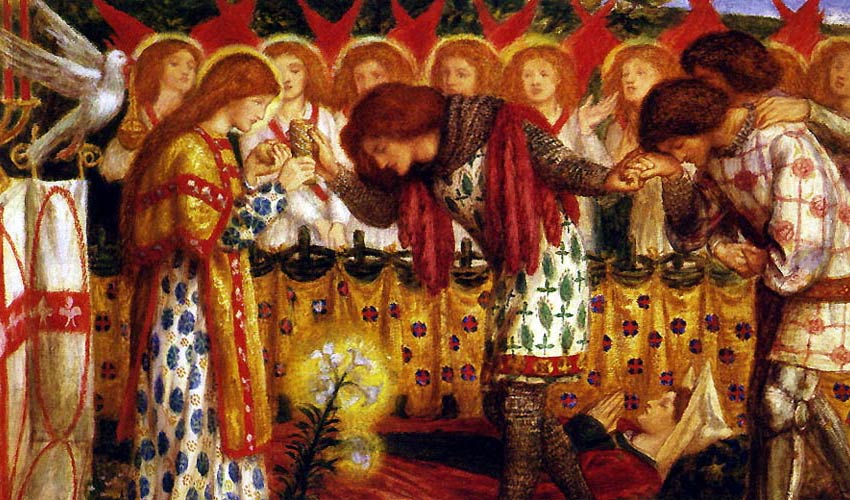
In our discussion of the searches for the Grail we noted that among all the knights who set out in pursuit of this relic, only the young Sir Galahad succeeded.
In Wolfram von Eschenbach’s version there is no Galahad. In his telling Parsifal penetrates the mystery of the Grail in order to heal Amfortas, the Fisher King. Parsifal does not vanish from this world along with the Grail but remains, thereby attaining the highest spiritual fulfillment.
The appearance of Galahad adds a new dimension to the Grail legend. Among the knights who followed their own paths, only Galahad’s path leads to the goal.
In all the legends in which he appears, his purity and the favor of higher powers and his destiny are often stressed, and Galahad himself is often called a ‘holy knight’ and sometimes said to descend from Jesus.
A well-known legend in Malory and the Vulgate describes Galahad as the illegitimate son of Lancelot and Lady Elaine.
In Chrétien de Troyes’s account, Lancelot, already a knight of the Round Table sworn in eternal love to Queen Guinevere, comes upon the enchanted castle of Corbenic after slaying a terrible dragon on his way. There dwell King Pelles and his daughter, the fair Elaine — the Grail maiden, the very one who presents the sacred Chalice to guests. It had once been foretold to Pelles that Elaine would bear a son who could free the kingdom from an ancient curse, and that Lancelot was to be his father. Unable to persuade Lancelot, who loves Guinevere, to lawfully marry Elaine, Pelles resorts to deception. After being drugged, Lancelot mistook the king’s daughter for Guinevere. In the morning, discovering the deception, he fled the castle, briefly losing his wits.
Unlike the innocent, simple Percival, Galahad is perfect in spirit and body. As Lancelot is destined for knightly exploits and dragon-slaying, so his son and Heir of the Grail, Galahad, is destined to be the Grail’s champion.
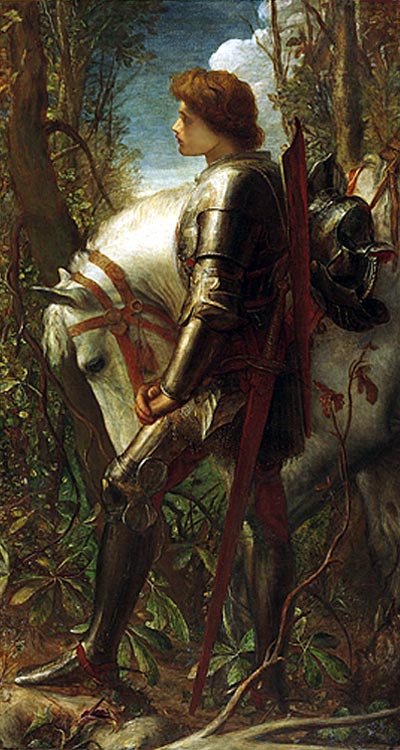
From childhood Galahad was raised by monks and became devout, famed for gallantry and chastity.
On Pentecost Day Galahad, clad in scarlet armor, came to Camelot to be knighted by King Arthur. The young knight sat in the forbidden Siege Perilous, said to be reserved only for the most worthy of all, under the special protection of God Himself.
That day the assembled knights were shown a vision: a golden cup veiled in silk, in which the knights recognized the Holy Grail — the cup in which Joseph of Arimathea gathered the blood of the crucified Jesus Christ. After this many of the Round Table knights, Galahad among them, vowed to set out in search of the sacred Cup. Although all the knights rejoiced at the upcoming adventure, King Arthur was sorrowful and said that he was losing his knights and that the fellowship of the Round Table would be no more, for the knights, “having set out on their wanderings, will never again gather in this world, and many will perish in the search.”
In the mysterious White Abbey Galahad obtains a wondrous shield, made in the thirty-second year after the Passion of Christ. He is told that Joseph of Arimathea himself traced a red cross on the white shield with his own blood. That shield could doom anyone who took it unworthily. Armed with the miraculous sword and shield, Galahad accomplishes many glorious deeds.
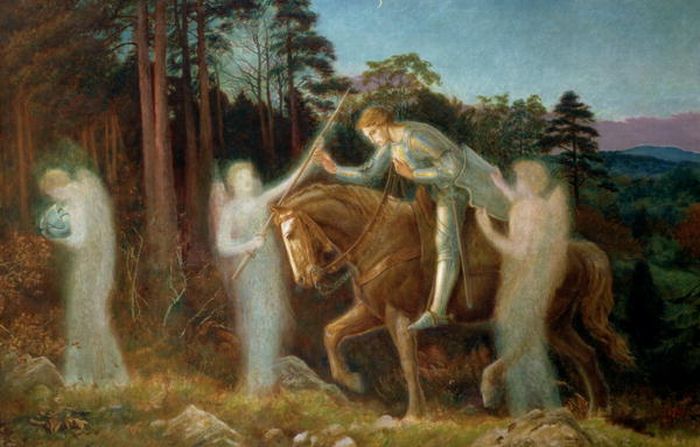
Percival, having set out like the other knights in search of the Holy Grail, encounters his aunt. She tells him that the Round Table was fashioned by Merlin as a symbol of the world’s roundness, and that one chosen into the brotherhood of the Round Table should regard it as the highest honor. She also tells Percival Merlin’s prophecy that Galahad will surpass his father Lancelot. Hearing this, Percival sets out to find Galahad.
Soon Percival and Bors meet Galahad, and together they perform glorious deeds in the name of the Holy Grail. Along the way Galahad meets his father Lancelot, and during their journey they hear a voice prophesying that this meeting will be their last. Malory does not attempt to set the sinful Lancelot against the chaste Galahad; by extolling Lancelot as the ideal knight, Malory at the same time moves away from mythological interpretations of the searches for the “Cup of Grace,” making them more prosaic and entertaining knightly adventures.
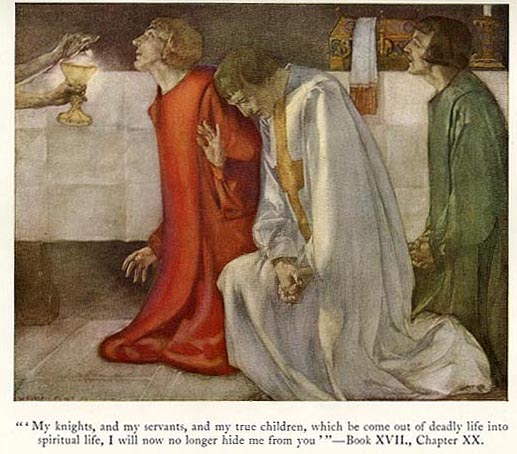
Galahad, Percival, and Bors arrive at King Pelles’s castle of Corbenic. In the castle the knights are shown various wonders, after which they become possessors of the Holy Grail, which only Galahad is permitted to see. “And the Holy Grail was revealed to them, which fed them, and even the Lord God revealed His countenance to them and gave them Communion. And there was shown to them the spear, drops of blood from which fell into a little box held by an angel. Galahad was allowed to wet his fingers in that blood and to anoint the wounds of King Pelles.” It is Galahad who heals the wounded king, lifting the curse from the land (in earlier accounts the hero was Percival, and Galahad was a later addition to the tale). Having taken the Grail, the knights leave the castle. “By the will of the Lord they embarked on their wondrous ship, which bore the sacred chalice of the Grail, and they sailed to the city of Sarras. They set the throne bearing the Grail upon the shore and entered the city gates. And a poor cripple who sat by the gates, unable to move for many years, was allowed to touch the throne and was immediately healed.
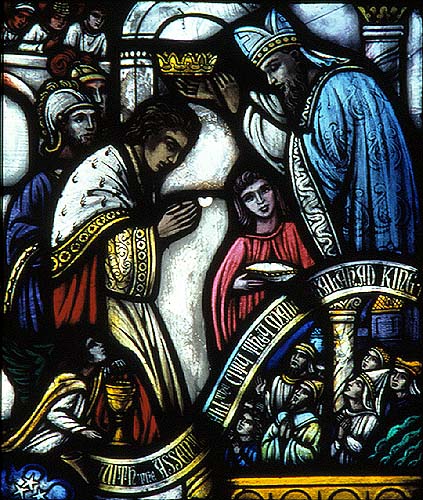
The king of Sarras, a pagan, learning of this miracle and that they had brought the throne with the sacred cup into the city temple, had them thrown into prison. But a year later he fell ill and sent for the knights and began to beg their forgiveness. Galahad, Bors, and Percival forgave him, and after the king’s death the townspeople chose Sir Galahad as their king. Galahad reigned as king of Sarras for exactly one year, and each day the knights of the Round Table offered prayers, and then on one Sunday, at his request, the Lord called Galahad to Himself and sent for Joseph of Arimathea,” from whose hands the knight received the holy sacrament, and soon, still quite young, he died. Having looked deeper into the mystery of the Grail, Galahad no longer wished to live and died in the midst of great beauty. At the moment of his death a hand reached down from heaven and took the sacred cup away. From that time on no human being has been granted sight of the Holy Grail.
Before his death the King of the Grail instructed Bors to bring news to the world, dubbing him “the Messenger.” He then appointed Percival his deputy, Keeper of the Grail, naming him “Keeper of the Highest Word.” Percival retired to become a hermit, took holy orders, and also died two years later.
Thus, apart from the historical and romantic framework of this legend, two elements are of primary importance. First — the Grail, as a symbol of sacred femininity, goes to the pure Galahad; second — shortly afterward he dies young. Having reached the supreme goal, Galahad forever leaves the sinful world together with the wondrous vessel.
Galahad, though conceived in sin, preserved purity and chastity in his earthly life and precisely for that reason was taken up to heaven alive.
The valor of this knight was of an entirely different order than Lancelot’s courage. At the sign of the cross the unclean forces — the many incarnations of the devil he met — would crumble to dust or flee in terror inspired by his purity. At the same time the blessing of the sinner Lancelot is received by Galahad as the most precious of all other blessings not only because it is paternal, but because in that blessing is reflected the priority of purity over the thirst for adventure: “‘Sir,’ answered Sir Galahad, ‘no prayer has such power as yours.’ And with that Sir Galahad plunged into the forest.”
This ideal was most unusual in the age of chivalry and courtly life.
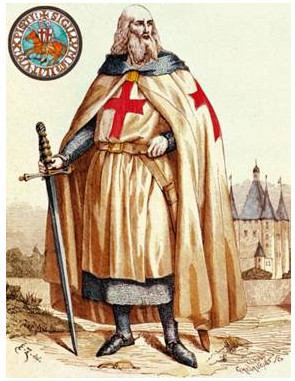
The ideal of Galahad — the pure man — set a course in the age of monastic knighthood to new heights of spirit and insight. It was precisely this ideal that was embraced both by the Albigensians (the Cathars) and, later, by the Templars.
The Cathars believed that humans are originally pure, and that “original sin” is a deception, a corruption introduced by the devil into the spiritual bodies of people when the soul descended from heaven to earth, presented by him as necessary for living on earth. Galahad was perceived as an example of such primordial purity. Unlike that alarming doctrine, the Cathars professed faith in the “original perfection” of the human. Cathar ascetic practice was aimed precisely at fostering divine love in the soul. The Cathar Perfect, like Galahad, did not resemble the gloomy Catholic ascetic. The fruit of his self-renunciation was not the expectation of “eternal salvation” in an uncertain afterlife, but a kindness and gentleness of temperament that created an attractive aura around him.
The Cathars understood virginity quite broadly, as a universal way of life that allows one to realize the divine potential of the human even while remaining in this world. They taught that God provides the necessary means. The Cathars did not understand virginity merely as the absence of sexual acts. For them it involved a complete transformation of the inner constitution, a change in the body. Spiritualized flesh ceases to be the devil’s instrument and no longer enslaves the soul — one must only shed its shell when passing into the divine world in order to continue life in other, heavenly bodies. This idea is illustrated by Galahad’s assumption into heaven.
The Cathars did not seek abstract perfection nor a “deliverance from eternal torments.” They worshiped the God of love — and all they did was in service of attaining that divine love.
Again, returning to Tolkien, Galahad’s image traces back to Beren…