
Blessings of the Magi

It is commonly assumed that the Magi possess various supernatural powers, gifts, or skills acquired in the course of learning magic.
At the same time, the mythic tradition itself regards such abilities as special gifts, blessings received from Power, the gods, or other Magi.
The idea that Power can be transmitted is well known. But it has long been observed that particular “skills” can be transmitted as well.
When people say that “a person is endowed with special gifts” they usually do not bother to ask whose gifts they are. Who is the donor?
It turns out that not all “abilities” are acquired through training. This is connected to the fact that actual training takes place within a given stable worldview, and accordingly one can only learn — i.e., gradually acquire a certain capability through personal effort — what that worldview allows. In other words, within the human conceptual framework one can learn to read, write, build houses, see an aura, etc., but one cannot learn to fly, pass through walls, or perceive energies within the existing paradigm. To acquire those or similar abilities, one must change the worldview, change the mythic framework — that is, step beyond the bounds of this world.
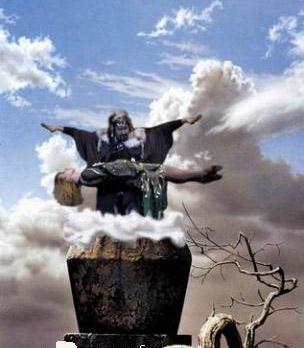
At the same time, for a student in the early stages of development, such excursions are fraught with the risk of leading to personality disintegration and therefore with death or madness.
It has long been observed that one person who possesses a certain ability, skill, or knowledge can transmit that property to another, provided the recipient can receive it.
Few realize that any true art is also transmitted — the student learns from the master something more than the pattern of action; he receives the energy of that action.
This energy, transmitted not merely during instruction but in the course of initiation (despite the word’s overuse), is traditionally called a blessing (traditional names — baruchim (Heb.), benedictum (Lat.)). Particularly detailed accounts of such gifts — siddhis — were developed in Indian traditions.
Moreover, it has been noted that a benedictum can convey the blessing of health (in healing traditions), the blessing of faith (in religion), and other “gifts from above.”
A benedictum may be received from a person (the tradition of initiations), a god, an angel, a demon, or another conduit of Power. Unlike Loans of Power, benedictums are not accompanied by a change in the recipient’s level of Power; they merely open possibilities that cannot be opened in any other way.
It is clear that only one who possesses a benedictum can give it, but at the same time, one who possesses a benedictum is not obliged to transmit it, unlike a Loan of Power. Nevertheless, sometimes giving a blessing is a matter of honor for a Magus, which makes withholding it dishonorable.
Possession of benedictums has never been as widespread in Western Magic as in the East; it is believed that what can be learned is most highly valued in the West, while what is received as a gift is often valued less than what is earned by one’s own effort.
This is largely true, yet to be completely deprived of benedictums is to be deprived of the call of the Mystery that is the life-giving force of any magic. Although the Western magus is oriented toward rationality, he too, from time to time, needs doses of myth that stir the mind and spur the Way.
Ideally, the picture of the world should include “self-expansion,” i.e., gradually increasing in volume, encompassing more and more world descriptions—as the depth and breadth of knowledge of the cosmos increase. And when passing blessings, abilities, the state inherent to the master is also transmitted—it motivates further continuity (paramparā).
Quote – ‘At the same time, for a student in the early stages of development, such exits are fraught with disintegration of his personality, and thus – death or madness.’ You are being overly categorical in this statement. Madness can be called any rearrangement of elements of consciousness in this way.
“Gifts are not returned” 🙂 And yet there must be some conditions for receiving and giving them. For example, someone tries to open a door from the other side, pushing against it, banging on it with a fist, he does not know what or who is behind the door… The one inside may, but is not obliged to unlock the bolt, and if he does, that can be called a gift. However, for a gift to arise, it is obviously necessary: a) the presence of someone who needs it (unlocking the bolt changes nothing without the presence of a person behind the door, who is trying to enter) b) the presence of someone who is capable of giving (knocking on the door changes nothing if there’s no one behind it, or no one who will open the door for strangers) The recipient of the gift creates a space within himself with his desire (a potential possibility of the unknown), the giver arises when this space within is genuinely created, and there is a response to the internal restructuring. The difference between a gift and receiving something deserved, in my opinion, is that the deserved is already present within beforehand, it can be a goal one is striving for, or an event resulting from internal justice. And a gift is, by nature, unexpected and alien to the logical course of events; sometimes this leads to the gift being rejected, and only later does the recognition of its significance come.
Lovely!