A Gaze Through Time
Continuing the conversation we began recently, we will try to understand how, from the perspective of the magical myth, the possibility of forecasting how situations will develop over time and assessing chances of particular scenarios occurring appears, and thus how to choose the optimal course of action.
We should note at once that such an assessment has significant value for the formulation of the Way’s strategy.
But first let us clarify how the magical myth describes time. We have already said that, from this myth’s perspective, the world-process is the realization of the potentials of the Monads, or, namely, the Absolute’s self-awareness in the totality of its differential elements.
It is precisely the direction of that realization that determines the flow of time. Thus, a change in time is understood as a change in the ratio of potential to actualized elements of consciousness (the ” energies“) in favor of the latter. The very category of time arises to describe the speed and direction of the movement of mind as it encompasses ever-new areas of being.
From this conception three important corollaries follow. First: time is a conditionally objective category, it is an element of the macrocosm, not only of the psychocosm. Nevertheless, at the level of objects, time is only the order and rate of change of their properties, and in this sense it has no independent existence, and therefore is inseparable from the observer. That is, time is a category ascribed to reality. Second — the rate at which time flows is individual and depends on the speed of expansion of awareness of a given Monad. And third — there are possible branchings in time, that is, the same expansion of consciousness can be achieved by different means.
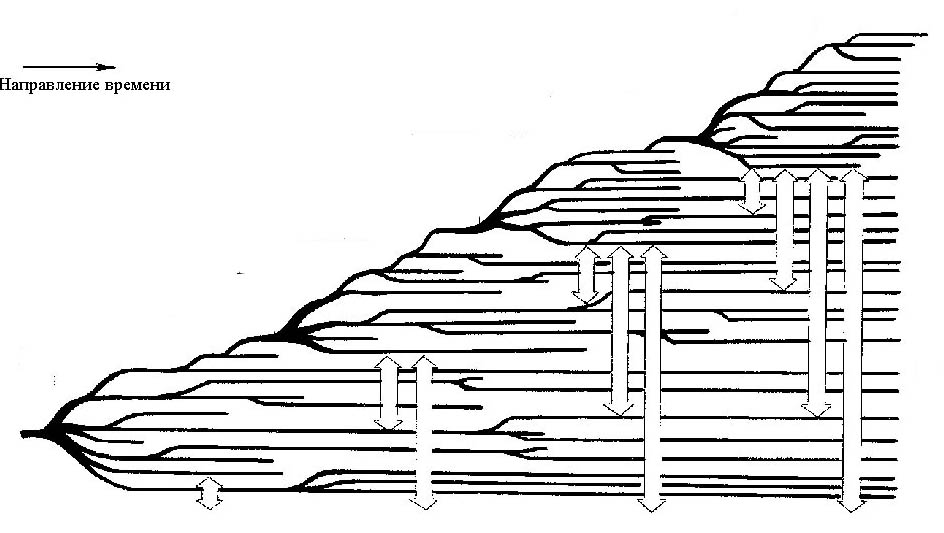
The last point requires some clarification. As we have already said, the pagan conception of fate notes that the Way of realizing a Monad’s potentials includes certain “key moments” determined by the very character of its individuality. These points must inevitably be passed. In the context of our discussion, we can add that the order of realization of these “key moments” may vary. It is precisely this freedom to choose the direction of development that is a defining characteristic of “free spirits.”
These points are the branch points in the flow of time, where a choice of further course is made and the flow is divided into the actual and the virtual. In other words, upon reaching such a point, the stream of consciousness chooses its next direction, and its attention focuses there, while all other possible events are realized in the space of dreams (though they are actual in other lines of causality).
It may happen, however, that the chosen course does not lead to the attainment of the next “key point.” In that case, two options are possible: either the reaching that point is postponed until the next incarnation, or a leap of awareness may occur, a rupture of the continuity of the stream and its transition to a path that had hitherto existed only virtually:
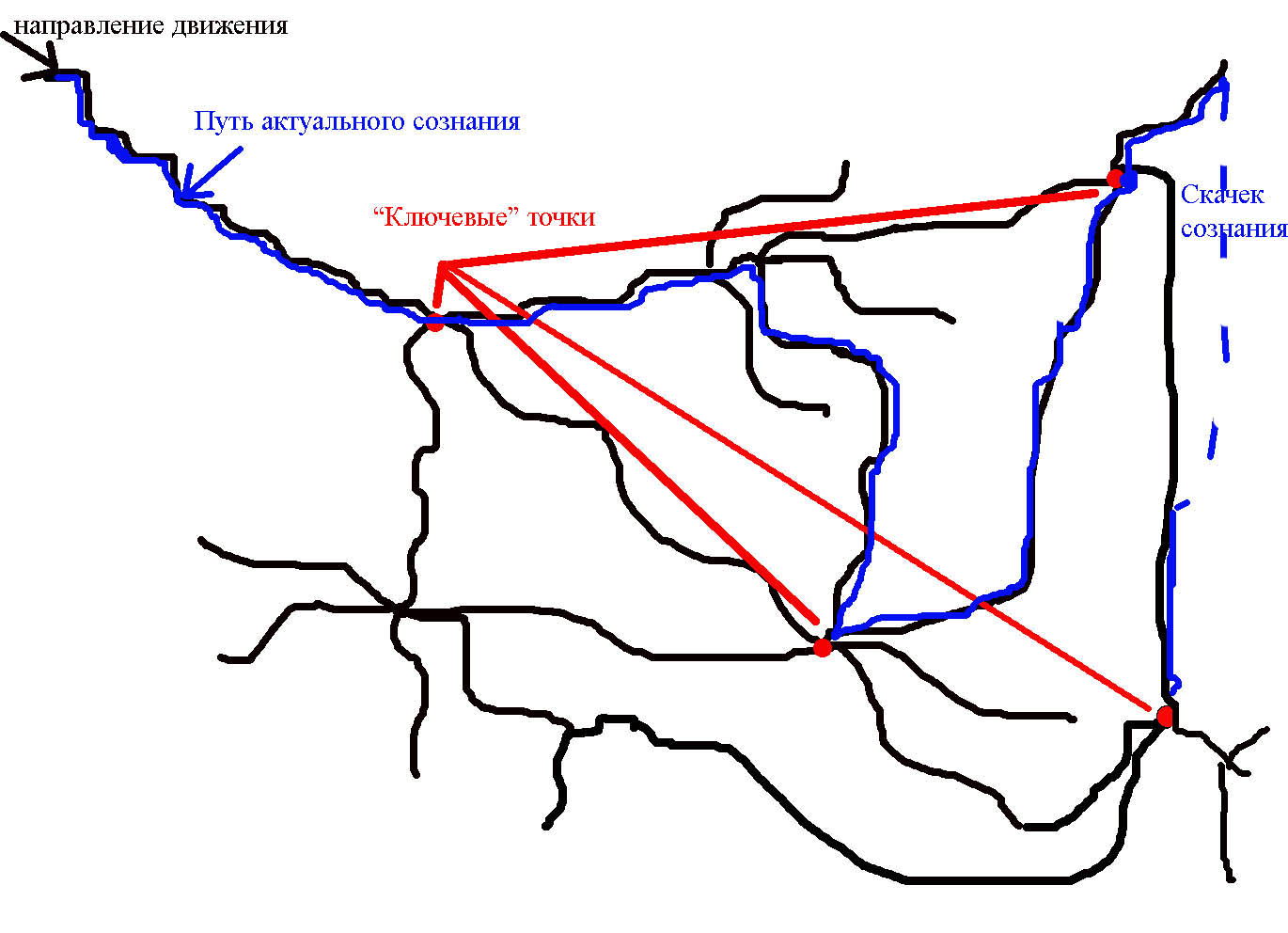
It is precisely such leaps that ensure the spontaneity underlying sudden transitions to new levels of consciousness.
But let us return to the matter at hand. The picture we have sketched has several implications for the modeling of situations. First, it shows that whenever one speaks of a scenario for how a situation might develop, one must use probabilistic terms, since the choice at an actual branching point may differ from that predicted, and therefore the subsequent course of events may unfold differently than predicted. Second, spontaneous leaps of consciousness can also introduce corrections into the picture described.
We must not forget that the world-process moves in a spiral, and analogous (but not identical) states recur in it many times. Such a mode of movement not only allows periods of accumulation and analysis of experience to alternate, but also permits one to look at each point from different angles, on different levels, and to achieve maximal awareness.
Moreover, from the point of view of the myth under consideration, the movement of consciousness through time can occur in any direction; however, in “looking into the future,” consciousness finds itself ‘lagging behind,’ because the future is a state of greater awareness; similarly, a glance into the past places consciousness in an anticipatory position.
Thank you for the interesting information.
Sometimes clear scenarios of the development of events in the future come from the dream space, and they are realized in reality regardless of what the person, as it seemed to him, consciously preferred a different scenario. It’s as if Someone decided for you and realized it without your consent.