
The Ornateness of Ritual
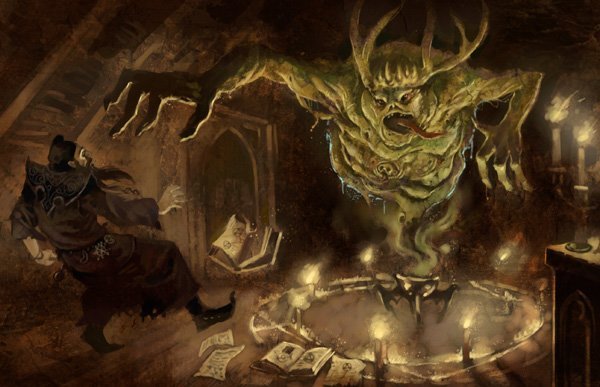
As an expression of the Magus’s will through mythological images, any Ritual, as we have already discussed, is aimed at changing reality.
At the core of this change lies the simple idea that if a Magus “plays out” a mythological scheme whose outcome he knows, and then transfers the action from the symbolic level to the objective level, the outcome of the Myth repeats in the real world.

This means that the conditions for a Ritual’s effectiveness are 1) a clear understanding of the structure of the Myth being enacted; 2) the presence of a powerful volitional impulse; 3) the effectiveness of the symbolic scheme expressing the Myth; and 4) sufficient energy necessary to transfer the Myth from the psychocosm into the macrocosm.
The first two conditions are part of the Magus’s general preparation; the fourth condition is achieved by attracting Signs of Power, incantations, and the like — ‘accumulators’ of energy — while the third condition, — the ritual actions themselves — usually causes the greatest difficulties.
On the one hand, it is clear that without the correct performance of the Ritual — that is, an adequate symbolic expression of the Myth — it would be absurd to expect success. But on the other hand, it is precisely the question of which representation of the Myth — i.e., which scheme of the Ritual — is adequate that becomes a stumbling block for many magi.
There are three approaches to the “body” of the Ritual.
The first approach consists of the literal, strict repetition of schemes developed by someone else, with no possibility of deviation. We have already discussed that this approach, while extraordinarily effective tactically, is strategically weak because it leaves almost no room for personal inspiration and therefore for the Magus’s creative development. Nevertheless, many choose it because it delivers guaranteed and easily predictable results.
The second approach, by contrast, is the complete rejection of traditional schemes in the conviction that realization is possible only through the operator’s will, and that the Ritual’s “body” is superfluous. This approach is very typical of modern magi who are proud of their independence from Tradition. In some cases, they can achieve results, possessing great Power, but the effectiveness of such realizations is dubious — the effort expended usually far exceeds the effect achieved. You can, of course, drive a nail with a mobile phone, but is such an action rational?
Finally, the third approach consists of accepting the traditional scheme of the Ritual and filling it with concrete content in accordance with the operator’s personality. This approach is a balanced combination of strategic and tactical considerations. On the one hand, it relies on the support of Tradition, and on the other, it leaves freedom for personal creativity.
By the way, it was precisely the third approach that guided the founders and reformers of major Traditional currents, for example, Crowley or Mathers, and accordingly, their systems bear a strong imprint of the structure of their personalities. It is clear that many such reformers, possessing a rich imagination, created or reconstructed Rituals based precisely on their personal sense of Power.
Accordingly, such Acts will be most effective for those magi whose personal Ways resonate with the Ways of the founding fathers, i.e., for the successors of those founders.
But even these successors may extract from the Ritual its bare bones, its “skeleton,” and clothe it with the specific details that suit them best.
For example, the Rituals of the “Golden Dawn” are phenomenally effective, but their efficacy can be preserved by removing elements that appealed to adepts of the previous century and replacing them with analogous elements more suited to the personality of the contemporary Traveler. The main thing here is not to “throw the baby out with the bathwater” — that is, not to dismiss as “superfluous” what is actually key, or to treat as “essential” what is in fact extraneous. The concerns of advocates of strict observance of Ritual schemes are understandable — even the slightest changes to such a complex operation can fundamentally alter its effect, causing irreparable harm to the operator and to those connected with them. But no less significant is the danger of a dogmatic mindset that arises through such blind reproduction of another’s steps. Therefore, each must decide for themselves whether they are prepared to take the colossal risk, and to what extent that risk is justified for them.
Of course, this careful attention (indeed, absolutely indispensable in any magical undertaking) requires great exertion and considerable experience, although for the novice Traveler it is especially important.
But, to repeat once more — victory on someone else’s Way is less desirable than defeat on one’s own. Therefore, the combination of wise strategy with measured tactics that is so necessary for the Magus on his Way should help him here as well: on the one hand, not waste time repeating another’s words, and on the other, not to indulge in a delusion of grandeur by discarding the achievements without discrimination of his magical predecessors.
It is better to poorly fulfill one’s dharma,
than to succeed in someone else’s, Arjuna:
another’s path, Partha, is dangerous,
accepting death on your own path is a blessing.
After this article, my eyes have opened. It would be good to include this information in books and resources containing rituals.