The Magic of Numbers
Western civilization, with its reverence for precision and practicality, has always attached special importance to calculations and measurements.
At the same time, numbers have enjoyed great veneration since the most ancient times, often acquiring a mystical aura.
Beginning with Pythagoras, numbers firmly entered Western thought not only as a tool for calculation but as a magical instrument.
Pythagoras told his disciples that numbers rule the world. His numerological teaching was founded on the conviction that numbers conceal and contain the secret of the universe. Plato, faithful to the Pythagorean tradition, maintained that a mathematical code — an intrinsic property of the cosmos — underlies all phenomena. Ideas expressed in numbers are absolute, immutable, and perfect. The Chaldean interpretation of the magical science of numbers is preserved in the Kabbalah, where, according to Gematria, numbers are not only symbols of the foundations of the universe but elements — the particles from which all things are made (incidentally, it is Gematria — manipulation of numerical correspondences of letters — that forms the basis of modern numerology).
At the same time, the very notion of the magical meaning and use of numbers often remained vague and poorly understood.
The magical myth, aimed primarily at expanding consciousness, has its own account of the mechanism by which numbers operate.
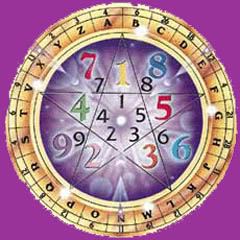
The central idea of this account is the obvious fact that the character of any interaction between objects directly depends on how many objects interact: one object is completely open to any influences and, at the same time, oriented chiefly toward itself; a certain opposition inevitably arises between two objects, leading either to their mutual weakening or to mutual aid; three objects almost always form two intersecting lines, i.e., they lead to the merging of different currents; four objects introduce a double opposition, forming a stable system; five objects bring one to the forefront; six objects establish the opposition of two integral systems — two triads; seven objects establish interaction between a triad and a tetrad, and so on.
Hence arose the idea that the number one corresponds to the notion of wholeness, the two to division, the three to harmony, the four to embodiment, the five to liberation, the six to consolidation, the seven to the dominance of spirit over matter, and so on.
But the reverse is also true: the idea of harmony requires three objects for its expression, while, for example, the idea of enclosed space requires six.
Moreover, according to the law of analogies, every idea is represented in the mind by its corresponding number. Thus, for example, in the life of a person inclined toward material concerns, the number four will predominate, whereas in the life of a person whose life tasks require maximum freedom of will, the number five.
And in this case, the converse also holds: by using four objects, the Magus facilitates materialization, while employing seven elements establishes the primacy of spirit.
Thus, at the core of the magical conception of numbers lies the idea of interactions, and the “power of numbers” in fact turns out to be precisely the energy of these interactions, the attention and tracking of which are the Magus’s focus.
Thank you.
This is genius and opens up possibilities for new discoveries.
By numbers like by instruments in an airplane, one can control the direction of action.
Thank you, interesting. But this raises the question of mathematical operations on numbers, which also seem to carry a semantic load, and not less than that of the numbers.
Of course. But the question is not whether it “carries a semantic load,” but how to use this load beneficially for one’s consciousness 🙂 And here it all comes down to personal suitability – for someone, manipulation with numbers drives them forward, while for others it serves as a brake and an illusion of movement.
I want to caution against the main mistake in numerology: adding (or multiplying) the digits that make up the number. That is, for example, 13, 1+3=4 – that doesn’t work. The whole point is the absence of a divine counting system, which includes the decimal system. Thus, the number 21 in the base-12 system used by the Egyptians appears as 19 (9th element of the second cycle out of 12). In any other counting system, our familiar two-digit numbers will consist of other digits, and using such systems is completely normal and a matter of personal choice.
A more or less correct approach would be to represent the number through sums (21=13+8; but there are many variations of sums), and the best way is through factors (7*3) or the ordinal position of a prime number if it’s prime (for example, 13 – the 6th prime number). Such justified mathematical actions are valid in any counting system. They indicate a meaningful connection between numbers.