The Middle Part of the “Great Arcanum”
At the foundation of any magical action, as is well known, lies a universal concept commonly called the “Great Arcanum of Magic.”
It is the idea of the Great Arcanum that underpins the division of the cosmos into three “planes” — the “mental“, the “astral” and the “physical“. In short, the essence of the Great Arcanum’s concept is that every manifestation passes through three stages: the Ternary (in the form of an idea), the Hexad (in the form of a vortex) and the Octad (in the form of a material result). Graphically the Great Arcanum is often depicted as a three-part construction:
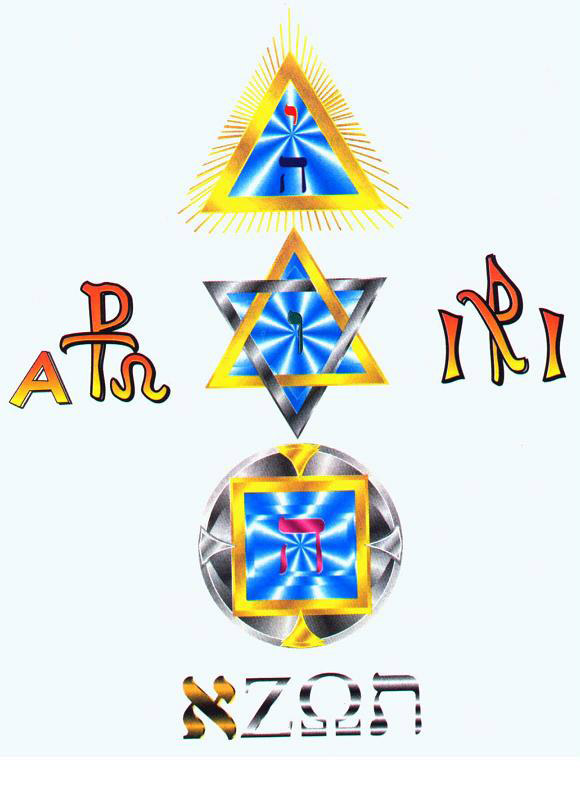
The Great Arcanum stresses the importance of a clear understanding of the idea being realized (specifically as a Ternary — that is, the idea is apprehended both in its binary aspect and synthetically), the ability to form harmonious vortices, and the correct choice of material basis for realization (the selection of the so-called “points of support” for realization).
According to the Great Arcanum, each magical operation also proceeds through three stages: the “oath” (formulating the goal), the “evocation/devocation” (calling forth/banishing) and the “manipulation” (alterations of the material plane). Incorrect performance of any of these stages dooms the whole operation to failure (or to unforeseen effects).
While the importance of understanding the operation’s goal and correctly choosing the support points usually does not escape an operator’s attention, the Middle part of the Great Arcanum is often underestimated.
Traditionally this part is called the “House” of realization, and that very name already underlines the special significance of this element.
By creating the Magical circle, the Magus forms a universe, governed by him as its creator. At the same time, as in the greater Universe, processes in this “magical space” have a vortex-like nature, the birth of which is described by the Great Arcanum’s Hexagram. In order not to confuse this sign with the Symbol of the Macrocosm — although it expresses the same idea in another aspect — the Great Arcanum’s hexagram is usually depicted as a “unicursal” symbol which, unlike the “proper” hexaculum, has realizing power and describes the particular process of the interrelation between the Operator and the “external” space he forms, the so-called “vessel of manifestation” (“kli hicon“).
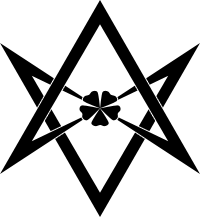
Note that the “classical” operation passes through the Middle part twice (as seen in the symbol itself): at the stage of “calling” and at the stage of “banishing” (or “releasing”).
The same dual nature characterizes the “magical House” in a broader sense. The Middle part shows that the House, on the one hand, demands attention and care from the Magus, and on the other — protects and assists its owner. This is true both of the Magical circle and of the actual “territory” belonging to the Magus.
A house where a Magus lives, over time, transforms from a simple shell into an active agent participating in magical processes. (It is well known that houses in which Magi lived acquire a special character.) This process is also described by the Middle part of the Great Arcanum. Conversely, the Magus must understand that the choice of a house for magical operations already constitutes part of those operations.
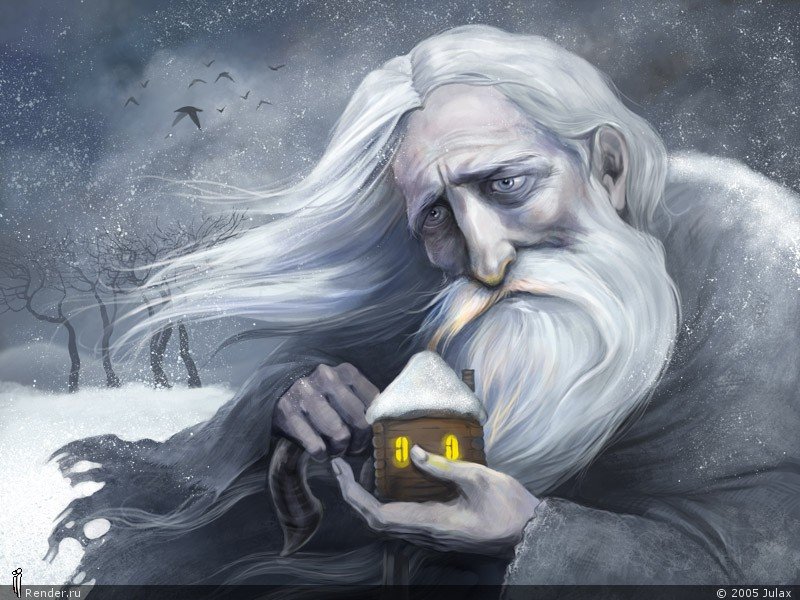
Another aspect of the Middle part is the so-called “Magical territories” belonging to many magical Lines. In fact, such a territory is an expression of the Line itself, the Middle part of its realization necessary for the Line’s successful existence. History knows many cases when, driven by a hunger for power or a mania for greatness, individual Magi or entire Lines attempted to seize territories belonging to other Lines, and such attempts always ended in the conquerors’ defeat, because a territory is inseparable from its Line and cannot be used by anyone else. This aspect of the unity Line/Territory is also expressed by the double tracing of the Middle part symbol. At the same time, the decline of a Line brings the decline of its territories, and conversely, the devastation of territories strikes at the Line.
Thus, the Middle part of the Great Arcanum of Magic reflects the necessity of a solid foundation for realization, upon which the ideas of that realization are laid and on which its concrete Points of Support are arranged. Forming the House of manifestation, whether at the level of a specific operation or the whole life of a Magus (Line), is the most important part of the entire process, creating a kind of “dual existence” composed of the symbiosis of the creator (the Magus) and his creation (the realization). The Magus penetrates the “House” with his being, but the “House” also influences the Magus’s being.
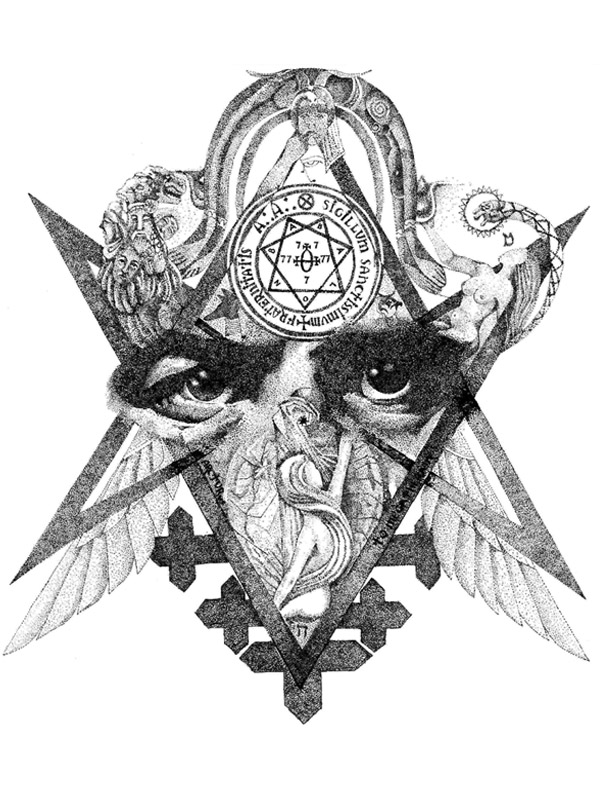
The middle part of the ‘Greater Arcana’ is the main focal point for the Mage in the Great Work. The success of creating and systematically using the middle part of the ‘Greater Arcana’ allows one to know what Freedom is.
It turns out that the “middle part” or house is a part of the astral plane where the realization of desire (whirlwind) occurs.
Very interesting!