The Three Spheres of Being

Although the world is born from the Biner, from duality, it is itself ternary.
The reason for this ternary nature is that the interaction of the poles of duality gives rise to a “third sphere,” a place of their mutual interaction and neutralization; this neutralization should not be seen as a return to the original unity but as a new, active property of the system.
In fact, it is this third component that constitutes the field in which life takes place. The poles of the Biner function more as categories of cognition than as concrete agents, and all activity is concentrated in their interaction — the “Neutral” element.
It is well known that many peoples, for example the Ancient Celts, divided being into three spheres — Gwynvid, Abred, and Annwn.
In Gwynvid “life predominates over death,” and in Annwn “death predominates over life.” At the same time, Abred is often associated with the manifested “our” world.
The depths of Annwn and the heights of Gwynvid surround Abred, forming with it a threefold system of the cosmos.
Nevertheless, the “middle” world is not simply the “sum” or mere result of the interaction of the “upper” and the “lower.”
Recall once more the Norse Yggdrasil.
According to the Elder Edda:
“Three roots grow
toward three sides
beneath the ash Yggdrasil:
Hel beneath one,
giants beneath another,
and humans beneath the third.”
or, according to the Younger Edda, the three roots of Yggdrasil lead to the Aesir, the frost-giants (hrimthursar), and to Niflheim.
In any case, the point is that consciousness (the Elder Edda regards humans as the most conscious beings, while the Younger Edda assigns that role to the Aesir) stands between two constituents more powerful than itself — the unmanifest power (Hel or Niflheim) and the power of the manifest (Jotuns — the Primordial Ones).
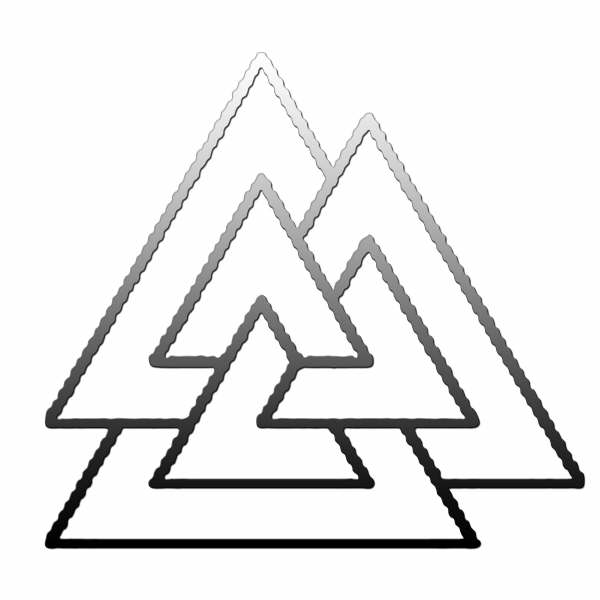
However one looks at it, we still have three sources of existence: the upper, the lower, and the neutral, the Middle?
What does this mean for us? This has important implications of great theoretical and practical importance: neutrality is not merely the balancing of the poles. It is an independent principle.
From the standpoint of myth, the principle of neutrality is not merely the field where the interests of high and low meet, not simply a “buffer zone” between them, but an autonomous entity capable not only of receiving influences from the adjacent principles but also of actively influencing them. We are not merely the result of creation; we are also a creative force. We are not only children of the universe but also its creators. This attitude is fundamentally different from the consumerist stance characteristic of modernity. According to pagan myth, we are responsible for the world in which we live, and that world is as much our offspring as it is the creation of gods or primordial chaos.
Alchemical views hold that although “sulphur” and “mercury” are present in every object, the object itself is “salt”; extracting, purifying, and harmonizing the interaction of the primary principles form the basis of the Work.
The conception of the ternary nature of manifested being is of great practical importance. One way to develop and harmonize the mind is to harmonize its vehicles — body and matter. Working with matter, caring for the body and surroundings, means transforming the “salt” through harmonizing the interaction of the principles of “sulphur” and “mercury.” Understanding the nature of their relationship is vitally important for the magus, because ordering one’s own being is one of their foremost tasks.
‘Neutrality does not mean simply balancing the poles’ – yes, that’s true.
‘Three sources of existence’ – this thesis is debatable. Is the vision of the ‘source of existence’ limited?! By what? Why? How come?
Triunity or trinity can be examined from the perspective of esoteric psychology. This will provide practical experience in working through one’s structure (for example, oneself as a personality), which will help become a more successful mage (capable person).
SVA: if the thesis is controversial, a task for ‘esoteric’ psychology: 1. source of creation. 2. source of time. 3. source of balance. process it… :-))
Does this mean that each Sphere of Being contains three worlds, and thus we get nine worlds?
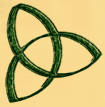
May I ask another question, it’s quite clear that the symbol in the first picture in the context of the topic should be arranged exactly as it is presented – sideways, but why is it depicted “straight” – one end upwards and the other two downwards? Does this mean that two different variants of the depiction carry different meanings, or is the essence in both cases – three spheres of being?
Thank you for your attention.
I was pondering the Third Beginning and could not quite ‘catch’ this moment… if one considers neutrality from the point of view of ‘dynamics’, that is, only the process of flowing ‘everything’ from one state to another, but if you consider it from the point of view of ‘statics’ – ‘a halted moment’ – then everything falls into place 🙂 . Between black and white there is gray. Between hot and cold there is warm. Between the past and the future – there is the present. Consciousness is also in between the Psychocosmos and the Macrocosm.
I ‘caught’ the third principle in the bewildered eyes of a child when asked: ‘Are you your mother’s or your father’s?’ There is the masculine, the feminine, and there is the Child—a product of their interaction, an independent Principle. Not a hermaphrodite, not a transvestite, but a Child. Or another situation: two argue, two opposing views, and there is a third—embracing understanding of both, accepting both viewpoints but not rejecting either, not indifference.
The three spheres of existence are probably not quite the same as three forces. After all, three mothers act in each of the three: the year, the world, and the person.
In my opinion, there is a significant metaphysical confusion regarding the third principle and the third force. This confusion has passed through all hermetic schools; the author has it too. The independent third principle is of the same level of synthesis as “active” + “passive” – it is a catalyst in chemical reactions, for instance. It is not the interaction of two principles, it is not their mixing, but something third. But our perception is limited by “binerness”, so the third principle is difficult even to imagine, let alone clearly see in all phenomena. But the result of the interaction of three principles (not two) is primarily described here; it is not a third, but rather a fourth principle of a lower level of synthesis or a more arbitrary stage of “creation”. The theme needs to be reconsidered and researched.