
Yav and Prav on the Way
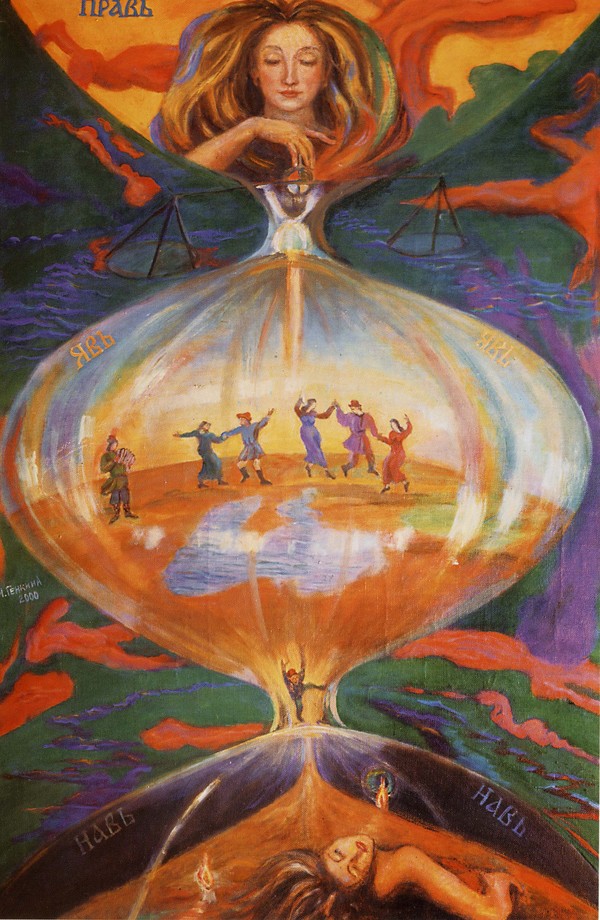
In our previous conversations we paid a great deal of attention to the Unmanifest — Nav, and much less to the Supra-manifest — Prav.
In the context of our discussion of the Way this theme becomes extremely relevant to understanding the necessity of moving beyond the Joy of Yav — the Force of Vunyo.
It is clear that Yav traditionally denotes manifested existence, the world-process in its unfolding.
The notion of Prav is more difficult to grasp. Traditionally it is held that Prav is the universal law established by Rod, and according to that law Manifestation exists. Yet the concept of Prav is broader than the notion of Law. Prav has its own substantive reality.
Often the notion of Prav is reduced to the neutralization of the Yav-Nav binary, Manifested-Unmanifested, and Prav is presented as the synthesis of Yav and Nav. However, as mentioned, traditional mythology treats Synthesis and Neutrality not as a philosophical abstraction but as a real principle.
In fact, the point is that a being whose life-process transforms life into awareness may belong either to Yav or to Prav, depending on the chosen Way of realization.
Any Way passes through stages of synthesis, awareness of the Unity that lies behind differences.

A person living in the awareness of World Harmony and standing “above” the Battle of Life seems more perfect than someone immersed in the battle itself and treating the nature of Harmony as an abstraction. At the same time, the person immersed in the battle, on the Way of developing their awareness, passes through a series of developmental stages, gradually approaching the awareness of harmony lying behind visible contradictions. It is this stage — the stage of awareness of the One behind differentiation — that corresponds to the stage of Vunyo.
Where to go next? One would think that this is Enlightenment, communion with Truth.
However, in practice a close look at harmony leads inevitably to the awareness of it as struggle. At this point the Ways divide.
It turns out that the world-process can be viewed both as the realization of the Monad’s potentials, the self-awareness of the Absolute, and as the harmonious coexistence of predators: a hierarchy of energy consumers in which each is both predator and prey. Naturally, the first view is formally broader, but in reality we have the phenomenology of the second view — problems that have nothing to do with the “Light that fills the Vessels”, problems of evil and violence.
In such a situation two forms of awareness of reality are possible and, accordingly, two forms of action within it. The first form involves looking ‘beyond’ the battle by ignoring it, proclaiming it an “illusion”, and recognizing as the sole reality the World Harmony of mind penetrating Being. It is well known that the best way to combat a problem is to proclaim the problem non-existent, illusory, and acknowledge reality as beautiful.
The second view attempts to center itself in the battle, understanding and accepting the reality of World Harmony, while at the same time acknowledging that the manifestation of this Harmony is not as joyous as philosophical contemplation suggests, because the state of Harmony is stretched infinitely through time, and at every moment within it we have a state of struggle and imperfection. Indeed, it often happens that a system perfect as a whole is constructed from imperfect elements, just as unstable cells, suppressed by their environment, form a stable multicellular organism.
Thus the majority of travelers regard the return to awareness of the reality of the battle as involution, a retrograde move, and remain aware of world harmony and of their own grandeur and purity.
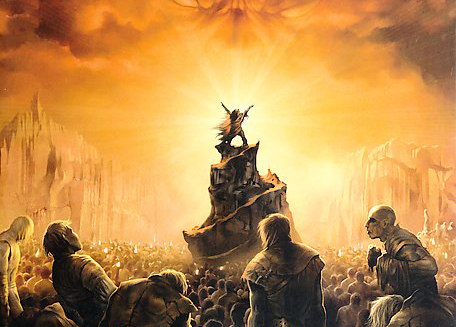
A smaller number feel drawn onward. And onward — where?
Onward — more death and suffering. Why?
Because, as it turns out, for an embodied being grasping the essence of things requires death. After all, the phenomenon of life itself arises as a sequence of binary oppositions such as spirit-matter, being-mind, and neutralizing these binaries the potential differences that create life are lost, destroying life itself. For Magi it is nevertheless possible to die without dying. But we will speak of that later.
For now it is important to understand that Life at all stages of its synthesis constitutes what tradition calls Yav.
And that which lies beyond this synthesis constitutes the substance of Prav. The state in which duality no longer exists, yet implicitly contains it, is Prav. In fact, by following the laws of Yav one can reach synthesis, but cannot enter it. Only by accepting Prav does a being become not a spectator of world harmony but a participant in it, with all its problems and contradictions. If the highest that Yav can give is the idea of Unity, then Prav gives existence in Unity, expressed through multiplicity. From the foregoing it is clear that it is the voice of Prav that compels the traveler to leave the comfort of Vunyo and go further, through storms and thunder.
Prav in the psychocosmic sense gives the Way its direction, governs the Way, serving as its guiding thread, inspiration, rule — just as Prav in the metaphysical sense governs the cosmos. To govern the mind, Prav expresses itself through its higher layers — the superself, conscience, the observer; in the same way in the cosmos Prav manifests as creative principles — gods.
For some reason, I imagined an analogy with a diamond that has many sharp facets but, when unified, is a beautiful creation.
It seems to me that people are overly “conditioned” to live in harmony, removing some aspects while leaving others that are more “noble.” As a result, we have the sad outcome of an attitude towards life and its lack of understanding.
Yes, they are happy to get accustomed to it themselves. And helpers are always around. Such static harmony acts like a sweet poison, slowly and imperceptibly poisoning and destroying the very essence of a person who has “everything good.” In such a state, there is no motivation for Battle, for Overcoming. The imbalance disappears, without which there is no driving force on the Path. The Path dissolves (if it even existed) because there is nowhere to go and no reason to do so.
What will be the analogy of the term “social death” in the context of this article?