
The Three Faces of Asmodeus
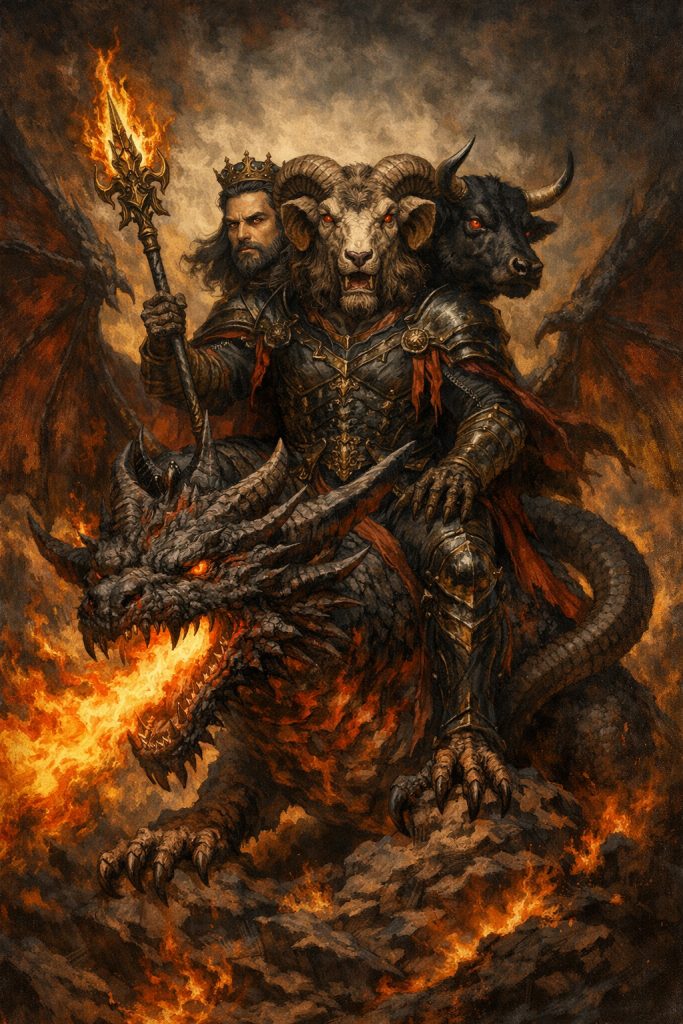
We have often discussed how the images in which an entity appears—its attributes and attendant phenomena—are essential to understanding that entity’s nature and character. This is why the “Lemegeton”, like other grimoires, devotes considerable attention to the outward appearance of demons. Every detail of a demon’s guise is not mere fancy, ornamentation, or menace, but a precise pointer to some property of the demonic matrix and the demonic vortex.
More often than not, the animal or object on which a demon sits during an apparition in ritual signals the element of nature or psyche that the demon chiefly governs, while the demon’s own form expresses the essence of its activity. As we have noted, a demon’s manifestation in ritual normally unfolds in three stages: 1) an abstract phase sensed through smell, sound or light; 2) a theriomorphic phase in which an animal (or more rarely a plant) form appears, because demons are bound to passions, reflexes and instincts; and 3) an anthropomorphic phase, when the aspect able to engage with a human comes forward.
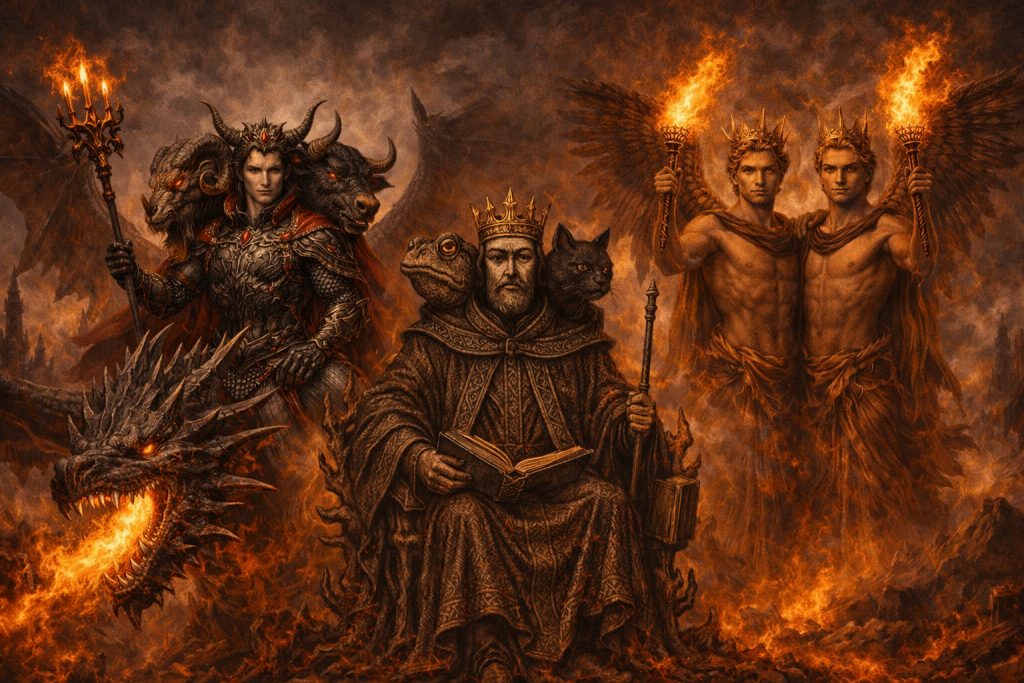
Entities that are many‑faced are especially instructive, since they disclose several levels of manifestation. Too often descriptions of a demon or destructor note only a single face, overlooking others and thereby missing crucial dimensions of its influence.
We have observed that the three supreme Kings of sin—for example, Bael, Belial and Asmodeus—appear in three-faced forms. This should be read as their activity across the three elements of the psychocosm: reason, feeling and will. Yet the particular character of those faces is often underestimated. Bael wears the faces of man (will), cat (feeling) and toad (reason), and yet he takes the form of a spider that paralyses movement. Belial shows two human faces (two angels), expressing power as unity-in-opposition, balanced by the chariot-dragon that signifies wrath and sustains his rule. Asmodeus bears the faces of man, bull and ram, and likewise rides a dragon—here indicating the realm of impulsiveness itself, his capacity to manipulate vast elemental currents of sensuality and consciousness. Note also Asmodeus’s goose feet (that same threshold quality, an «amphibiousness» like Bael’s toad), sometimes rooster legs as a sign of dominion over sensuality and moral ambiguity, and his serpent tail (a mark of deceptive wisdom).
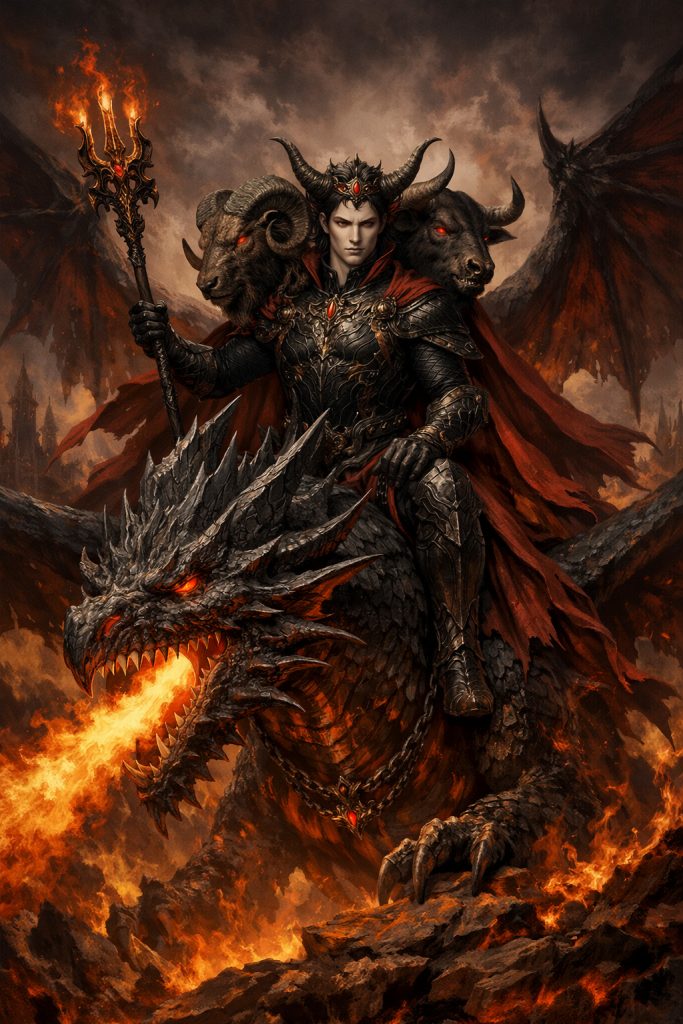
Asmodeus is three-faced because he governs the very operation that transmutes the force of attraction into avarice. In this reading the ram signifies appropriation in the domain of instincts and bodily gravity—the substitution of “I want” for “it’s mine”; the bull signifies appropriation in the informational realm, by accumulation and retention—the substitution of “I have” with “I matter”; and the human face signifies appropriation through logic and justification, turning “I’m right” into “I’m entitled,” transforming sensuality into calculative commodification—exchange and contract.
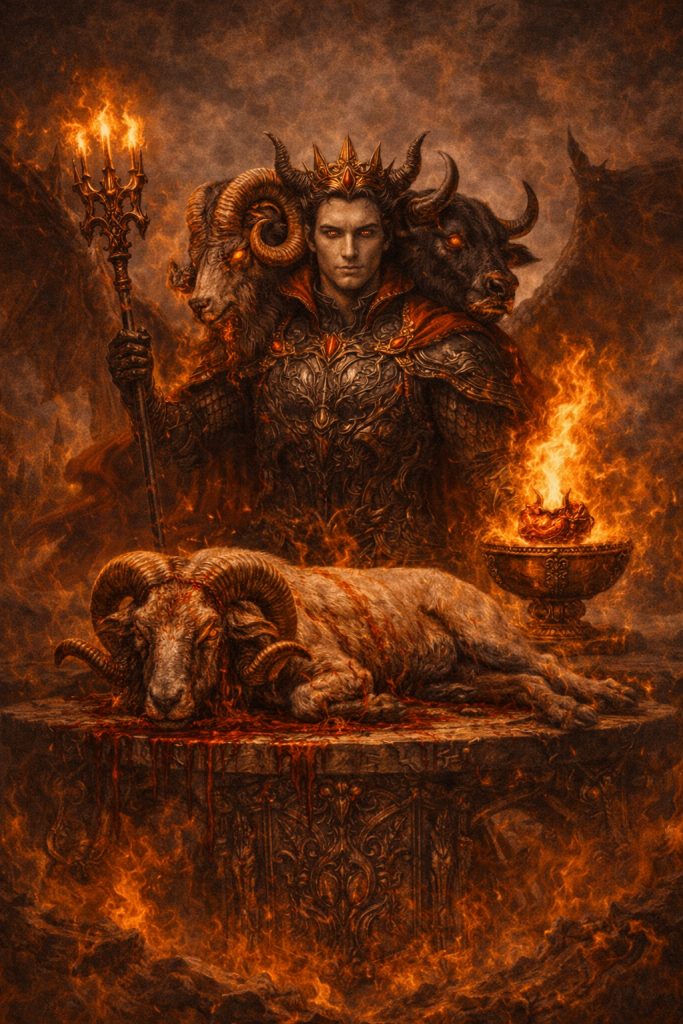
Traditional descriptions of Asmodeus tend to emphasize his sensual-emotional side and label him, broadly, a “demon of lust,” focusing primarily on his ram face. The ram—image of unbridled sensuality—often embodies the familiar visage of the King of the Cold Heart. For the ancients the “sacrifice of the ram” was a central mystery: offering personal passion upon the altar of the Higher, since until recently the chief struggle for humans was mastering their instinctive, sensual nature. Yet the modern age—marked by heightened Archontic activity—has altered the structure of the field of psychic destructors: where unchecked passions were once the primary threat, today psychic asthenia and the lack of inner fire predominate.
This shift explains why over human history the role of Astaroth—a demon without royal title who nevertheless became a chief leader among civilized peoples—has steadily grown.
But this does not mean the Kings have withdrawn; to think so is to underrate them gravely. Though the sexual fire on which Asmodeus long sat has grown thin and sooty, the power of the King of possession remains undiminished—only his dominant face has changed. Today Asmodeus more often manifests not as the Ram of lust but as the Bull of information: avarice now appears as hyper‑consumption of external streams of stimuli. The ram in this context becomes the market, the content cycle, mechanical arousal without discharge or real encounter. Relationships grow not freer but emptier: the body reacts, the heart goes mute, the will is drained. Asmodeus is not supplanted by the Archontic economy; he adapts it to serve the Realm of Avarice. When inner heat wanes, it is compensated by an external stream—an endless flood of content. Even Asmodeus’s dragon no longer represents a beast of instinct but a mechanism of the new milieu: interfaces, feeds, notifications, clickbait and perpetual accessibility are as elemental as the furnace of emotion. Thus Asmodeus rules not when someone “loses control,” but when they can no longer distinguish ruptures—their own from those imposed. If once his principal instrument was testosterone, today it is dopamine. Modern people find it easier to trust stimuli, technology and surrogates than to risk a living encounter—hardly surprising that belief in love grows difficult.
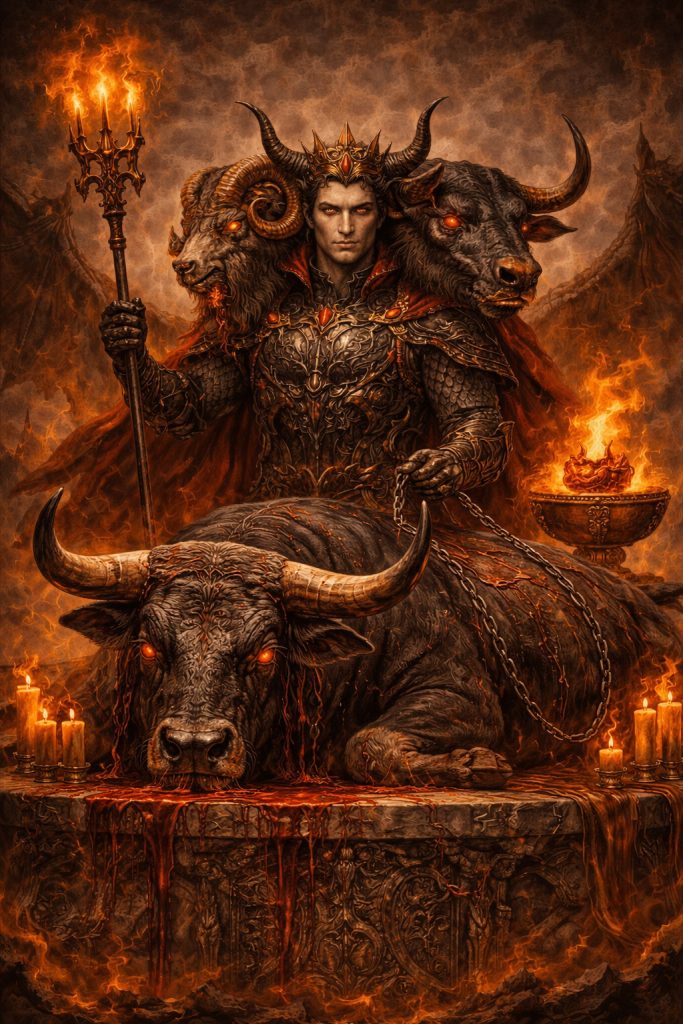
Thus the King of the Cold Heart attains his ends: the more mechanical the substitutes, the less capacity for genuine communion, the easier it is to live in a world where another person is reduced to a function. People today do not know one another; they interact with avatars and social images on a screen, rarely attempting to perceive anything living behind them. This is the contemporary form of avarice: the desire to “be in the loop” replaces the aspiration to be strong, and the accumulation of stimuli and data takes the place of inner work.
Modern mechanisation is thus a new mode of possession: the living is replaced by the controllable. Acting “on autopilot,” one seeks to make others, relationships and life itself predictable—seeing people as evaluable functions: convenient or inconvenient, useful or useless; turning relationships into service—“so it works”; converting conversation into signal exchange—say, get reaction, move on. Life becomes a ledger of tasks and metrics—make it, squeeze it, optimise it. This makes possession easier, for the living and free resists ownership: it changes, argues, demands participation, may leave. Turn the living into a scheme or mechanism and it is far easier to hold and control. Therefore, instead of contact, the Taurean aspect of Asmodeus offers constant audits—where does this interaction lead, what can be extracted, how best to reply; instead of trust, lists of conditions and rules arise as inner bonds vanish; instead of real power, accumulation appears—techniques, explanations, confirmations that simulate control without deepening consciousness; instead of the path to the Logoi, there is endless optimisation, where even rest, love and inspiration are treated as “projects” to be improved and preserved. The mechanistic person treats self and others as machines to be switched on and calibrated, without protest. It appears rational, but in truth it is fear and greed—a craving for guarantees and an aversion to the uncertainty that requires owning one’s choices.
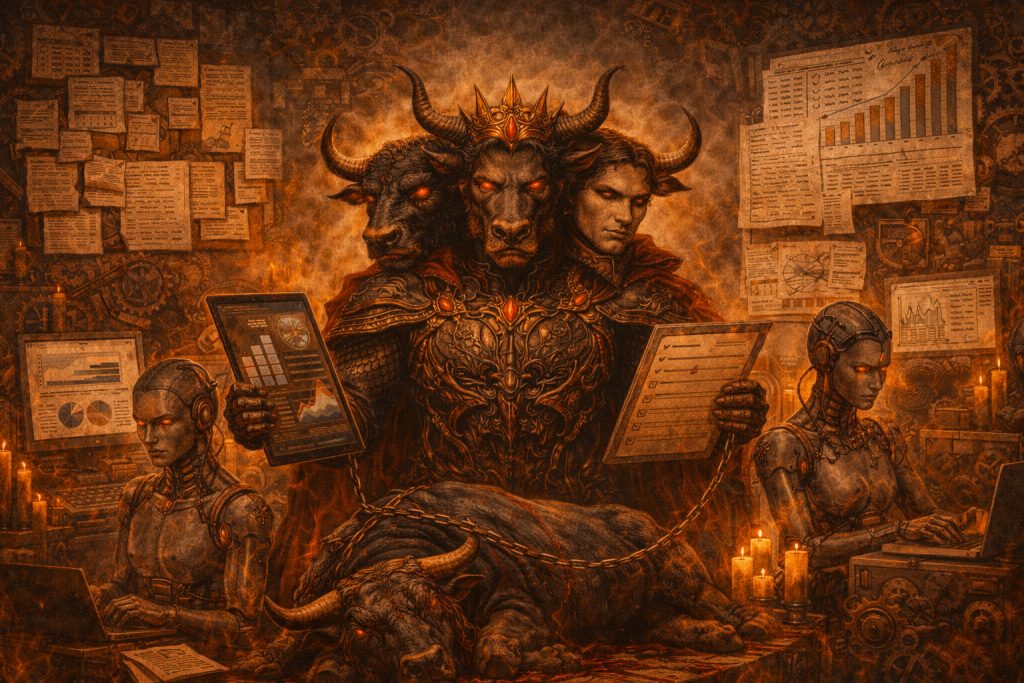
Whereas in former times the Ram was offered—raw passion so the heart might become clearer and freer—today the age calls for the sacrifice of the Bull: submission to the Higher of the belief that sufficient external reinforcement can replace inner strength, and that an external stream of stimuli will stand in for inner fire. Further, the sacrifice of Asmodeus’s human face is demanded: renouncing the right to possess, to justify appropriation, and to make another the object of one’s manipulations.
Accordingly, remedies against Asmodeus must honour his triplicity: the same King closes the heart with three hands, so liberation requires three forms of awakening. Against the ram face, which turns longing into a right to dispose, one must restore the bodily attraction to its original meaning: relationships are healthy when the other’s subjectivity is preserved. The decisive capacity is to hold clarity within passion, not to let desire harden into a grip. Asmodeus delights in the substitution of passion for “love,” so the first defense is discernment—where life and mutual consent flow, and where consumption and appropriation prevail.
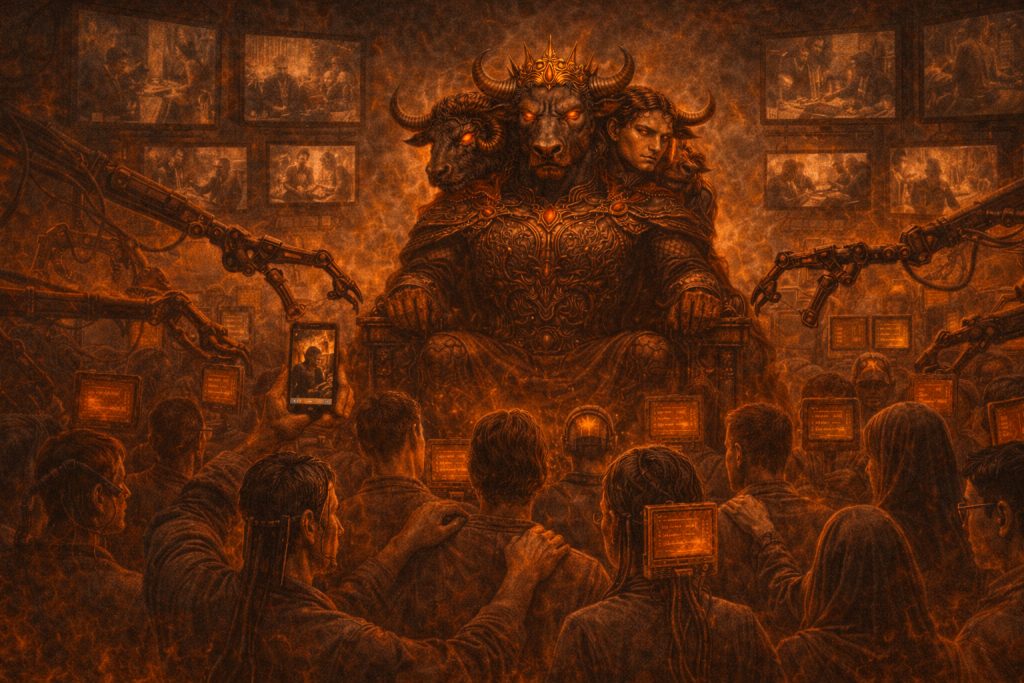
Against the bull face, which promises power by hoarding, one must align information with action: knowledge is valuable only insofar as it flows into practice, and practice matters only as it serves the expansion of consciousness. Remember that feelings require the same care as thoughts; when one notices one’s own cooling, one ceases to mistake clarity for insensitivity and control for maturity.
Against the human face, a return to personalism helps: the other must remain an autonomous centre, not a function; fidelity must be a free choice, not coercion; care must become empathic presence, not manipulation. It is this clarity of a loving mind that most effectively drives out the King of the Cold Heart.
Thus the chief problem of the modern world under Asmodeus is the denial of freedom and spontaneity and the reduction of people to “gadgets” to be manipulated without doubt or conscience. The tale recurs in tradition: Asmodeus once usurped Solomon’s throne, replacing the wise king with a deft manipulator. Hence the ideal of freedom is more urgent than ever: in a world where people no longer feel even their own reality, they must relearn to recognise the reality of the other, lest they remain not only subjects of possession but its objects too—mere resources to be used and discarded.
Some of “them” prefer to work individually with people, specifically with black “mages.” One such mage is Ass, and Beliar practices it too. Such a “mage” becomes a gateway for the demon’s influence here, consciously carrying out its will and following its direct orders, fully aware of what they are doing. In return, the demon teaches them and somehow “helps” them. Refusing to obey orders results in punishment after the first harsh warning — death. After such “collaboration,” when the “mage” finishes their life here, if they don’t end up in the lower hells burdened by karma, the demon often “re-codes” them and waits for their next reincarnation. When the “mage” is ready, the demon “comes back” to them, often starting in dreams, and the “service” continues. That’s how it works. However, if in the next life no “contract” is made, there’s a possibility to refuse the “service” and renounce the demon. In this case, the demon “has no right” and won’t be able to punish for the refusal. But it goes without saying that it’s difficult to do when you’ve become almost like it, and its coding resonates in your blood and mind…
just a small correction. I made a mistake with the names. Beelzebub prefers “individual” work. But the likes of Astaroth and Belial ignore individual people.
Hello. Thanks for the article. I have a question.
How can I interact with a girl normally?
I have fears of betrayal and worries that she might reject or leave me, and so on.
At the same time, I understand that trying to control someone is exhausting, stressful, and unpleasant. Plus, it takes away from the pleasure of the interaction. And yes, during our time together, I keep thinking about how to influence her.
I don’t like this, I get tired of it, and these worries will probably only worsen our relationship, health, and happiness in the future.
What attitude should I have towards the girl I have feelings for?
The future is scary, and her past worries me. But I have no intention of giving her up.