Runes and the Way. Second Att
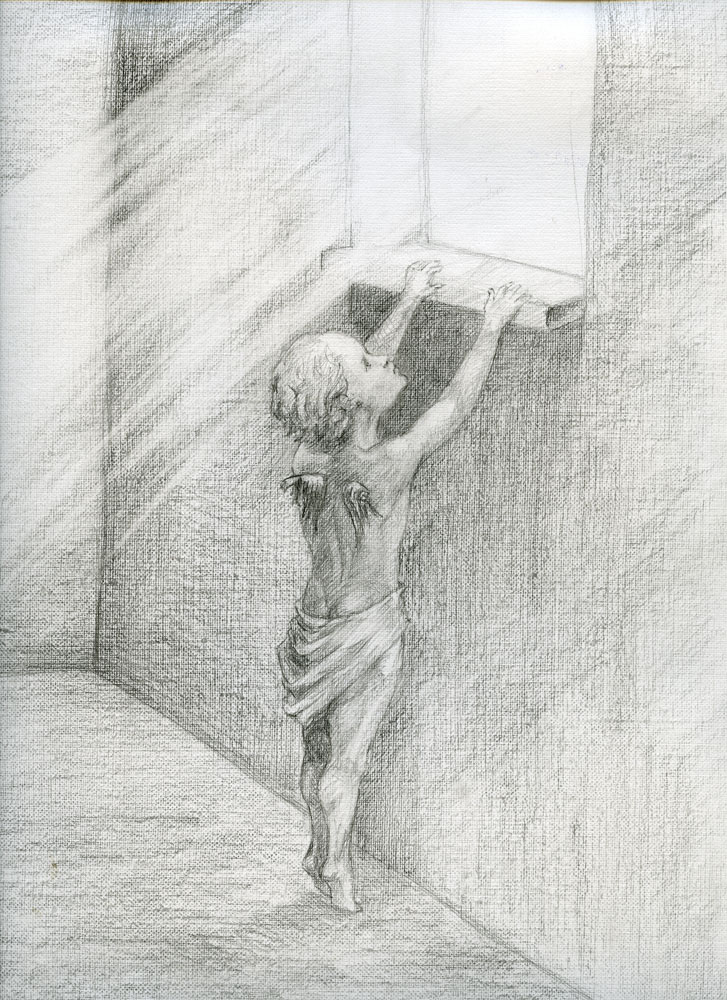
Having overcome the temptation of Wunjo, the Traveler enters a state of reassessment of values. Everything that once seemed understood and clear becomes shaky and uncertain. It turns out that the harmony of Wunjo was merely the consequence of underestimating the seriousness of the World Drama.
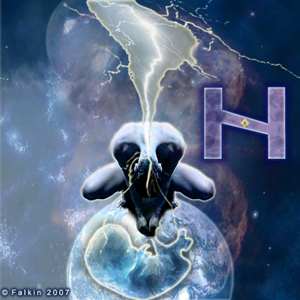
Such a thought leads to a deep shock, symbolized by the Rune Hagalaz. This trauma, the “midlife crisis“, brings about the loss of most inner reference points and points of support and is often subjectively experienced as the “Wrath of God.” That very feeling constitutes Hagalaz’s main danger because it creates the sense of having made a wrong choice and being punished for it. Yet sober reflection on the situation allows one to find a way out and to understand that destruction is a necessary stage of Becoming, since it corresponds to “shedding”, the discarding of worn-out concepts, and to Social Death. The result of passing through the Hagalaz stage is a restoration of balance, the ordering of the few surviving elements, and the creation of a new, solid, personal foundation for one’s Way and life.
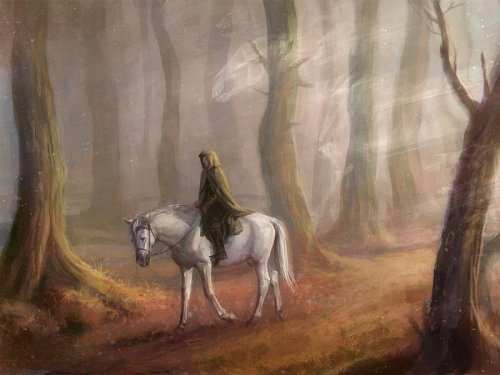
However, a long road to rebirth still lies ahead. The loneliness and emotional devastation that descend at the Hagalaz stage lead to prolonged isolation, a grim, heavy, and painstaking labor of reexamining the building blocks of ideas, notions, and concepts from which a new edifice, a new soul, a new person — the Magus — will be built. At the Nauthiz stage, the Traveler needs enormous endurance and unwavering resolve to continue the Way, along with awareness of one’s actions, motives, and needs. We have already seen that at Nauthiz the gulf between what is desired and what is achieved becomes most obvious, and the abyss most threatening from all sides. The primary danger of Nauthiz is the loss of faith in oneself, gloom and depression, impatience that leads to additional traumas, since accelerating at this stage is impossible and attempts to hasten things are harmful. The result of successfully passing Nauthiz is the attainment of a state of detachment, non-attachment, and the gaining of a sober view of oneself and the world.
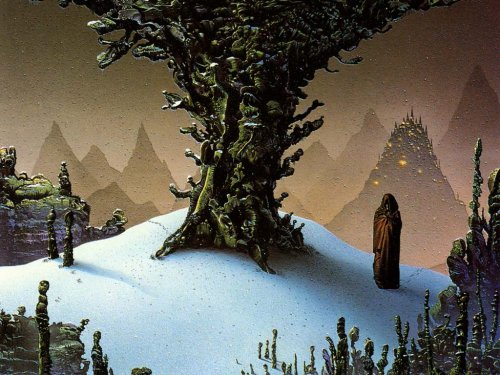
Yet the mastery achieved at Nauthiz can initially be overapplied. It binds the person with strict restraints; self-limitation becomes almost ascetic, which brings a sharp slowing of progress, an “icing” of heart and Way. This stage is symbolized by the Rune Isa and corresponds to hermitage and asceticism as a necessary stage of any Way. At this stage the Magus attains the maximum detachment and, at the same time, focused intention. This self-limitation, the turning external activity inward into the Traveler’s inner life, is absolutely necessary for forming the firm foundations of the Way, the crystallization of new anchor points and principles of existence. Yet the danger of this stage lies in the psychological allure of asceticism, which gives a sense of safety, chosenness, and separateness, and appears to be the only right state. Overcoming this problem leads to the establishment of a firm axis around which further existence can be built.
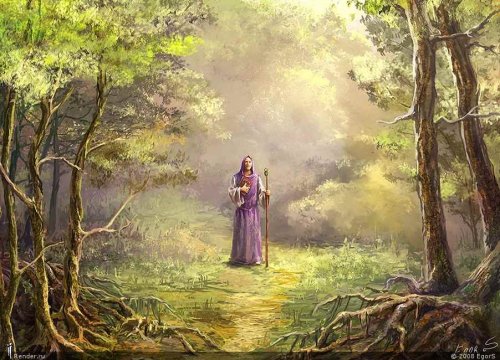
The appearance of an axis naturally leads to rotational motion around it, the emergence of a vortex structure, and the manifestation of new life. The Jera stage corresponds to the Magus’s return to the circle of being, yet this is already a new Magus, and his being is new too. Reaching this stage testifies to the end of the most severe and dangerous period of the Way, to a rebirth, a kind of resurrection. A new chapter begins, and the new phase is perceived as a new field of battle; connection to past problems is no longer felt, and past limitations are discarded. The road is free and the Way is clear. The danger of Jera lies in the notion that the path traveled and the hardships endured grant the right to judge others’ deeds and paths. Overcoming this illusion brings the awareness that ways are manifold, there are no “good” and “bad” Ways, but rather suitable and unsuitable ones.
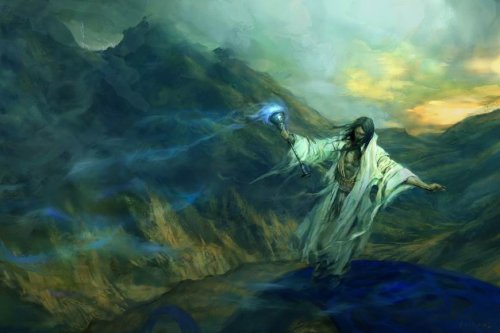
Such an awareness leads to a new understanding of unity, no longer the simple synthesis (as at Wunjo), but unity in the struggle of opposites, unity of life and death. This awareness advances the Traveler to a new rung — the Eihwaz stage. Universal connection is perceived as a necessary and sufficient condition for the universe’s existence, and it is precisely the balance of individual impulses that generates world harmony. The awareness of life and death’s unity at Eihwaz has a practical dimension — the Traveler sees themselves in the totality of births and deaths, recognizing their own Way as a thread of lives spanning centuries or even millennia. But here a danger appears as well: the temptation to regard these “past lives” as one’s own and to extend one’s personality over centuries. Overcoming this temptation means understanding the mortality of the personality amid the immortality of individuality, apprehending the self beyond the limited being. The result of a correct passage through Eihwaz is the formation of a value system as the outcome of awareness of the hierarchy of forces in the cosmos.
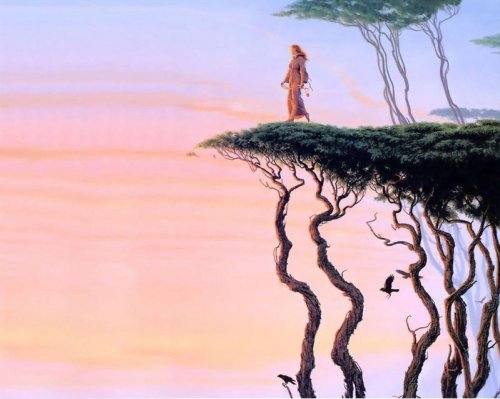
However, one of the forces operating in the cosmos and recognized at the level of Eihwaz is Spontaneity, the force of fortune. Recognizing this power as an autonomous principle constitutes the essence of the Perthro stage. It becomes apparent that spontaneous manifestations often prove decisive, and the idea of accumulating potential arises. If previously it seemed that one manifestation leads to another and that only causal chains operate in the world, at the Perthro level it becomes clear that the causes of phenomena do not necessarily lie in the manifested world; they may be unmanifest, potential. It turns out that not all influences and acting elements in any given scenario can be accounted for, and that an unnoticed influence can trigger an avalanche of consequences in the unmanifest. The danger of this stage is seeing the world as a blind “game of chance” in which results cannot be predicted. Overcoming this danger lies in recognizing the autonomous principle of potential existence alongside actual existence, and in the ability to perceive potential causes alongside actual ones. The result of transcending Perthro is the formation of an understanding of initiation as a mode of advancement considered in the totality of manifested and unmanifested processes.
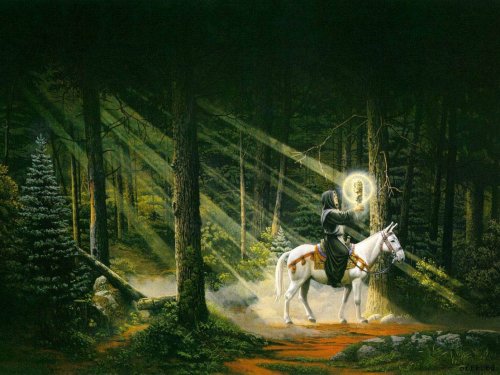
The awareness of the unmanifest’s importance for processes of actual being gives rise to ideas about the roots of reality that reach deep into the Nav. Simultaneously there comes the realization that potential existence is not only the beginning but also the end of manifestation, and that the roots of manifestation lead not only into the Nav but into Prav, the Supra-Manifest. This view produces insights, intuitive revelations into the synthetic principles of being, making being more comprehensible and existence more secure. When various causes are visible, it is easier to foresee the necessary course of action for the most effective outcome of a process. The Rune Algiz corresponds to this rooting in the pre- and supra-manifest, to the formation of a stable link between higher and lower forces. The danger of this stage lies in excessive caution, the result of seeing the complexity of interconnections, which restrains movement. Successfully passing Algiz results in the formation of a state of security. The Magus ceases to defend themselves and instead becomes protected.

The sense of security born of Algiz gives new strength and courage for a renewed surge forward. The Magus learns to trust not only themselves but events, learns to see the world not only as a field of action but as an ally in battle. It seems there are no insurmountable obstacles. At the Sowilo stage we see a return to a bright view of the world’s wholeness which, unlike at Wunjo, already bears the imprint of death and rebirth and therefore accepts the world’s integrity as the result of directed effort rather than as self-evident. Awareness of interconnections spawned by the previous stages, and of one’s place within that web of causes and effects, turns the Magus from enforcer of laws into a lawgiver who, of course, must also obey the laws they set. He understands that there is nowhere left to retreat to, nor any reason to do so. His drive is unhesitating and victory inevitable. The danger of Sowilo is excess enthusiasm and, as a result, underestimating the enemy who, although considerably battered, is not yet defeated. Effective mastery of Sowilo leads to a powerful but controlled application of Power, a strong yet calculated surge toward victory.
Thus, at the level of the Second Att, the laws of the Magus’s existence on their Way are forged; they are the result of building a hierarchy of values within the Way and finding that Way’s place in the world’s economy. Yet throughout the Second Att the Magus struggles alone; even his enemies do not confront him directly, and friends are absent. The manifestation of the forces operating in the Magus and around them at the manifest level occurs only in the Third Att.
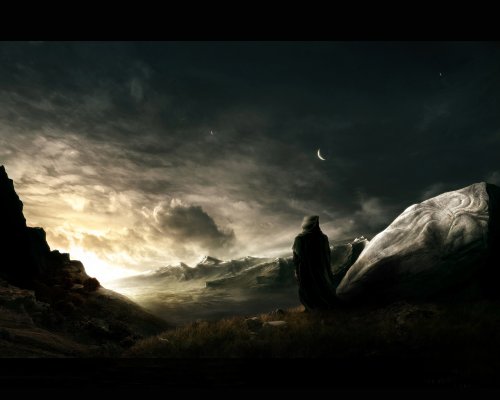
Regarding the rune Algiz – it is not only a “shield” in its usual understanding – it is also a call to the World, to the Sky, to the Divine (naturally, not in the profane-monotheistic sense of the word). Even the very shape of the rune speaks to this – it is a person raising their hands to the sky. And the “shield” is just a consequence. The rune Sowelu – pay attention to its meaning – it is the sun. The sun that shone in response to the calling. Unlike Wunjo, whose harmony comes “from within” a person, the ending of the second attunement – is reconciliation and harmony with the external environment. Hence the “integrity of the world as a result of directed efforts” 🙂
Indeed, Algiz itself corresponds to the Calling, as I have already written. However, in the context of the Path, the state of protection is achieved through various means for different travelers.
At the stage of Isa (2 att), an axis is formed. What is this axis? Is it some kind of energy structure? Isn’t this what is called antahkarana?
The Second Att is a sort of school of independent vigilance and concentration with the effect of persecution mania.
At the beginning of the Second Atta, is it correct to focus on some elements that actually led to the Path in the first place?
The beginning of the Second Atta is about collapse and destruction. There is no time for “orientation” in it. It’s about surviving somehow…
Thank you, Enmerkar, for the precise definition in one sentence. That’s exactly how it is… 🙂
Why is it exactly collapse and destruction? A magician begins to doubt everything and re-check. Destruction comes when that which the magician believed fails the test, doesn’t it?
What does the number of enemies 1 atta depend on? Do they appear as power accumulates or does it depend on the amount of liberated territory?
It is obvious that the main enemies at this stage of the path are the blocks of illusions that played a role in the formation of the “human,” but if we look more specifically… Are there more precise characteristics of the enemies?
Hello! As I understand it, an analogy can be drawn between the neophyte’s transition to level 2 of the attunement and the transition to the level of Tiferet with the crossing of the Temple Veil?
If we consider the Runic order linearly – then yes, such a parallel is justified.