
Magic or Practical Psychology
Most online resources devoted to Magic, in fact, are far removed from it.
Some offer solutions to various problems by “magical” means — love spells and counterspells, hexes and the evil eye, promises of success in business, and so on. It goes without saying that many such offers are sheer charlatanry.
At the same time, the social function of Magic has been the subject of sharp debate throughout human history. On the one hand, magi living in a society cannot stand apart from a society’s values and laws that govern it.
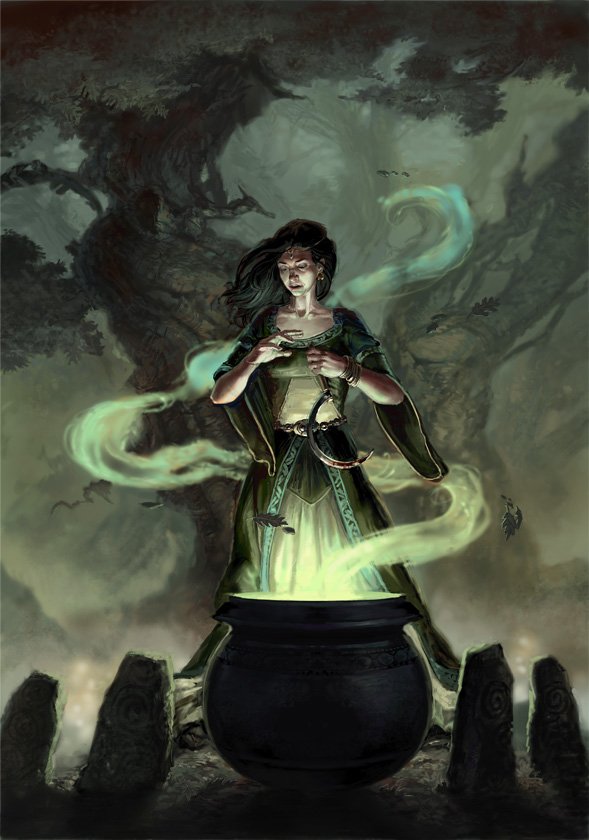
In the tribal era, magicians called the rain, divined the outcomes of battles, and pronounced spells for a successful hunt. Later this social Magic developed into religion, which assumed responsibility for the tribe’s welfare. Priests, who sought the gods’ favor for their tribe, and Magi, who attempted to impose their will on the cosmos, entered into sharp conflict — a conflict that continues to this day. Nevertheless, with the rise of religion the task of securing human prosperity passed to it. Humanity moved on to a new stage of development.
If, in pre-religious times, people did not distinguish themselves from nature — and therefore did not distinguish the gods from the general spiritual milieu — then, upon seeing themselves as a creative principle, humanity established a connection with the cosmos’ creative forces — the gods. If previously methods of influencing nature were exclusively magical and analogical, then in the age of religion influence was directed not at nature itself but at its sources. Vestiges of that original magic constitute today’s system of witchcraft. People still turn to such magic, typically when all other means have been exhausted. Practitioners performing these rituals, heirs to shamans of the primitive era, effectively replace the religious approach to solving problems with a magical one, “winning” followers away from the churches. The question is what this activity gives them. For some, of course, it is merely money. That doesn’t count. But for others, witchcraft becomes a way of life. And, like any Way, given a sufficient degree of inner cohesion, such social magic can confer power and authority on practitioners who live it.
Another group of “magical” resources focuses on methods of “self-improvement,” “spiritual growth,” and the like. One quote:
…the primary goal of magic is self-improvement. This is achieved by cultivating faith in oneself… A magus’s faith is developed through victories, first over easy magical tasks (to unsettle a nervous person with a steady gaze, to resist eating another pastry), and then over ever more difficult ones — here magic closely approaches yoga and its practices of restraint…
This approach closely resembles textbooks on practical psychology. The fashion for this understanding of magic arrived with the vogue for Indian spirituality, the mahatmas and “spiritual teachers” in the early twentieth century. It proved very convenient for the frantic pace of modern life to “self-improve” with little effort — in an hour or two after work. “Spiritual,” “Shamanic” and similar practices became almost as ordinary a part of modern urban life as beer and televised football. Utterly profane, this approach devalues magic as a way, reducing it to a set of (admittedly effective) psychological techniques. The idea arises that anyone can practice magic if they choose a few techniques and have a little free time. This idea undermines magic as a phenomenon; moreover, it conflicts with religion. Rapid spiritual growth and quick prayers satisfy the needs for invocation and evocation of the modern person, drawing them away from both the gods and from themselves. Unfortunately, this approach has no positive aspects.
Interestingly, the most “magical” resources are often those devoted to mythology and pagan traditions. There one often encounters ideas of magic as a way that forms a person’s essence. Not “magical practices,” but Will as the substance and foundation of existence, not “self-improvement” but following one’s path — these form the basis of the traditional attitude toward magic.
Born from primitive arts of influencing oneself and one’s surroundings, and tempered by millennia of coexistence with religion, magic engulfs a person completely, reshapes their being, and creates a new being — the magus.
Those who practice magic have turned this into a business, which also brings in a lot of money; there are also charlatans who know nothing.
There are people for whom magic is a given; it is an inseparable part of their lives. And they do not care whether they can earn money from it. After all, sane (though how can we call ourselves sane?) mages/witches/sorcerers will not sell their Power, as for them, Power is the most precious thing in the world.