
Gods and Their Names
Since ancient times, a name has long been considered extremely important as a distinct form of existence. All nominative magic is based on manipulating names: by naming a doll after a person, voodoo practitioners gain the ability to influence that person,

by giving weapons personal names they gain the ability to cause those weapons to perform actions previously impossible for them; knowing the Name of a Deity allows one — if not to control, at least to interact closely with the deity.
Therefore it is understandable that, since those ancient times, names — both the ‘true‘ names of people and the Names of gods — were kept strictly secret, replaced by sobriquets or epithets. It is said that the ancient Greeks kept secret not only the names but even the genders of their gods. The ancient Egyptians regarded the Name (Resh) as one of the most important forms of existence (alongside Ka, Ba, Shuit, Akh).
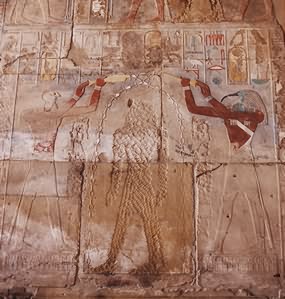
The destruction of a name (for example, its erasure from stelae or tombs) was regarded as a barrier to eternal life.
Giving a name is one stage of incarnation; it is the process of determining a person’s (or a god’s) place within the overall order of creatures, deities, and processes. Thus, according to the law of analogy — known in one form or another to all magical systems — manipulating a name equals manipulating the soul (whatever one may understand by that word).
Nominative magic reached its height in Jewish and especially Christian Kabbalah. It is precisely the manipulation of the Names of the Most High and of the angelic hierarchies which is central to Western ceremonial magic. The first question to ask a summoned spirit is its name. Only by knowing a spirit’s name can one be sure of power over it.
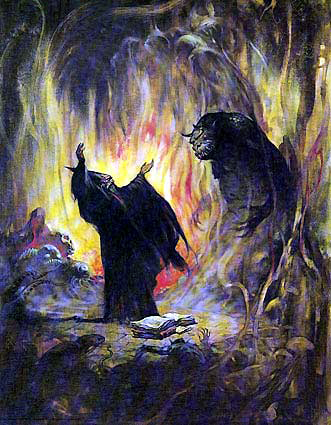
‘Barbarian’ civilizations are no exception. The impressive list of names for Odin and other Aesir, their appearance in myths under different names, and the habit of assuming different names in different circumstances vividly confirm this.
This phenomenon creates considerable difficulties for researchers, which confuses them, because different Names may refer to 1) different gods, 2) different manifestations of the same god, and 3) the same god in different situations.
Let us address the second and third cases. The ancient Sumerians believed that the nature of an object depends on its environment. For example, a stone in the desert and “the same” stone brought into a house were, to them, different stones. Such a notion reflects the inseparable connection between an object and its function. A stone in the desert may be a scorpion’s dwelling; a stone in a house may be building material or ballast. To us this loss of identity seems odd, but in fact it has a real basis in the practical use (not only by humans, but also by animals and natural phenomena).
Therefore a god, as a functional being (as mentioned, a fundamental trait of deities is that their actions often affect entire worlds), by changing its mode of activity depending on 1) the goal or plan of action and on its environment and interactions, effectively assumes different forms of its alternative mode of existence. Moreover, such forms can be entirely unlike one another. What unites them is the deity’s personality, the common tone of its existence and the orientation of its actions.
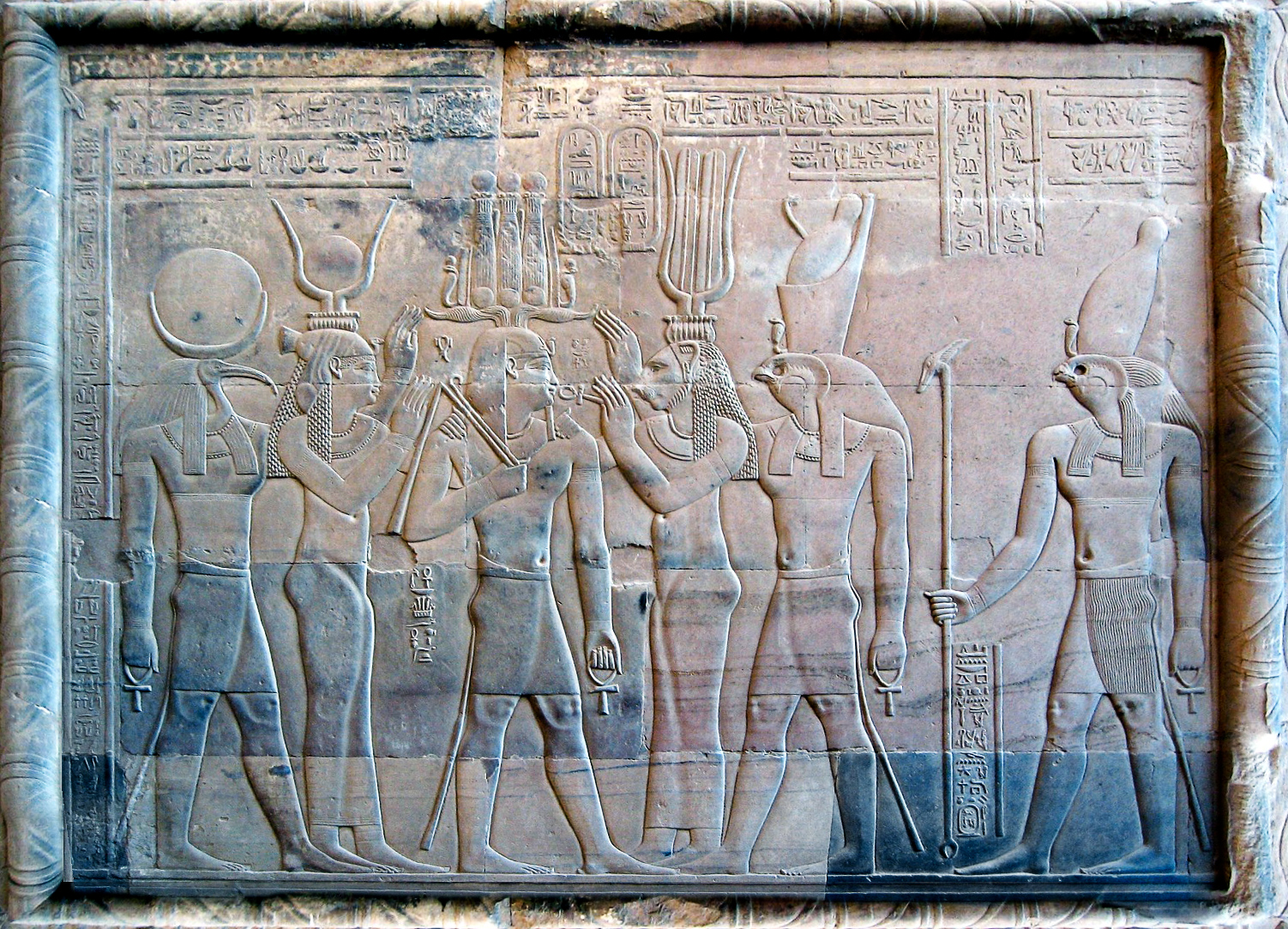
A simple example is the ancient Egyptian myth of the transformation of the Goddess Hathor into Sekhmet. The Goddess of Life and Love becomes the Goddess of Death. As discussed above regarding two-faced nature of the Goddess, it is important that the goddess, when she changes her mode of action, also changes her name.
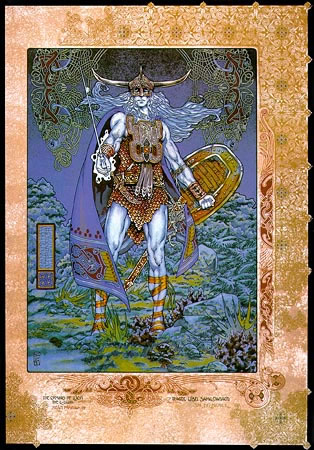
Another example can be found in Celtic mythology, where one Great Earth God appears under different names among different tribes, with somewhat different functions: Dagda, Cernunnos, Esus.
Therefore, when examining mythological systems it is very important not only to understand the superficial layer of the myth; one must make an effort often considerable to discern when a myth speaks of different gods and when it speaks of the same one acting in different situations. Such a perspective helps to understand the unity within the diversity of related mythological systems, since different peoples may have revealed different faces of a single deity — faces that are not identical but complement one another, and thus enrich our understanding of the nature of that deity. Note again that drawing comparisons between myths is possible only with this caveat, quite obvious but not always taken into account. Sometimes the similarity in functions of different deities in no way indicates their identity or even kinship; conversely, deities dissimilar in their actions may share a common spirit and thus be manifestations of one being.
An example of such confusion is the difficulty of identifying the deities of the Celts or Germans described by Caesar or Tacitus with their actual Celtic and Germanic names known from other sources. For example, Tacitus identifies Odin with Mercury based on a common day of observance (Wednesday) and on the shared cunning of both gods.

But it is clear that the manifestations of these deities differ radically. Much the same story concerns Caesar’s identification of Mercury with Lugh.
Which names, then, should one use to call the gods? Can one equate Perun with Thor, Veles with Cernunnos? Should the applicability of the description of each aspect be specified for different situations and peoples? These questions have different significance for a historian and for a practitioner who lives in myth. The former focuses attention on sources, artifacts, and manifestations. The latter focuses on spirit, character, and meaning. Therefore what is entirely unacceptable for one may be perfectly harmonious for the other. Which position to take — each must choose for themselves.
Who names spirits with names that they themselves provide?
I believe that a name is the internal image of any Spirit, with which it currently associates itself most comfortably within the framework of communication with someone (a group of people, an egregore, other spirits, Gods, etc.).
For me personally, the word “Name” was associated with a set of letters, but that’s not the case 🙂 A name is not letters, we just got used to it that way; it’s inscribed in the worldview: all forms perceived discreetly, regardless of whether they have consciousness (in our understanding) or not, are given a name (a letter-sound manifestation), but this is not necessarily the case 🙂 A name is not necessarily letter-sound-images………………. By the way, regarding the word “Image,” if you dig deeper into the essence of the word image, the deeper you try to dig, the less clarity you find 🙂